
Cheque is an order to a bank to pay a stated sum from the drawer’s account, written on a specially printed form. In Bolanle Abeke v State SC. 271/2005, the court defines a cheque as “a written order to a bank to pay a certain sum of money from one’s bank account to oneself or to another person.”
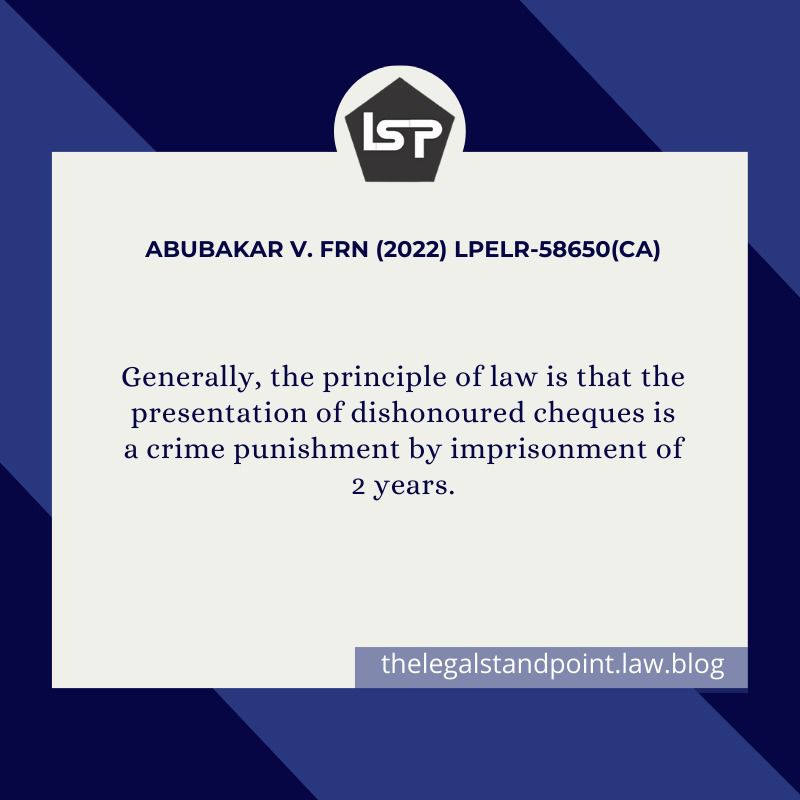
Cheque becomes valuable only when there’s enough money in that account. If someone writes a cheque without having sufficient funds, resulting in a bounce (commonly called a Dud Cheque), it’s a criminal offense in Nigeria under the Dishonoured Cheques (Offences) Act. In Abubakar v Federal Republic of Nigeria (2022) LPELR-58650(CA), the court held that the rationale was that The Dishonoured Cheque (Offences) Act was enacted to safeguard the integrity of banking operations involving cheques. It aims to reinforce the security and confidence associated with cheque payments, ensuring that any breach of trust is penalized to maintain the reliability of banking transactions.
When a cheque is dishonored, it means that the bank refuses to honor the payment stated on the cheque. This can occur for various reasons, such as insufficient funds, a mismatched signature, or an expired cheque. The non-payment indicates a failure to fulfill the financial obligation specified in the cheque.
Section 1(1) of the Act outlines that an individual who, through deceit, acquires something that could be stolen or obtains credit using a cheque that bounces due to insufficient funds within three months of issuance, commits an offense. Upon conviction, an individual faces a two-year imprisonment without the option of a fine, and a corporate entity could be fined a minimum of N5,000. By virtue of section 3 of the act, The High Court of a State is the only Court with jurisdiction to try the offence of issuance of dud cheque. The Act also stipulates that the offence of issuance of dud cheque should be tried summarily.
Furthermore, the law allows a three-month window before someone can be deemed guilty of issuing a dud cheque. If a cheque is presented for payment after this period and is dishonored, the issuer cannot be considered to have committed an offense.
In the case of Abubakar v FRN (Supra), the appeal challenges the judgment of the Federal Capital Territory High Court in Charge No. FCT/HC/CR/7/2012, issued on October 2, 2020, by Hon. Justice M. E. Anenih. The trial court convicted the Appellant, Mr. Abubakar, who is the owner and Chief Executive Officer of Foot Trip Oil & Gas Ltd, for issuing a dud cheque. The sentence was 2 years of imprisonment without the option of a fine. The Appellate court upheld the decision of the trial court, affirming the conviction and sentencing of the Appellant.
Thank you for reading. See you next week
 THELEGALSTANDPOINT