
In criminal law jurisprudence, the law is trite that there are three ways for the prosecution to prove its case against an accused person, and these are: (a)direct evidence; (b)circumstantial evidence; or (c)his confessional statement. Fatilewa v State (2008) 12 NWLR (Pt. 1101) 518; Ogedengbe v.State (2014) 12 NWLR (Pt. 1421) 338; Egboghonomev. State (1993) 7 NWLR (Pt. 306) 383.
A confession, whether made extrajudicially or judicially, is an admission by the accused suggesting their guilt. Confessions carry significant weight in court, often considered stronger evidence than other forms of proof. Adebayo v State (2014) LPELR-22988(SC) and Oseni v. State (2012) 5 NWLR (Pt. 1293)351.
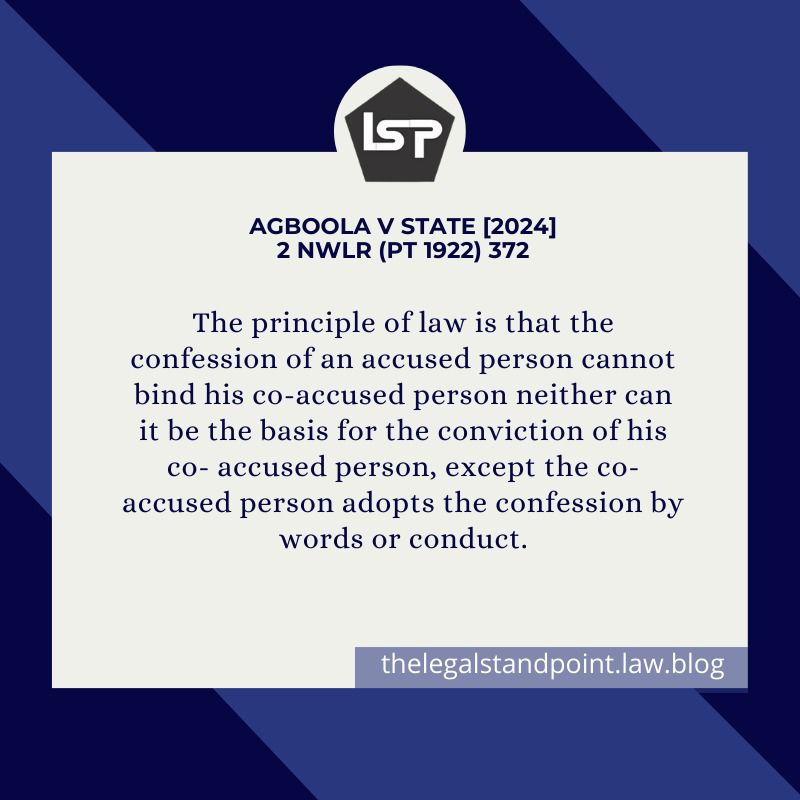
However, a crucial question arises when considering jointly committed crimes: can a person be convicted based on the confession of a co-accused? The law is settled that The confession of an accused person cannot bind his co-accused person neither can it be the basis for the conviction of his co- accused person, except the co-accused person adopts the confession by words or conduct. Agboola v State [2024] 2 NWLR (pt 1922) 372(P. 409, paras. A-F).
Section 29(4) of the Evidence Act 2011 further emphasizes this point, stating that if one co-accused makes a confession in the presence of others, it cannot be used against those others unless they explicitly adopt it. Failure to comply with this provision renders such confessions inadmissible against the non-adopting co-accused. Thus in Nwamiro v State (2023) LPELR-60423(CA), the court held that: “Accordingly, I agree with the appellant that Section 29(4) of the Evidence Act was not complied with by the respondent, nor was there any title of evidence to establish that the appellant adopted the confessional statement of the co-defendant by word or conduct, consequently, the lower Court erred in relying on the confessional statement(s) of the co-defendant as one of the planks in convicting the appellant.”
In conclusion, while an accused’s confession can be damning evidence against themself, it cannot automatically implicate a co-accused but where the prosecution or the police intends to use the statement against a co-accused then the prosecution or the police is bound to make a copy of the incriminating statement available to the co-accused and the co-accused then adopts the statement.
Thank you for reading. See you next week
 THELEGALSTANDPOINT