
Law

LSP141: Defence of Intoxication using Imasuen v State

In society, insanity is often recognized by outward appearances such as tattered clothes and unkempt hair. However, in law, insanity is defined differently and does not necessarily align with medical definitions or societal perceptions of madness. Legally, insanity can encompass various conditions, including sleepwalking as seen in R v Burgess [1989] 1 QB 92 (CA); epilepsy as held in R v Sullivan [1904] 1 AC 156 (HL) and other similar states. This explains why cases on this matter that come before the court are always considered in the legal sense. After all, no one expects otherwise. who wan go sue madman whey dey street?


Moving on, the general principle of law is that the law presumes every human being is sane until the contrary is proven, as stated in Section 27 of the Criminal Code. Under our criminal law jurisprudence, the defense of insanity is statutorily provided for in both Section 28 and Section 29(2)(b) of the Criminal Code. While the defense of insanity under Section 28 pertains to mental disease or natural mental infirmity, the defense of insanity under Section 29(2) is founded on involuntary intoxication. There is a common bond in these two defenses: in either case, the accused must establish that at the relevant time, they were deprived of the capacity to understand what they were doing, to control their actions, or to know that they ought not to do the act or make the omission. Involuntary intoxication occurs when someone becomes intoxicated without their knowledge or against their consent, such as through spiked drinks, forced consumption, or unexpected medication reactions.

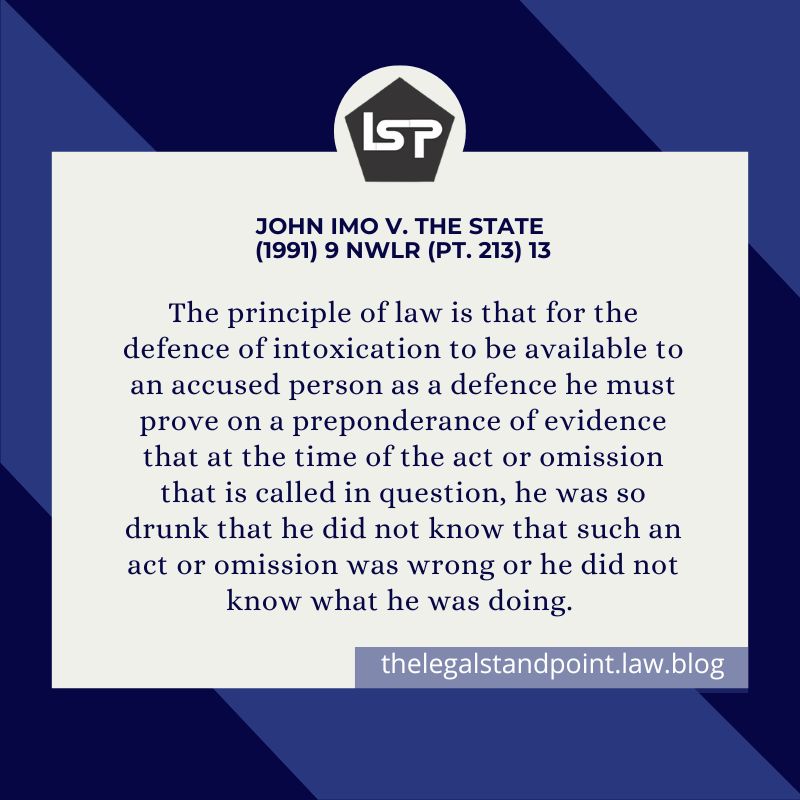
Furthermore, the law is settled and beyond dispute that the onus of establishing the defense of drunkenness, which amounts to insanity and unsoundness of mind such that the accused did not know what they did, rests squarely on the accused person. The burden is discharged on a preponderance of evidence led by and for the accused person, as established in John Imo v. The State (1991) 9 NWLR (pt. 213) 13. The surest way of establishing insanity is through medical evidence or compelling evidence from eyewitnesses, particularly relatives of the appellant, relating to their general conduct, family medical history, and behavior before, during, and after the incident in question, as seen in Anthony Ejinima v. The State (1991) 722.

Thus, when an accused person relies on the provision of Section 29(2)(b), they assume a burden of proof analogous to a person who relies upon a defense of insanity simpliciter under Section 28. They must prove that as a result of the intoxication, they were in a similar state of mind as an insane person, i.e., that they did not know what they were doing or that they did not know that what they were doing was wrong. This was highlighted in Imasuen v. State (2014) LPELR-22193(CA), where the appellant was convicted on a charge of the murder of a nine-year-old girl, Favour Ihoeghilan, under Section 319(1) of the Criminal Code Laws of Bendel State of Nigeria, 1976, applicable in Edo State. The prosecution’s facts indicated that the appellant took the young girl under the pretext that her mother needed her in the market, lured her to the bush, raped her, and then set her ablaze.

He raised the defense of insanity by intoxication under Section 29(2)(b), claiming that he was involuntarily intoxicated by inhaling the smoke of Indian hemp, which was caused by a group of boys at a canteen in Urora village on April 5, 2003. He argued that he became confused and did not know what happened until he found himself at the police station the next day. However, the court rejected this defense. The court held that, based on his confessional statements (Exhibits ‘A’ and ‘D’), he was conscious of his actions before and after the incident. His actions, such as drinking four bottles of Guinness stout, buying a bottle for a girl and the barman, and purchasing and smoking Indian hemp, were all deliberate and unsolicited decisions.

Therefore, the court concluded that his intoxication could not be attributed to the malicious or negligent acts of others, and as a result, sentenced the appellant to death by hanging.

Being dissatisfied with the decision of the trial court, the appellant appealed to the Court of Appeal. Dismissing the appeal, the court, per Yakubu JCA, held that the appellant’s consumption of Indian hemp and Guinness stout on April 5, 2003, boosted rather than impaired his sexual appetite. This led to his sexual encounter with a girl and subsequent assault of a nine-year-old, indicating he was a sex maniac rather than insane. Additionally, the learned justice opined that the appellant did not establish, on a preponderance of evidence, that he was “out of his mind.” The justice suggested that had the appellant instead gone to his own family compound and committed the same acts on a young relative, such as a sibling, niece, or cousin, it would have unequivocally demonstrated his insanity. Since this was not the case, the court rejected his insanity defense.

In conclusion, the defense of insanity, whether due to mental disease or involuntary intoxication, requires substantial evidence to prove that the accused was deprived of the capacity to understand their actions or know they were wrong. In the case under review, the appellant’s actions were found to be deliberate and conscious, thereby failing to meet the legal standard for insanity.

Thank you for reading. See you next week.

Law

LSP140: Variation of Contract of Employment


This week’s article examines employment law, addressing whether an employer can put a job offer on hold or request another interview after the offer has been accepted, particularly when the contract does not permit such actions. In doing this, attention is given to the 2019 Supreme Court case of Iyeke & 25 Ors v Petroleum Training Institute [2019] 2 NWLR (Pt. 1656) 217.

In that case, the appellant and 25 others initiated a lawsuit against the respondents at the Federal High Court in Benin City, seeking a declaration that they were employed by the respondents from December 2002. They also sought a declaration entitling them to monthly salaries and allowances from that date and requested an order for the respondents to pay these salaries and allowances from February 2003 onward.

According to the appellants, they were hired by the 1st respondent after interviews conducted in September 2002. However, three months later, they received a letter indicating that their employment was on hold and were instructed to appear before a committee. Following the committee meeting, they were directed to stay away from the 1st respondent until further notice. When the respondents failed to recall them, the appellants declared a trade dispute. A conciliator appointed by the Federal Minister of Employment concluded that there was a deadlock. Consequently, an order of mandamus required the respondents to refer the appellants’ complaints to the National Industrial Arbitration Panel or the National Industrial Court, which the respondents did not do.

In response to the appellants’ affidavit, the 1st respondent admitted offering employment but claimed the appellants refused to appear before the committee, thus abandoning the offer. The trial court ruled that the appellants’ employment had statutory protection, necessitating strict adherence to statutory procedures for termination, which the respondents had not followed. As a result, the court ordered the appellants to be reinstated and paid their salaries and allowances from March 2003. The 1st respondent complied, and the appellants resumed work in October 2005. However, their employment was terminated again in January 2006. Subsequent contempt proceedings led to the termination letters being set aside.

The 1st respondent then challenged the trial court’s judgment at the Court of Appeal, which overturned the decision, stating that there was no reasonable cause of action. Dissatisfied with the Court of Appeal’s decision, the appellants appealed to the Supreme Court.

In explaining how the Court of Appeal (Lower Court) handled the case, the Supreme Court clarified that putting something on hold means deciding not to proceed with it for the time being, but this was not justified in the context of this case. The appellants had attached their letters of appointment to their supporting affidavit, which included specific terms and conditions governing their rights and obligations. The Court of Appeal should have closely examined these terms to determine if the contract could be put on hold or postponed. Instead, the Court of Appeal overlooked these terms, particularly paragraph 12, which clearly stated, “Under no circumstances will the terms and conditions of this offer be renegotiated after your acceptance.”

The Court of Appeal noted that the Petroleum Training Institute (PIT) had not dismissed or terminated the appellants’ employment but had informed them that their appointments were on hold, leaving the appellants in limbo. However, since the letters of appointment explicitly prohibited renegotiation of the terms and conditions after acceptance, PIT could not alter the employment terms by putting the appointments on hold or asking the appellants to attend another interview. The Supreme Court concluded that the Court of Appeal made a serious error by not recognizing that asking the appellants to attend another interview constituted a renegotiation of the employment contract, thus deviating from the established terms. Thus, the Court of Appeal’s decision was unjustified, and the issue was resolved in favor of the appellants.

In conclusion, the principle that an employer cannot put employment on hold or call for a subsequent interview after an offer has been accepted, without contractual allowance for renegotiation, is justified by the fundamental legal concept of respecting binding agreements. Once both parties have agreed to the terms of employment, any unilateral attempt to alter these terms disregards the principle of honoring agreements, leading to instability and uncertainty for the employee.

Thank you for reading. See you next week.

Law

LSP139: Passenger’s Right in Airflight transportation.

Hello, good afternoon, readers! It’s wonderful to be writing to you again after completing my undergraduate studies at the University of Ibadan during the hiatus. Now, let’s go. This week’s article focuses on the rights of airline passengers. As a passenger, the airline has a common law duty of care to protect you and your belongings. Breaching this duty can result in damages.

The Supreme Court addressed airline liability to passengers in the case of Harka Air Serv. Nig. Ltd v. Keazor (2011) 13 NWLR (Pt. 1264) 320. The court outlined that an airline’s liability to its passengers can arise from various scenarios, including injuries sustained on board, death during the journey, damage or loss of goods, delayed or denied boarding, and actions during flight operations.

By virtue of Article 17 of the Warsaw Convention 1929, a carrier is liable for the damages sustained inthe event of the death of a passenger or injury to passenger, if the accident which caused the damages so sustained took place on board the aircraft or in the course of any of the operations of embarking or disembarking. To establish liability, the claimant must prove:

  1. that the passenger got wounded or suffered/ bodily injury;
  2. that the injury arose from the accident; and
  3. that the accident occurred on board the aircraft or during the course of embarking(c)or disembarking.

In Harka Air Service Nigeria’s case, the plaintiff, now the respondent on June 24, 1995, boarded a flight from Kaduna to Lagos with Harka Air Services Limited. Despite adverse weather leading other airlines to cancel flights, Harka Air proceeded, encountering turbulence and eventually crash-landing in Lagos. This incident caused panic among passengers, with the respondent sustaining injuries, losing personal belongings, and requiring medical attention, significantly impacting their life and work. Believing the crash stemmed from the airline’s negligence, the respondent sought compensation but faced dismissal, leading to legal action. 

Initially, the Federal High Court ruled in favor of the respondent, awarding damages in Naira. However, the Court of Appeal partially overturned this decision, acknowledging evidence of misconduct but adjusting damages to $11,000 in US Dollars for general damages. The appellant’s liability is rooted in Article 25 of the Warsaw Convention of 1929  which outlines that an airline cannot use the convention’s provisions to limit its liability if the damage is caused by willful misconduct or fault equivalent to willful misconduct. Additionally, if the damage is caused by an agent of the airline acting within their employment scope, the airline cannot use these provisions to limit liability either.

The Supreme Court defined Misconduct as actions where the person knows they are doing wrong but continues anyway or acts recklessly without caring about the outcome. Horabin v. BOAC. (1952) 2 ALL ER 1006.  Goldman v. Thai Airways International Limited (1983) 3 ALL ER693. In this case, the court held that it is clear from the records that on June 24, 1995, the airline operated a flight from Kaduna to Lagos despite other airlines cancelling due to bad weather. The pilot didn’t receive clearance to land and didn’t respond properly to the Air Traffic Controller’s inquiries. The plane was flying higher than usual and touched down late on the runway. The trial judge rightly concluded that the airline’s actions amounted to willful misconduct, justifying a larger compensation award. The pilot consistently took risky actions, knowing they were wrong and disregarding the potential consequences, leading to the unfortunate outcome of the flight. As a result of this, the Court upheld the decision of the trial and lower courts. 

Also, in this case, there was  a question about whether Nigerian courts can issue judgments in foreign currencies if it’s deemed appropriate. The Supreme Court confirmed that they do have this power. The appellant in this case breached their duty of care to the respondent, causing damages. Therefore, the Court of Appeal was correct in awarding damages in the foreign currency as claimed by the respondent. This decision aligns with previous legal precedents such as Koya v U.B.A. Ltd. (1997) 1NWLR (Pt. 481) 251; Nwankwo v. E.D.C.S. (2002) 1NWLR (Pt. 749) 513; U.B.A. Ltd. v. Ibhafidon (1994)1 NWLR (Pt. 318) 90; Broadline Enterprises Ltd. v Monterey Maritime Corp. (1995) 9 NWLR (Pt. 417). 

Furthermore, in Emirate Airline v. Ngonadi (2014) 10 NWLR (Pt. 1413), where the respondent was denied boarding and no justification was provided, the court held that the appellant was liable. 

In conclusion, passengers have rights protected by the law, and airlines must uphold their duty of care. Instances of negligence or misconduct can lead to liability and compensation for affected passengers. Nigerian courts have the power to ensure justice is served, including awarding damages in foreign currencies when necessary.

Thank you for reading❤️. See you next week.🙏