The undefended list procedure is a mechanism that simplifies the process for a plaintiff to get a judgment for a liquidated sum (specified amount of money) without going through a full trial. This procedure is used when it’s clear that the defendant doesn’t have a valid defense against the plaintiff.
In Nkwo Market Community Bank (Nig) Ltd v Obi (2010) LPELR – 2051(SC), the court explained that the purpose of this procedure is to let the plaintiff get a quick judgment without a trial when the case is obviously in their favor. Similarly, in Sodipo v. Lemninkainen & ors. (1986) NWLR (Pt.15) 220, it was affirmed that this procedure is appropriate when the defendant likely has no defense.
The undefended list procedure is suitable for claims involving debts or clearly defined money amounts, as seen in Bendel Construction Co. Ltd. v Anglo Development Co. (Nigeria) Ltd. (1972) All N.L.R. (Pt.1) 153. For a plaintiff to use this procedure, he must file an affidavit (a sworn statement) when they apply to the court. This affidavit needs to provide enough facts to show that the defendant has no defense. If the court agrees that the defendant has no defense based on the affidavit, it will put the case on the undefended list, as demonstrated in S.B.N. Plc v Kyenta (1998) 2 NWLR (Pt. 536) 41.
However, this law is not without an exception. The law is clear that if the defendant’s affidavit shows they have arguable and triable issues, justice requires that the defendant be allowed to defend the case. In such instances, the case is moved to the general cause list for a full trial. Adebisi Macgregor Associates Ltd. v. Nigeria Merchant Bank Ltd. (1996) 2 N.W.L.R. (Pt. 431) 378. To contest a claim under this procedure, the defendant’s affidavit must provide specific details showing a real defense. This includes: • Raising a real issue or a complex point of law. • Showing a factual dispute that needs to be tried. • Demonstrating a genuine dispute over the amount owed, which might require detailed accounting. • Presenting any other reasonable grounds for a bona fide (good faith) defense. Federal Military Govt Vs Sonna (1990) 7 SCNJ 159.
In conclusion, the undefended list procedure is an effective tool for plaintiffs seeking to enforce clear-cut claims efficiently. By allowing for swift judgments in cases where the defendant has no defense, this procedure saves both time and resources for the court and the parties involved. However, it also provides a fair opportunity for defendants to present their case if they can demonstrate that there are legitimate issues to be tried. This balance ensures that justice is served while maintaining efficiency in the legal process.
Thank you for reading❤️. See you next week🙏. If you can, drop a comment. Thank you.
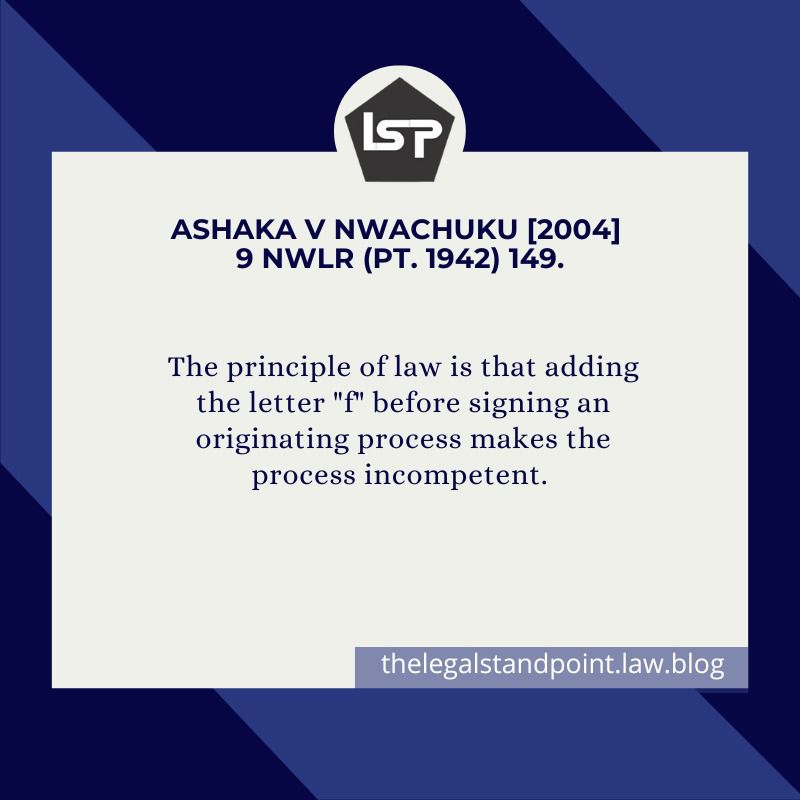
Good afternoon, readers. Today, we’ll look into what adding the letter “f” before signing a document means in law. In consideration, attention is paid to the recent 2024 supreme court case of Alhaji Shehu Ashaka v Samson Chidi Nwachuku [2004] 9 NWLR (Pt. 1942) 149.
In this case, there’s a contract dispute between an appellant and a respondent regarding a road construction project. The appellant awarded the contract to the respondent, who subcontracted part of the work. An amount of N2 million was owed by the appellant to the respondent, which included payment for additional work. To fund the project, the respondent took a loan. Initially, the respondent sued for the outstanding balance and interest using an undefended list, later moving the case to the general cause list. The trial court ruled in favor of the respondent, ordering payment of N2 million plus interest. The Court of Appeal partially allowed the appeal, reducing the interest rate. The appellant then appealed to the Supreme Court, arguing that the respondent’s initial legal process was invalid since it wasn’t signed by a legally recognized practitioner, as mandated by the Legal Practitioners Act and the Plateau State High Court Rules. The Supreme Court examined these legal provisions as part of its decision-making process in the appeal.
Generally, an originating process is indeed crucial in legal proceedings as it sets the stage for the entire lawsuit or appeal. Its competency is vital for establishing the court’s jurisdiction and activating its authority. A valid initiating process must be signed by either the plaintiff (if self-representing) or a legal practitioner if one is involved. This signature is essential for clarity and compliance with legal requirements. Any ambiguity or improper signature can render the document invalid, which not only violates legal statutes like the Legal Practitioners Act but also risks undermining the integrity of the legal process itself. It’s imperative to uphold these standards to prevent unauthorized individuals from engaging in legal representation and to ensure the legitimacy of court documents.
Now to the issue in contention, the law is that when the letter “f” precedes a signature on a document, it signifies “for,” indicating that the signatory is signing on behalf of someone else who cannot sign the document themselves. If a court document is signed in this manner, it creates uncertainty about the identity of the person signing the originating process. This uncertainty is a significant issue under the law because legal documents must be signed either by a party involved or their legal representative. The court cannot speculate or gather evidence to determine the identity of an unknown proxy.
In the case at hand, the originating process submitted by the respondent to the trial court was deemed incompetent because it was signed by an unidentified individual. Jauro JSC opined that: “In the instant case, the writ of summons was signed in the same way the motion ex parte to place the suit under the undefended list was signed. It was signed thus: “f “signature impression/mark” Oba Madaubuchi, Esq 4 New Zaria Terrace, Jos. From the manner in which the writ of summons was signed or executed, there is no doubt that it was signed by an unnamed and unknown person whose status as a legal practitioner is unknown and unascertainable. There is nothing on the face of the Writ or indeed any other document before the court to show that it was signed by a legal practitioner. The LPA does not envisage the signing of court processes through an unknown proxy.”
Relying on the precedent of AI-Masmoon Security Ltd v. Pipelines Marketing Products Co. Ltd. Kekere Ekun JSC, in her judgment at page 176, paragraphs F-H, addressed a similar issue. The notice of appeal in that case was signed by an unknown proxy on behalf of the named legal practitioner, Emmanuel Esene of Emmanuel Esene & Co. The signature had the prefix “pp” before Emmanuel Esene’s name. There was an attempt during the proceedings to argue that “pp” stood for “Principal Partner,” but this argument was dismissed based on the established dictionary meaning of “pp” as “per pro,” indicating “by proxy.”
Having pointed out the issue, the court clarified the correct procedure for signing on behalf of another person by emphasizing the importance of disclosing both the name and identity of the signatory and the person they are signing for, especially in chambers. In the case under consideration, the writ of summons had a prefix “f” before the name “Oba Maduabuchi, Esq,” creating uncertainty about the signatory’s identity on behalf of Oba Maduabuchi, Esq. It was impossible to determine whether the signatory was a recognized legal practitioner in Nigeria or not. This fundamental defect rendered the originating process defective, resulting in the trial court lacking jurisdiction to handle the case.
Consequently, the Court of Appeal also lacked jurisdiction to entertain the appeal arising from this case. In essence, you cannot build something on a flawed foundation and expect it to stand. Therefore, the action was struck out because when a court finds that the suit before the trial court is incompetent and deprives the courts of the necessary jurisdiction to adjudicate, the appropriate and proper order is to strike out the suit.
Interesting, there is a difference between a dismissal and striking out of a case. When an action is dismissed, it means that the court has considered the merits of the case and found them lacking, thus the case cannot be litigated again. In contrast, when an action is struck out, it means the court has not considered the merits of the case. Instead, the case is removed from the court’s list, often due to procedural issues or defects, but it can be resuscitated or relisted once the issues are resolved.
Giving this a judicial encomium, the supreme court per Tanko Mohammed (as he then was) in Re Apeh & Ors (2017) LPELR-42035(SC) opined that “I think I should re-state the well settled principle of the law and permanent feature of the practice of the Courts that when action is struck out, it is still alive and could be resuscitated by the plaintiff/appellant. It is not so when a matter is dismissed. The matter comes to a final bus-stop and the particular claim or relief suffers the vicissitude of death and it can hardly be revived.”
At this point, it is understandable to feel emotional, especially if you’re not a lawyer or law student. After spending many years in court, you might wonder why the court struck out the action. It might even seem surprising that the appellant’s lawyer raised the issue of the process not being signed by a lawyer for the first time at the Supreme Court. You might ask, why not apply substantive justice?
However, I believe the court’s decision is correct. In our pursuit of substantive justice, we cannot afford to violate fundamental laws. As noted in Nweke v Okafor (2007) 10 NWLR (Pt. 1043) 521, Fabiyi JSC (as he then was) held that substantial justice is achieved not by bending the law but by applying it as it is written, not as it ought to be. Applying the provisions of sections 2(1) and 24 of the Legal Practitioners Act as drafted by the Legislature is not a matter of technicality. It is about upholding the substantive provisions of the law as they stand. The law should not be bent to suit the whims and caprices of the parties or their counsel. Therefore, it is not merely a technicality when a substantive provision of the law is rightly invoked.
In conclusion, while it may seem frustrating that the court struck out the case after many years, the decision was correct because it adhered to fundamental legal principles. Legal documents must be properly signed by recognized practitioners, as mandated by the Legal Practitioners Act. Upholding these standards ensures the integrity of the legal process. As stated in Nweke v Okafor, justice is served by applying the law as it is, not by bending it to fit circumstances. Therefore, the court’s adherence to these rules, even at the expense of procedural setbacks, ultimately supports the rule of law and fair legal practice.
Please kindly leave a comment. I need to have at least 50 comments on this article. Thank you for reading. See you next week.
Good Afternoon, Readers. It’s a new week and we are here to discuss the burden of proof of the Certificate of Incorporation and the alleged negligence of the Corporate Affairs Commission (CAC) using the 2024 case of A. Dikko & Sons v CAC [2004] 8 NWLR (Pt 1939).
Evidence that a company has been registered is its certificate of incorporation. Just as every individual in Nigeria has a certificate of origin to show their state of origin, companies have a certificate of incorporation to verify their registration status. The Corporate Affairs Commission (CAC) is the body responsible for registering companies and issuing these certificates. According to the Companies and Allied Matters Act 2020 (CAMA), which is the principal legislation guiding companies affairs in Nigeria, the CAC has the authority to regulate and oversee company registrations.
The facts of the case under review was that the appellant, A. Dikko and Sons Ltd, was registered by the CAC as a private limited liability company on September 4, 2008, with Registration No. 771050. However, the CAC negligently registered another company with a similar name, A. Dikko and Sons Nigeria Limited, on December 17, 2008, with Registration No. 791987. This was a breach of Section 30 of CAMA, which prohibits the registration of a company by a name identical to an existing one or so similar that it could deceive.
Consequently, cheques meant for A. Dikko and Sons Ltd were deposited into the account of A. Dikko and Sons Nigeria Limited, and the promoter of the latter company withdrew and made off with the money. The appellant argued that the CAC’s negligence in registering a company with a nearly identical name caused their financial losses.
Both the Federal High Court and Court of Appeal needed the appellant to provide evidence of the existence of the second company to support their claim. While A. Dikko and Sons Ltd produced its certificate of incorporation, it failed to present the certificate of incorporation for A. Dikko and Sons Nigeria Limited. The Court stressed that the certificate of incorporation is essential as prima facie evidence of a company’s registration under Section 36(6) of CAMA. Without this certificate, the appellant could not prove that the second company existed.
On appeal to the Supreme Court, the court ruled that, under the law of evidence, the appellant must prove its case based on its strength, not the weakness of the respondent’s case. The appellant’s inability to produce the certificate of incorporation for A. Dikko and Sons Nigeria Limited meant it could not establish the necessary facts to support its claim of negligence against the CAC.
The judgment is consistent with legal principles and statutory requirements. Section 30(1) of CAMA 2020 clearly states that no company shall be registered with a name identical to an existing company’s name or so similar that it could deceive. However, to prove such negligence, the existence of the allegedly negligent registration must be established through the production of the certificate of incorporation.
In legal precedents such as Odinaka & Anor v Moghalu (1992) 4 NWLR (Pt. 233) 1 and Heaven vPender (1883) 11 QBD 503 at 507, negligence is defined as the failure to exercise the care which the circumstances demand. Similarly, Reptico S. A Geneva v. Afribank Plc (2013) 14 NWLR (Pt. 1373) 172 confirms that the certificate of incorporation serves as prima facie evidence of a company’s registration. Moreover, in NNPC v. Lutin Inv. Ltd. & Anor (2006) LPELR-2024(SC), the court also held that the conclusive proof of a company’s incorporation is through its certificate of incorporation.
On personal stuff yeah? I feel that had there indeed been an identical company and the appellant truly lost their money, the appellant should have sued that second company alongside the CAC. Additionally, the appellant could have requested the court, in the interest of substantive justice, to compel the production of the second company’s certificate of incorporation. While this approach might seem like a stretch, as it essentially shifts the burden of proof, introducing this additional step could have made the appeal more robust and intriguing. It might have even led to a new position in company law, thereby advancing our jurisprudence.
However, since this was not done, the position of the law is clear. Given the appellant’s failure to provide the second company’s certificate of incorporation, it did not meet the burden of proof required by law. Therefore, the court’s decision to dismiss the appeal is justified, as the appellant could not substantiate its claims of negligence against the CAC.
Thank you for reading❤️. See you next week🙏. And Happy Eid al-Adha Mubarak in advance to our amazing muslim readers. Send meat👍



 THELEGALSTANDPOINT