Law

LSP149: State High Court jurisdiction over minors

This week’s article takes us to the street of the Court of Appeal, lodging at the hub of Joseph v State. In Joseph v State (2020) LPELR-51101(CA), the Court of Appeal provided a clear interpretation of the jurisdictional boundaries between the State High Court and the Family Court regarding criminal matters involving minors. As you know, a minor is someone generally below the age of 18 in Nigeria. This decision is rooted in the Child Rights Law of Kogi State, 2009, and the constitutional provisions that govern court jurisdictions in Nigeria. The main issue for determination is whether the State High Court can handle criminal cases involving minors, despite the establishment of the Family Court.

It is noteworthy that Sections 149 to 151 of the Child Rights Law of Kogi State, 2009, set up a Family Court specifically for dealing with issues related to children. Section 149 creates the Family Court, referred to as “The Court” in the law, designed to address children’s matters. Section 150 explains that the Family Court operates at two levels: as a Division of the High Court and as a Magistrate Court. Section 151 expands the jurisdiction of the Family Court, giving it broad authority to hear any criminal case involving or related to offences committed by or against children.

In Nigeria, courts follow the principle that laws should be interpreted based on their plain and ordinary meaning. This is known as the Literal Rule of Interpretation. This principle was emphasized in A.G. Federation v. A.G. Lagos State (2013) LPELR 20974 (SC), where the Supreme Court stressed that the intention of the legislature must be respected without altering the clear wording of the law.

Furthermore, the Family Court’s jurisdiction, described as “unlimited” in matters involving children, means it can handle a wide range of issues. However, “unlimited” does not mean exclusive. This distinction is crucial because it means that while the Family Court can hear many cases involving children, it does not have the sole authority to do so, allowing other courts, like the State High Court, to hear these cases as well.

Moving on, Section 272 of the Constitution of The Federal Republic of Nigeria 1999 (as amended) grants the State High Court broad jurisdiction over both civil and criminal matters. Section 272(1) authorizes the High Court to hear any civil or criminal case involving penalties, forfeitures, punishments, or other liabilities for offences committed by any person. This constitutional provision ensures the State High Court retains its jurisdiction unless explicitly limited by the Constitution itself. This constitutional jurisdiction cannot be overridden by any other legislation. Any attempt to do so would render the conflicting law void. Tukur v. Governor of Gongola State (1989) 4 NWLR (Pt. 117) 517. As such, the Child Rights Law of Kogi State, while creating the Family Court and granting it extensive jurisdiction, cannot negate the jurisdiction of the State High Court as given by the Constitution.

In the case under review, the appellant was convicted of kidnapping under the Kogi State Kidnapping, Thuggery, and Other Related Offences (Prohibition) Law, 2010. This law, enacted by the Kogi State House of Assembly, creates criminal offences under the State High Court’s jurisdiction.

The appellant argued that the State High Court lacked jurisdiction because the victim was a minor, suggesting that the Family Court should have exclusive jurisdiction. The Court of Appeal rejected this argument, highlighting that the Child Rights Law does not grant exclusive jurisdiction to the Family Court. The Court emphasized that the State High Court’s jurisdiction, outlined in Section 272 of the Constitution, remains intact and cannot be displaced by the Child Rights Law. The Court further clarified that the Family Court’s jurisdiction is broad but not exclusive, allowing the State High Court to adjudicate cases involving minors, particularly those concerning serious offences like kidnapping.

In conclusion, the principle of law is that the State High Court has jurisdiction to hear criminal matters involving minors despite the establishment of the Family Court under the Child Rights Laws of states as its jurisdiction is not exclusive and cannot override the constitutional jurisdiction conferred on the State High Court. Despite being the sole judicial authority on this matter, the decision aligns with the principle that statutory provisions should not override constitutional mandates. While I expect the Supreme Court to provide finality on this subject in subsequent years, the decision in Joseph’s case remains the law. .

Thank you for reading. leave a comment. we need more of it. see you next week❤️🙏

Law

LSP148: Exception to inadmissibility of unsigned documents

Generally, the principle of law is that an unsigned document is not admissible as evidence because it is considered a worthless piece of paper with no evidential value. One of the rationale behind this is the lack of authenticity. A signature serves as a means of authenticating a document, signifying that the document has been reviewed, agreed upon, and endorsed by the signatory. Without a signature, there is no clear indication of who created the document or agreed to its contents, making it difficult to verify its authenticity. This principle of law has received judicial approval in a plethora of cases such as G.S.&D Ind Ltd  v NAFDAC (2012) 5 NWLR (PT.1294)11; Adamu v Akogwu (2023) LPELR-59522(CA) among others.

Nevertheless, there are exceptions to this general rule. These exceptions are a product of judicial activism. In Chiagorom v Diamond Bank (2012) 44, N.L.L.R (Pt. 140) 335–159 (460 – 461, para H-D, P.464 Paras. C-D), the Court held that: “Unsigned documents should attract little or no evidential weight. Though many decisions say that an unsigned document is a worthless piece of paper that has no evidential value. It is not everything in writing that goes under the rubric of “document” that will lose its evidential worth simply because it is not signed”

These exceptions are:
• Oral Clarification.  The purport of this exception is that if oral evidence is provided to clarify the document and its authorship, the unsigned document may be admissible. This means that if someone can testify to explain who made the document and what it means, the court may consider it valid evidence. As such, in Ashakacem v. Ashara Mubashshurun Investment Ltd (2019) LPELR-46541(SC), the purchasing manager of the appellant, who was one of the addressees on the email (Exhibit L), confirmed under cross-examination the details and authenticity of the email and its attachment. His testimony provided the necessary clarification that validated the document.

• Recognition and Acknowledgement by Parties exception states that even if a document is unsigned, it can still carry evidential weight if it is recognized and acknowledged by the parties involved. In U.L.O. Consultants Ltd v. La-Afos Global Links Ltd (2022) LPELR-57521(CA), the job orders (Exhibits A2 – A16) were issued by the Appellant and were recognized by the Appellant’s witness as emanating from the Appellant. Although the Appellant claimed that the documents were signed by unauthorized persons, this claim was not substantiated with evidence.

•Performance of Duty. A local purchase order is essentially an instruction to perform a duty or function, akin to a purchase instruction. Once the duty or function is performed based on the LPO, the validity of the document cannot be challenged on the grounds that it was not signed by the performer. The key factor is the performance of the duty or function as per the LPO, not the signature of the performer. U.L.O. Consultants Ltd v. La-Afos Global Links Ltd (2022) LPELR-57521(CA)

•Shipping Contract. This was supported by the precedent set in Awolaja & Ors v Sea Trade G.B.V(2002) 4 NWLR (Pt. 758) 520 where it was held that the lack of a signature does not affect the validity of a contract of affreightment if the parties acknowledge and intend to be bound by it.

•Where a party refuses to sign a contract but performs the terms of the contract, it creates a binding estoppel. This is the recent exception held in the 2019 Supreme Court case of MTN (Nig.) Communications Ltd. v. Corporate Communications Inv. Ltd. [2019] 9 NWLR (Pt. 1678) 427.

In conclusion, these exceptions serve the purpose of ensuring that substantive justice is achieved.

Thank you for reading.🙏 See you next week❤️

Law

LSP147: Transfer of Cases and Judges


Hi readers, today we are discussing  an interesting topic about the jurisdiction and transfer of cases cum judges under Nigerian law. We will be discussing three main things: transferring cases from one court to another, transferring cases within the same state’s judicial division, and the transfer of judges. This area of law has been shaped by numerous court decisions that clarify when and how a case can be transferred.

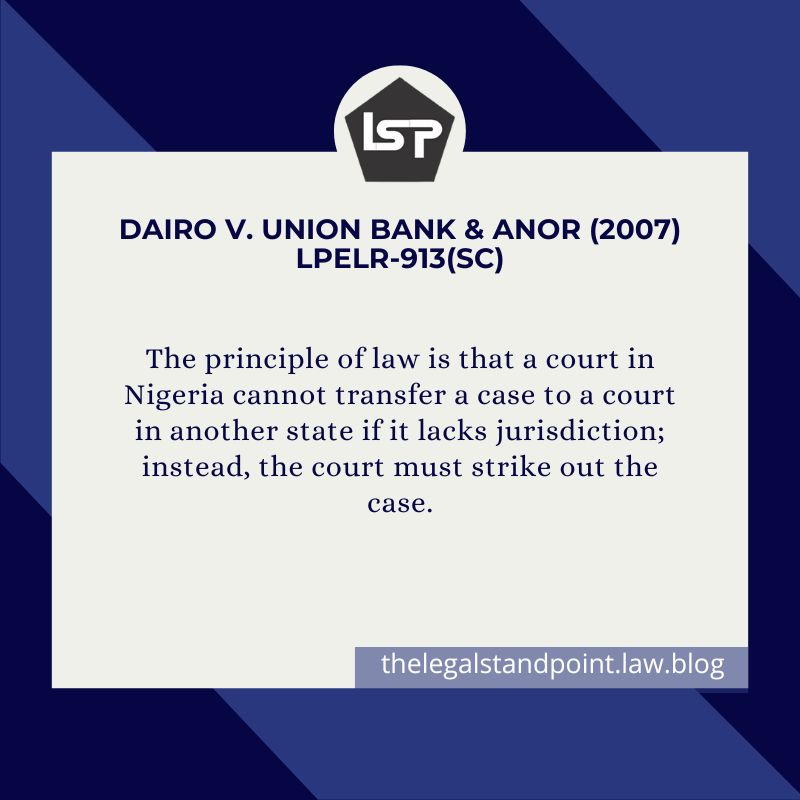
Starting with the transfer of cases between states, let’s look at the case of Dairo v. Union Bank & Anor (2007) LPELR-913(SC). The Supreme Court dealt with whether a court can transfer a case from one state to another. They concluded that it’s not possible to transfer cases between states. For instance, the Lagos State High Court and the Ogun State High Court cannot transfer cases to each other because they are in different judicial divisions. This was supported by sections 234(1) and 236 of the 1979 Constitution, emphasizing that only the Chief Judge of a state can transfer cases within that state. Any attempt to transfer a case across state lines would be unconstitutional and void. This principle was also affirmed in Najih Stephen v. Ollivio Pedrochi (1938) NNLR 51.

Moving on to another notable case, Zerock Construction (Nig) Ltd v. Faplin (Nig) Ltd (2022) LPELR-57504(CA), the Court of Appeal addressed whether a High Court in one state can transfer a case to another state if it lacks jurisdiction. According to sections 255 and 257 of the Nigerian Constitution, the High Court of the Federal Capital Territory (FCT), Abuja, can hear cases within its jurisdiction. The court referred to Order 41 Rule 6 of the FCT High Court’s Civil Procedure Rules, which allows transfers within its divisions but not to other states. If a court finds it lacks jurisdiction, the only option available is to strike out the case. This position was reiterated in Mudiaga-Odje v. YPS (Nig) Ltd (2014) 5 NWLR (Pt. 1400) 412, where the Court of Appeal held that the proper order when a court lacks jurisdiction is to strike out the case, not transfer it. The Supreme Court in Umanah v. Attah (2006) 17 NWLR (Pt. 1009) 503 also stated that once a court lacks jurisdiction, the matter ends there and the court’s only duty is to strike it out.

Similarly, the Supreme Court in Fasakin Foods v. Shosanya (2006) 4 SC (Pt.2) 204 discussed whether statutory provisions could empower a court to transfer a case to another court when it lacks jurisdiction. The court concluded that such statutory provisions could not override the constitutional principle that a court lacking jurisdiction must strike out the case. This principle reinforces the supremacy of the Constitution over any conflicting statutory provisions.

Reinforcing this, in Ijeoma v. Petromed Oil (Nig) Ltd & Ors (2009) LPELR-8420(CA), the Court of Appeal addressed the issue of transferring cases from a State High Court to the Federal High Court. The appellant argued that the trial High Court, after finding it lacked jurisdiction, should have transferred the suit to the Federal High Court. However, the court, referencing Fasakin Foods Ltd’s case, concluded that Section 22 (3) of the Federal High Court Act did not provide the legislative authority for such a transfer. The decision underscored that no law empowers a State High Court to transfer a case to the Federal High Court.

Furthermore, Uzoma v. Asodike (2010) LPELR-4535(CA) exemplifies these principles. In that case, the Court of Appeal stated that a state High Court cannot transfer a case to another state’s High Court because such courts are of coordinate jurisdiction. Without explicit constitutional or statutory authority, transferring a case across state lines is not permissible.

Now, let’s discuss the transfer of judges within the same state judicial division. The principle of judicial jurisdiction and transfer within the same state division is crucial in Nigeria. The case of
Habibu v State (2018) LPELR-44722(CA) offers a clear exposition of this principle. The issue was whether a judge loses jurisdiction over a matter by mere transfer to another judicial division within the same state. The trial judge was initially hearing the appellant’s case at High Court No. 6 of Jigawa State in the Ringim Judicial Division. During the trial, the judge was appointed as the vacation judge to Court 4 of Dutse Judicial Division by the Chief Judge, and the case was transferred there. Despite the transfer, the same judge continued hearing the matter and eventually delivered judgment.

The principle that a judge does not lose jurisdiction by mere transfer within the same state division is well-established. In Hassan v Gwani (2014) LPELR-24594(CA), Adefope Okojie JCA, stated that a judge of a state high court retains jurisdiction to adjudicate on a matter despite being transferred to another judicial division of the same state. Jurisdiction is not lost due to administrative transfers within the state.

In conclusion, Nigerian courts have clear rules about the transfer of cases and judges. Cases cannot be transferred between states, as seen in Dairo v. Union Bank & Anor and other cases. Within the same state, cases can only be transferred within judicial divisions, but if a court lacks jurisdiction, it must strike out the case, as highlighted in Zerock Construction (Nig) Ltd v. Faplin (Nig) Ltd. Regarding judges, they do not lose jurisdiction if they are transferred within the same state, as established in Hassan v State and Hassan v Gwani. These principles ensure the proper functioning and integrity of the judicial system in Nigeria

Thank you for reading. See you next week