
Hi readers, today we are discussing an interesting topic about the jurisdiction and transfer of cases cum judges under Nigerian law. We will be discussing three main things: transferring cases from one court to another, transferring cases within the same state’s judicial division, and the transfer of judges. This area of law has been shaped by numerous court decisions that clarify when and how a case can be transferred.
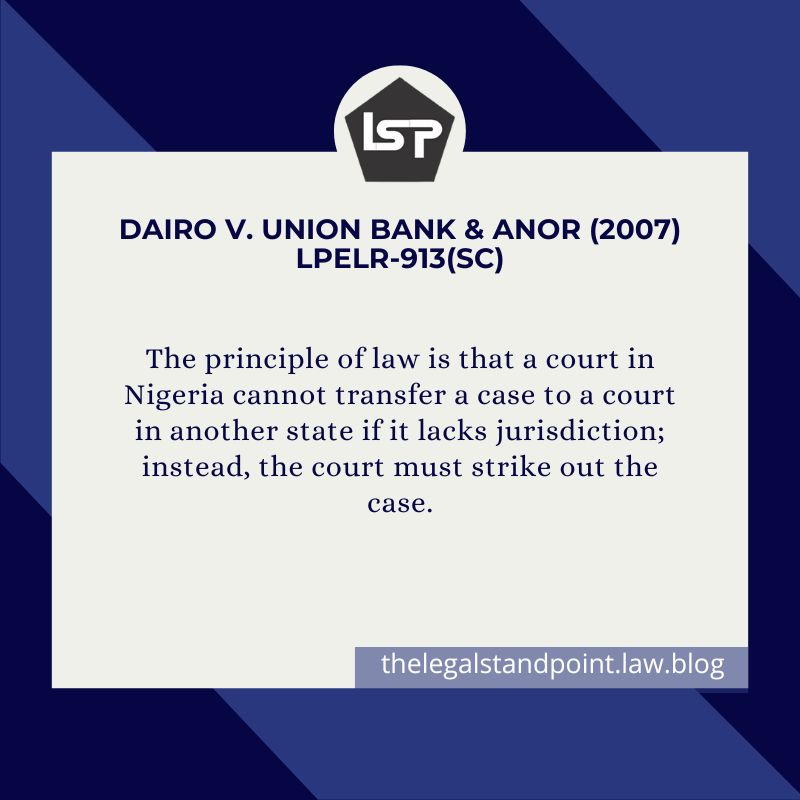
Starting with the transfer of cases between states, let’s look at the case of Dairo v. Union Bank & Anor (2007) LPELR-913(SC). The Supreme Court dealt with whether a court can transfer a case from one state to another. They concluded that it’s not possible to transfer cases between states. For instance, the Lagos State High Court and the Ogun State High Court cannot transfer cases to each other because they are in different judicial divisions. This was supported by sections 234(1) and 236 of the 1979 Constitution, emphasizing that only the Chief Judge of a state can transfer cases within that state. Any attempt to transfer a case across state lines would be unconstitutional and void. This principle was also affirmed in Najih Stephen v. Ollivio Pedrochi (1938) NNLR 51.
Moving on to another notable case, Zerock Construction (Nig) Ltd v. Faplin (Nig) Ltd (2022) LPELR-57504(CA), the Court of Appeal addressed whether a High Court in one state can transfer a case to another state if it lacks jurisdiction. According to sections 255 and 257 of the Nigerian Constitution, the High Court of the Federal Capital Territory (FCT), Abuja, can hear cases within its jurisdiction. The court referred to Order 41 Rule 6 of the FCT High Court’s Civil Procedure Rules, which allows transfers within its divisions but not to other states. If a court finds it lacks jurisdiction, the only option available is to strike out the case. This position was reiterated in Mudiaga-Odje v. YPS (Nig) Ltd (2014) 5 NWLR (Pt. 1400) 412, where the Court of Appeal held that the proper order when a court lacks jurisdiction is to strike out the case, not transfer it. The Supreme Court in Umanah v. Attah (2006) 17 NWLR (Pt. 1009) 503 also stated that once a court lacks jurisdiction, the matter ends there and the court’s only duty is to strike it out.
Similarly, the Supreme Court in Fasakin Foods v. Shosanya (2006) 4 SC (Pt.2) 204 discussed whether statutory provisions could empower a court to transfer a case to another court when it lacks jurisdiction. The court concluded that such statutory provisions could not override the constitutional principle that a court lacking jurisdiction must strike out the case. This principle reinforces the supremacy of the Constitution over any conflicting statutory provisions.
Reinforcing this, in Ijeoma v. Petromed Oil (Nig) Ltd & Ors (2009) LPELR-8420(CA), the Court of Appeal addressed the issue of transferring cases from a State High Court to the Federal High Court. The appellant argued that the trial High Court, after finding it lacked jurisdiction, should have transferred the suit to the Federal High Court. However, the court, referencing Fasakin Foods Ltd’s case, concluded that Section 22 (3) of the Federal High Court Act did not provide the legislative authority for such a transfer. The decision underscored that no law empowers a State High Court to transfer a case to the Federal High Court.
Furthermore, Uzoma v. Asodike (2010) LPELR-4535(CA) exemplifies these principles. In that case, the Court of Appeal stated that a state High Court cannot transfer a case to another state’s High Court because such courts are of coordinate jurisdiction. Without explicit constitutional or statutory authority, transferring a case across state lines is not permissible.
Now, let’s discuss the transfer of judges within the same state judicial division. The principle of judicial jurisdiction and transfer within the same state division is crucial in Nigeria. The case of
Habibu v State (2018) LPELR-44722(CA) offers a clear exposition of this principle. The issue was whether a judge loses jurisdiction over a matter by mere transfer to another judicial division within the same state. The trial judge was initially hearing the appellant’s case at High Court No. 6 of Jigawa State in the Ringim Judicial Division. During the trial, the judge was appointed as the vacation judge to Court 4 of Dutse Judicial Division by the Chief Judge, and the case was transferred there. Despite the transfer, the same judge continued hearing the matter and eventually delivered judgment.
The principle that a judge does not lose jurisdiction by mere transfer within the same state division is well-established. In Hassan v Gwani (2014) LPELR-24594(CA), Adefope Okojie JCA, stated that a judge of a state high court retains jurisdiction to adjudicate on a matter despite being transferred to another judicial division of the same state. Jurisdiction is not lost due to administrative transfers within the state.
In conclusion, Nigerian courts have clear rules about the transfer of cases and judges. Cases cannot be transferred between states, as seen in Dairo v. Union Bank & Anor and other cases. Within the same state, cases can only be transferred within judicial divisions, but if a court lacks jurisdiction, it must strike out the case, as highlighted in Zerock Construction (Nig) Ltd v. Faplin (Nig) Ltd. Regarding judges, they do not lose jurisdiction if they are transferred within the same state, as established in Hassan v State and Hassan v Gwani. These principles ensure the proper functioning and integrity of the judicial system in Nigeria
Thank you for reading. See you next week
 THELEGALSTANDPOINT