
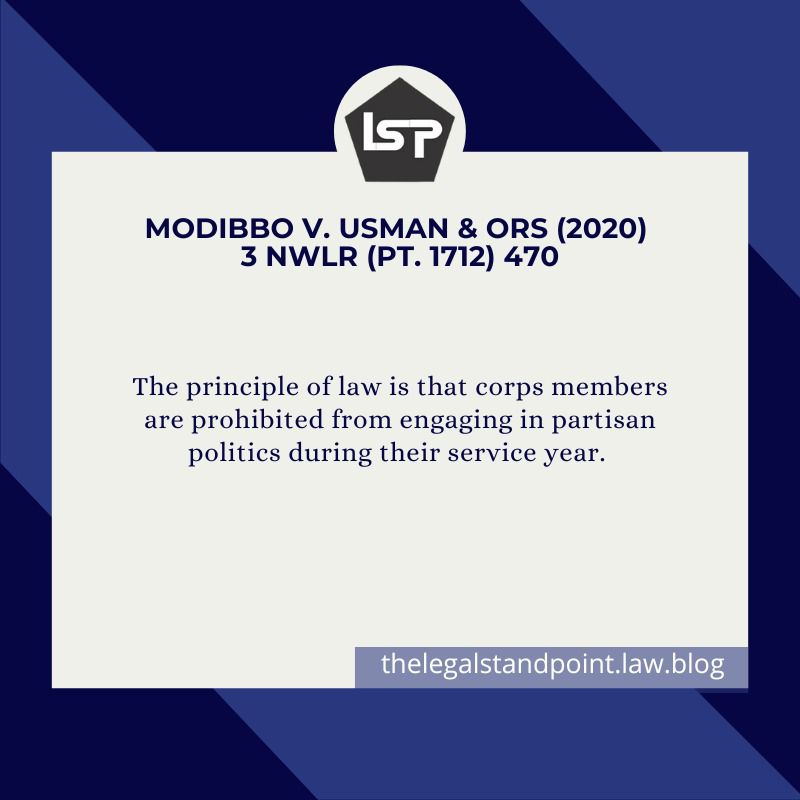
Good afternoon, Readers. Our discussion today is divided into two parts. First, we will explore whether NYSC service is compulsory for eligible graduates. Second, we will examine whether a serving corps member can participate in partisan politics. To better understand these issues, the case of Modibbo v. Usman (2020) 3 NWLR (Pt. 1712) 470 is relied upon. This issue is particularly relevant to many young Nigerians who are navigating their obligations under the NYSC scheme while considering their political ambitions.
On the first issue, the National Youth Service Corps (NYSC) scheme is compulsory for all eligible Nigerian graduates. According to Section 2(3) of the National Youth Service Act, any person called upon to serve in the NYSC must do so for a continuous period of one year from the date of their call-up. Failure to report for service or refusal to make oneself available for the entire service year is considered an offense under Section 13(1) of the Act. The penalties for such an offense include a fine of N2,000 or imprisonment for a term of twelve months, or both.
Furthermore, Section 13(3) of the Act makes it an offense for any person to cause, aid, or abet another to contravene the provisions of the Act. This section specifically targets employers or organizations that might attempt to lure individuals away from fulfilling their mandatory service. The penalty for such an offense is a fine of N5,000 or imprisonment for a term of three years, or both. The law is clear that disobedience to the NYSC Act is not merely a matter of indiscipline but constitutes a criminal act.
The case of Modibbo v Usman revolves around a political dispute in the lead-up to the 2019 general elections. Both the appellant, Modibbo, and the respondent, Usman, were aspirants seeking to be the All Progressives Congress (APC) candidate for the House of Representatives seat representing Yola North/Yola South/Girei Federal Constituency of Adamawa State. On October 7, 2018, the APC conducted its primary election, in which Modibbo emerged victorious with 293 votes, while Usman, the respondent, secured 124 votes. Despite acknowledging his loss, Usman initiated legal action on November 5, 2018, challenging Modibbo’s eligibility to contest the primary election.
Usman claimed that Modibbo, at the time of the primary election, was still a serving corps member under the NYSC scheme. He argued that Modibbo’s participation in the primary election violated the NYSC Act and its Bye-Laws, which prohibit corps members from engaging in partisan politics. Usman also alleged that Modibbo provided false information about his age and educational qualifications in the forms submitted to the Independent National Electoral Commission (INEC).
The court considered the core issue: whether a serving corps member could lawfully engage in partisan politics. According to Section 4 of the NYSC Act Bye-Law (Revised 2011), every member of the NYSC is expressly prohibited from participating in partisan politics. The law defines partisanship as any action that favours one political group or party over another, which includes active involvement in political contests.
The court emphasized that the rationale behind this prohibition is to prevent corruption and political thuggery, particularly among young people serving the nation under the NYSC scheme. The court noted that being a member of the NYSC is a public office, and the responsibilities associated with it are incompatible with holding a political position. This is because public officers, including corps members, are expected to maintain political neutrality during their service.
In Modibbo’s case, the court found that his participation in the primary election while still a serving corps member was a clear violation of the NYSC Act and Bye-Laws. It further held that the essence of the law is not merely to impose penalties but to prevent corps members from engaging in partisan political activities altogether. The court highlighted that a lawbreaker, such as someone violating the NYSC regulations, should not be allowed to become a lawmaker.
The court also addressed whether a person could benefit from their own illegality. It was established that no one is permitted to benefit from their own wrongdoing. Modibbo had concealed material facts in his INEC Forms CF001 and CF002, fraudulently stating that his Senior Secondary Certificate was his highest qualification, despite being a graduate with a B.Sc. in Public Administration. This deliberate falsehood was intended to deceive both the APC and INEC. The court found that Modibbo’s actions constituted a serious breach of legal and ethical standards. As established in cases such as Brosette Manufacturing Nig. Ltd. v. Ola Ilemobola Ltd. (2007) All FWLR (Pt. 379) 1346 and B.Manfag (Nig.) Ltd. v. M/S. O.I. Ltd. (2007) 14 NWLR (Pt. 1053) 109, such acts of deception invalidate any claims to benefit from the resultant positions or opportunities.
In conclusion, the principle of law is that NYSC service is compulsory for eligible graduates, and during this period, any engagement in partisan politics is strictly prohibited.
Thank you for reading❤️. See you next week🙏

 THELEGALSTANDPOINT