
Good afternoon, amazing readers. This week, we will be exploring the topic of proof of adultery under two distinct legal systems: the Marriage Act and Islamic Law. Our discussion will center around how adultery is defined, the standards of proof required, and the consequences under these systems, with particular emphasis on the cases of Alabi v. Alabi (2007) 9 NWLR (Pt. 1039) 297 and Rungumawa v. Rungumawa (2002) 1 NWLR (pt 747).
In Alabi v. Alabi, the appellant married the respondent on January 3, 1999. By 2002, the appellant sought a divorce, citing the respondent’s behaviour as intolerable and the marriage has irretrievably broken down. He also sought custody of their only child. The respondent countered with allegations of adultery, claiming the appellant had been involved with one Aramide Babatunde even before their marriage. This relationship allegedly resulted in the birth of two children, one conceived before the marriage and the other after. The respondent further described the appellant as a man of unstable character, with a disregard for their marriage and an insatiable appetite for women. After the appellant drove the respondent away in June 2002, she filed a cross-petition seeking dissolution of the marriage, damages for adultery, custody of their child, and monthly maintenance.
In Rungumawa v. Rungumawa, the appellant sought to dissolve her six-year marriage under Islamic law, citing her husband’s failure to pray, neglect to provide for her, and false accusations of adultery that led to her arrest and detention. The respondent denied the allegations but admitted to reporting the supposed adultery to the police. During the trial, the respondent was unable to provide witnesses to substantiate his claims. The Sharia Court dissolved the marriage and reprimanded the respondent for his unfounded accusations. Dissatisfied, the respondent appealed, leading to a series of appeals that ultimately upheld the dissolution of the marriage.
On definition, adultery is a consensual sexual intercourse between two persons of opposite sexes, where at least one of the parties is married to someone else. The act must occur after the marriage has been celebrated. When proving adultery, the burden lies on the party making the allegation to establish it to the court’s reasonable satisfaction. The standard of proof in adultery cases is on the preponderance of evidence, usually a little bit higher than that of civil cases. This principle was upheld in cases such as Ikpi v. Ikpi (1957) WRNLR 59, where the court emphasised that the evidence must be compelling but not to the level required in criminal matters.
To establish adultery, circumstantial evidence often plays a crucial role since direct evidence is rare. Circumstantial evidence can include situations where the parties were alone in compromising circumstances, the contraction of a venereal disease, visits to a brothel, or confessions and admissions, though the latter must be treated cautiously. In Alabi v. Alabi, the birth of two children by Aramide Babatunde, one conceived before and one after the marriage, was sufficient evidence of adultery.
When assessing damages for adultery, the court considers the harm done to the petitioner’s honor, family life, and emotional well-being, rather than merely compensating for the petitioner’s loss. In Alabi v. Alabi, the court highlighted the severe impact on the respondent’s honor and family life, noting that the damages awarded were conservative given the circumstances.
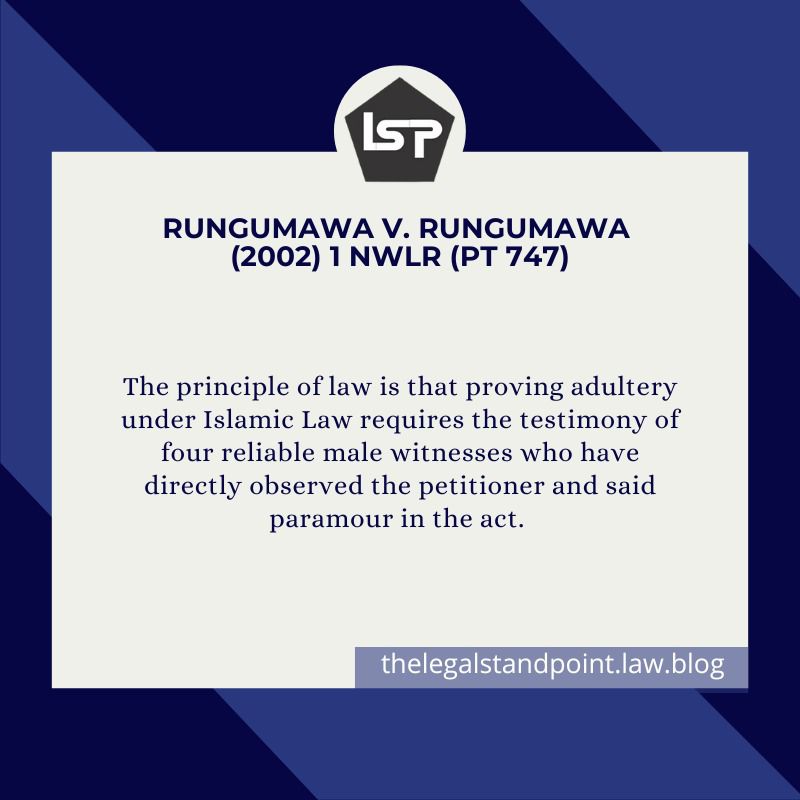
In contrast, under Islamic law, proving adultery (Zina) requires the testimonies of four unimpeachable male Muslim witnesses who have seen the act. Now it gets serious in the sense that if even one witness provides a different version, the accused will be acquitted, and the other witnesses will be punished severely for giving false testimony. This high standard of proof underscores the gravity of such accusations in Islamic law. Moreover, in cases of “Lia’n,” where a husband will swear that he saw his wife making love with another man directly, the husband must take a special oath five times before the court or a large gathering. Had he declined to take that multiple oath the punishment of Qazf, defamation, must be meted out on him. That is eighty lashes of cain.
In Tukurwa v. Kwa-Kwa (1992) 2 NWLR (Pt. 224) 449, the court reiterated that while adultery or fornication requires the testimony of four male witnesses under Islamic law, other cases can be proven with the testimony of at least two credible witnesses.
In conclusion, proving adultery under the Marriage Act and Islamic Law highlights the different approaches each system takes. While the Marriage Act relies on a preponderance of evidence and often circumstantial evidence, Islamic Law imposes a much stricter burden of proof, requiring the testimony of four unimpeachable male witnesses or the invocation of Lian.
Thank you for reading. See you next week.
 THELEGALSTANDPOINT