
In Nigeria, the role of the Attorney-General (AG) is fundamental in ensuring the proper administration of justice, particularly in criminal proceedings. A critical issue that often arises is whether the AG of a state needs to seek the leave of the court before initiating criminal charges. This question was addressed in the case of State v. Egigia [2024] 11 NWLR 1949 which offers valuable insights into the scope of the AG’s prosecutorial powers and the necessity of obtaining leave before filing charges.
The Attorney-General, as the Chief Law Officer of a state, is constitutionally empowered under Section 211 of the Constitution of the Federal Republic of Nigeria, 1999 (as amended), to institute and undertake criminal proceedings against any individual in respect of any offence under any law of the state. Given the vast responsibilities associated with this role, the AG cannot personally handle every criminal case. Therefore, the Constitution allows the AG to delegate these powers to law officers within their department. These law officers, acting as agents of the AG, perform their duties on behalf of the AG and are vested with the same prosecutorial powers.
In the case under review, the respondent, a policeman, was involved in an incident in February 2006 that led to the death of an individual named Ismaila Dodo. While investigating a case in Ayama village, Jigawa State, the respondent and another officer severely beat Dodo, resulting in a fractured leg. Dodo later died from this injury. The respondent was charged with culpable homicide not punishable by death under Section 244 of the Penal Code. The charge was prepared and filed by a Principal State Counsel in the Ministry of Justice, Jigawa State, rather than by the AG personally.
During the trial, the prosecution presented evidence and witnesses to support the charge. However, the trial court found that while the respondent’s actions caused Dodo’s death, there was no sufficient evidence to prove that the respondent intended to kill him. As a result, the court convicted the respondent of serious assault under Section 224 of the Penal Code and sentenced him to five years imprisonment
The respondent appealed this decision, and the Court of Appeal ruled that although the AG had the constitutional power to file charges without seeking the court’s leave, the Principal State Counsel who filed the charge was required to obtain such leave as a condition precedent. The Court of Appeal held that the failure to obtain leave deprived the trial court of jurisdiction, rendering the trial a nullity. However, since the respondent had already served the sentence, the Court of Appeal did not order a retrial but set aside the trial court’s judgment.
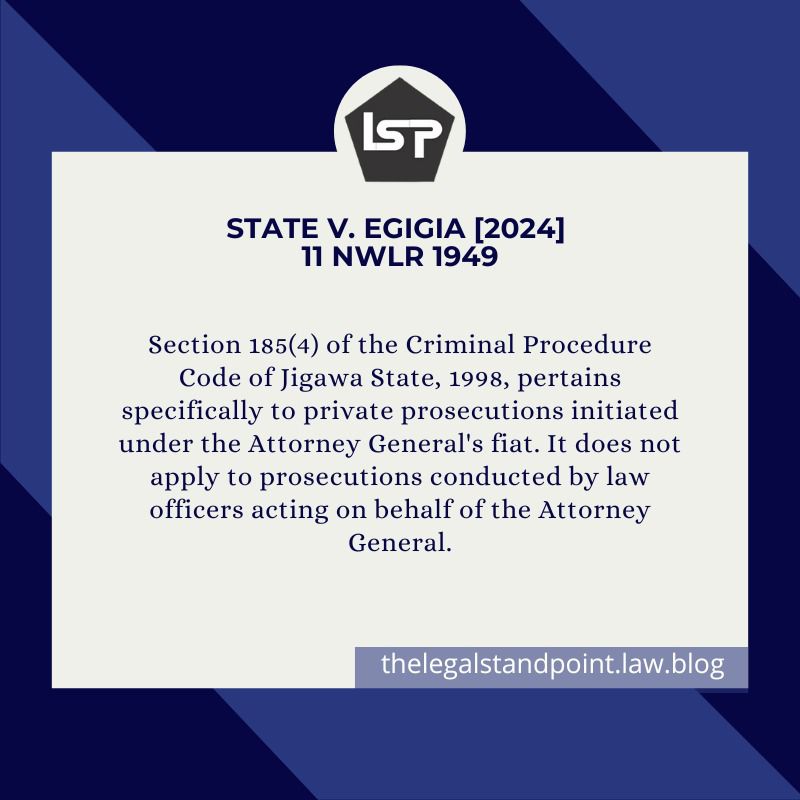
The Supreme Court, however, provided a crucial clarification on this issue. It emphasized that under Section 211(2) of the Constitution, the AG’s prosecutorial powers could be exercised either by the AG personally or through officers in their department. The Court further explained that the requirement for leave under Section 185(4) of the Criminal Procedure Code of Jigawa State, 1998, applies to private prosecutions initiated under the AG’s fiat, not to prosecutions carried out by law officers acting on behalf of the AG. The Supreme Court concluded that the prosecution was validly initiated without the need for leave and that the Court of Appeal had misinterpreted the law.
Moreover, the Supreme Court highlighted the principle of agency in this context. It noted that when the AG delegates prosecutorial authority to a law officer, that officer acts as the AG’s agent. Therefore, the actions of the law officer, taken within the scope of their delegated authority, are considered the actions of the AG. This principle is encapsulated in the Latin maxim qui facit per alium facit per se (he who acts through another acts himself). Consequently, the law officer who filed the charge on behalf of the AG was not required to seek leave before doing so, as the officer was operating under the AG’s delegated powers.
An important aspect of the Supreme Court’s decision in State v. Egigia involved the issue of the repealed law. Justice Abba Aji JSC, concurring with the lead judgment of Ogunwumiju JSC, emphasized that a repealed law no longer holds legal validity and cannot be cited as if it still exists. He referred to the earlier decision in Bature v. State (1994) 1 NWLR (Pt.320) 267 which relied on Section 185(b) of the Criminal Procedure Code Cap. 30 of the Laws of Northern Nigeria, 1963, and the Criminal Procedure (Application for Leave to Prefer a Charge in the High Court) Rules, 1970. These laws had been repealed long before the current case was initiated. The Supreme Court criticized the Court of Appeal for relying on the Bature’s case, stating that using repealed laws to influence current legal arguments is incorrect and misleading. The current case was initiated under the Criminal Procedure Code of Jigawa State, 1998, which is the applicable law, and the Court of Appeal erred in not recognizing this distinction.
Thank you for reading. See you next week.
 THELEGALSTANDPOINT