
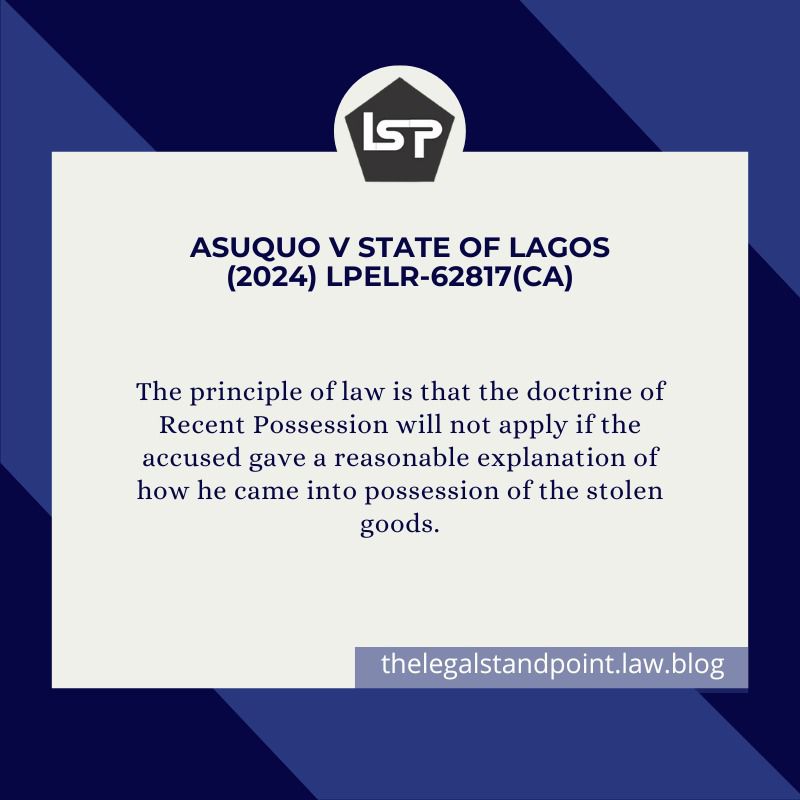
Hello dear readers. Today, we are going to talk about the Doctrine of Recent Possession in law, a concept often used in criminal cases that involve stolen property. The idea behind this doctrine is pretty straightforward: if someone is found with stolen goods not long after they were stolen and can’t give a good reason for why they have them, the law assumes they were involved in the theft or were aware that the goods were stolen.
To successfully utilize this doctrine, four elements need to be in place: first, it must be proven that the goods were indeed stolen; second, the accused person must have been caught with the goods; third, they must have been caught shortly after the goods were stolen; and lastly, the accused can’t provide a reasonable explanation for why they had the stolen property. This doctrine is captured under Section 167(a) of the Evidence Act, 2011. It has been consistently applied and refined through various judicial interpretations. Let’s now explore how it has played out in some notable judgments
In Asuquo v. State of Lagos (2024) LPELR-62817(CA), the prosecution claimed that Asuquo was part of a group of young men who robbed a house in the early hours of the morning. A few hours later, Asuquo was found in possession of two laptops that had been stolen during the robbery. The prosecution tried to use the Doctrine of Recent Possession, arguing that Asuquo must have been one of the robbers. However, Asuquo explained that he found the laptops on the street while on his way to work and planned to turn them over to the police. His defense of alibi – that he wasn’t even near the scene of the crime – was not investigated by the police. Because of this, the Court of Appeal found his explanation reasonable and the doctrine wasn’t successfully applied. Asuquo was discharged and acquitted
On the other hand, in Yisa v State(2019) LPELR-47474(CA), the doctrine was applied successfully. In this case, the appellant was caught driving a car that had been stolen in a robbery just five hours earlier. The proximity of time between the robbery and the appellant’s possession of the stolen car left little room for doubt, and the court applied the Doctrine of Recent Possession, presuming the appellant to be either one of the robbers or someone who knowingly received stolen goods. The appellant failed to provide a satisfactory explanation for his possession, and the presumption stood, leading to his conviction
However, this doctrine isn’t absolute. In Ogogovie v. State (2016) LPELR-40501(SC), for example, the Supreme Court made it clear that if someone can give a reasonable and believable explanation for how they came to possess stolen property, the presumption doesn’t apply. In other words, just because someone has stolen goods doesn’t automatically mean they are guilty, especially if they can explain their possession in a way that makes sense.
In conclusion, the Doctrine of Recent Possession can be a powerful tool in criminal law when there’s no other explanation for why someone has stolen goods. But it’s also important to remember that it’s not foolproof. If the person can explain how they got the goods, like in Asuquo’s case, the doctrine won’t work against them. On the flip side, as seen in Yisa’s case, when no explanation is provided, the presumption of guilt is strong enough to secure a conviction.
Thank you for reading ❤️. See you next week🙏

 THELEGALSTANDPOINT