
Hi LSP Readers! Bawoni, how far? Sannu, ndewo. I apologize for not publishing last week; a couple of things came up. But thankfully, everything is sorted out now! So, hop in the car, and let’s go!
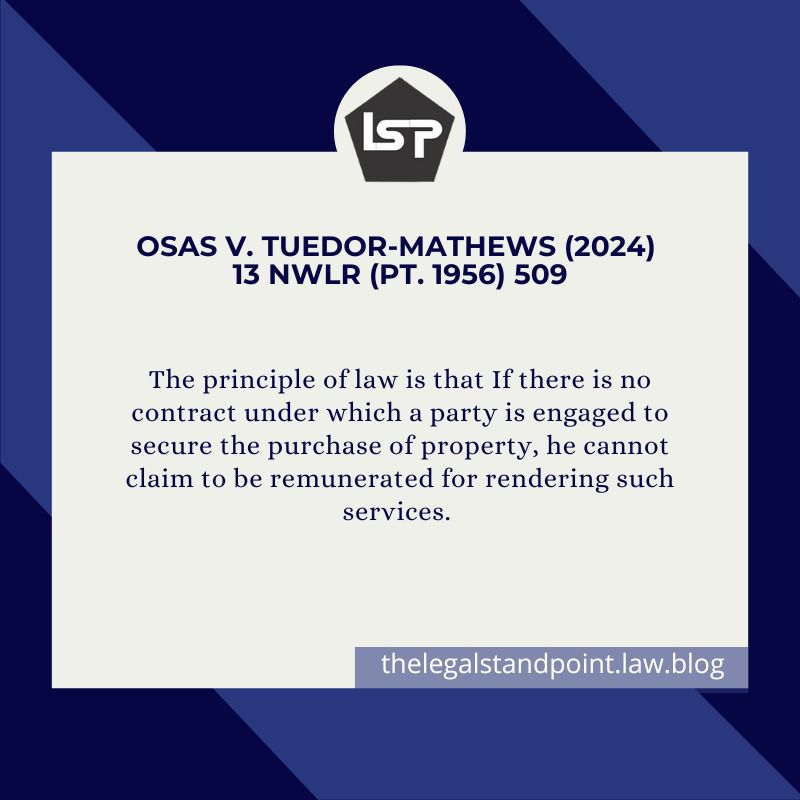
Today, we’ll discuss an important topic: can someone claim payment for services rendered as an agent when there’s no clear contract of engagement? We’ll examine the Supreme Court decision in Osas v. Tuedor-Mathews (2024) 13 NWLR (Pt. 1956) 509, which addresses this issue in a dispute involving a property transaction.
To set the stage, let’s look at the facts of the matter. The appellants were tasked by the owner of a property in Lagos, to help find a buyer. They introduced the respondent to the property, who showed interest, even bringing her daughter for an inspection. After some back-and-forth, the respondent made an offer of ₦850 million, which the owner rejected, insisting on ₦960 million.At this point, communication between the appellants and the respondent broke down.
Suspicious of her silence, the appellants later discovered that the respondent had bypassed them and purchased the property directly from the owner. Feeling wronged, they demanded their commission which was ₦48 million but the respondent refused to pay, claiming there was no deal. The matter escalated to court, with the appellants initially winning some ground. However, the Court of Appeal disagreed, and when the case reached the Supreme Court, the final ruling was not in their favour.
Furthermore, one of the issues for determination was whether a contract existed between the parties. The Supreme Court held that without an agreement stating that the appellants were entitled to a commission if the respondent purchased the property, there was no basis for their claim. As such, without a written agreement, it’s like working in the dark. You cannot demand payment for services you believe you rendered when no such contract exists.
Additionally, the court acknowledged that while an agent doesn’t have to be involved in every step of the negotiations, there must be a clear connection between their actions and the sale. In this case, there was a significant disconnect between the introduction of the property and the eventual sale. The breakdown in negotiations meant the appellants were no longer involved after the price disagreement. This indicated they could not claim they were the reason the sale occurred, as the transaction proceeded without their involvement.
Nevertheless, I feel an interesting point to consider is that the appellants might have succeeded had they been able to prove that this was not their first business transaction with the respondent and that past dealings had always been conducted without a written contract—relying instead on spoken instructions. This history could have established a pattern of expectation and trust that might have influenced the court’s decision. But without that, it’s just like explaining with no evidence.
In conclusion, Osas v. Tuedor-Mathews serves as a critical reminder to always formalize your agreements. Whether you’re acting as an agent or broker, don’t assume you’ll be paid unless it’s in writing or clearly agreed upon. Relying solely on good faith can easily leave you empty-handed when the dust settles. In the world of contracts, it is the agreement – not emotions – that speaks loudest.
Thank you for reading❤️. See you next week🙏

 THELEGALSTANDPOINT
Interesting! ✍️
LikeLike