
Hi readers, welcome to the last article for October. How are you, and I hope you’re doing well?
Today, we’re exploring an interesting aspect of Nigerian constitutional law, illustrated by the recent Supreme Court decision in Ani v. State (2024) LPELR-62746(SC). This case sheds light on Section 294(1) of the Nigerian Constitution, which mandates that judgments must be delivered within ninety days of the conclusion of evidence and final addresses. At the heart of the appeal was whether a judgment delivered beyond this timeframe automatically becomes invalid or if certain circumstances allow for exceptions. Samuel Ani, convicted for the murder of his uncle, challenged the validity of his trial court’s delayed judgment, contending that it violated his rights and sought to overturn his conviction based on this delay.
The Appellant’s Counsel argued that Section 294(1) uses the term “shall,” which implies a mandatory duty for courts to comply strictly with the ninety-day deadline. According to the defense, compliance with this timeframe ensures a fair judicial process and prevents judgments from being tainted by fading memory or unfair bias due to time lapses. The trial proceedings had ended in November 2016, with final addresses submitted in September 2017, yet the court did not deliver its judgment until July 2018. The defense cited cases like Ifezue v. Mbadugha (1984) 1 SCNLR 427, Amadi v. NNPC (2000) 10 NWLR (Pt. 674) 76, and Agip v. Agip Petrol Int’l (2010) 5 NWLR (Pt. 1187) 348 to support the argument that delayed judgments might lead to unconstitutional outcomes. While acknowledging that the judge had been involved in an election tribunal and had health issues, they contended that these reasons did not fully account for the delay and that the integrity of the trial process had been compromised.
The Supreme Court, however, adopted a more nuanced approach to interpreting Section 294(1). The Court clarified that although the word “shall” generally suggests a command, it can be understood as either mandatory or permissive depending on the specific context of the case.
Citing Abdullahi v. The Military Administrator (2009) 15 NWLR (Pt. 1165) 417, Atungwu v. Ochekwu (2013) 14 NWLR (Pt. 1375) 605, and Amokeodo v. IGP (1999) LPELR-468 (SC), the Supreme Court emphasized that non-compliance with the ninety-day deadline does not automatically invalidate a judgment. According to Section 294(5) of the Constitution, a judgment will only be set aside if the delay causes a real miscarriage of justice. This means that to invalidate a delayed judgment, the complaining party must show that the delay itself harmed their case. This interpretation aims to prevent parties from exploiting procedural issues to invalidate judgments purely on technical grounds. Cotecna International Ltd v. Churchgate Nig. Ltd (2010) 18 NWLR (Pt. 1225) 346; Savannah Bank of Nig. Ltd v. Starite Industries (2009) 8 NWLR (Pt. 1144) 491.
In the case under review, while both parties acknowledged that the judgment was delivered outside the stipulated ninety days, the Supreme Court found no substantial injustice had occurred. The Court noted that the appellant failed to demonstrate how the delay specifically impaired the judge’s evaluation of evidence or fairness of the proceedings. They reiterated that it is not merely the length of delay that matters but the effect of that delay on the judge’s reasoning. Even though the trial court experienced a considerable delay, the judgment was ultimately well-reasoned and backed by evidence.
The Court thus concluded that the appellant had not sufficiently shown any miscarriage of justice due to the delay. In its view, although the delay in the trial judgment was regrettable, the judge’s reasoning and conclusions were unaffected by it. Hence, the Supreme Court upheld the conviction, dismissing the appeal.
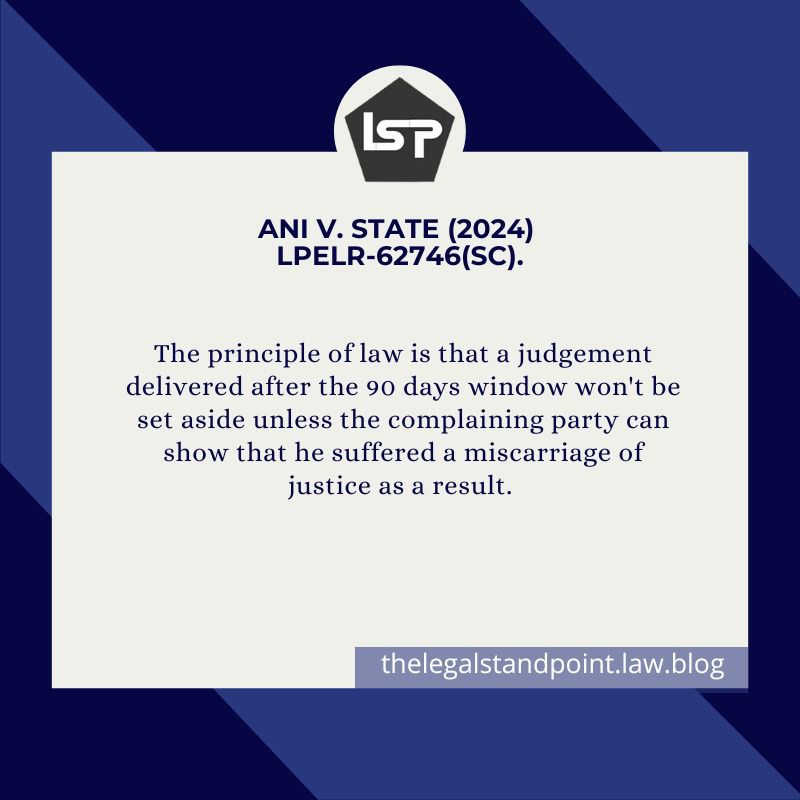
In conclusion, the principle of law is that a judgement delivered after the 90 days window won’t be set aside unless the complaining party can show that he suffered a miscarriage of justice as a result.
Thank you for reading ❤️. See you in November❤️🙏
 THELEGALSTANDPOINT