
Hello, LSP Readers!
Today, we will be discussing the implications of failing to endorse a process served on another party in a different state, using the case of Mohammed v. N.D.I.C. (2024) 14 NWLR (Pt. 1957) 67 as our focal point.
The facts of this case reveal that the appellant’s husband, Alhaji Muktar Ahmed Muhammed, served as the Chairman of the Board of Directors of Commercial Trust Bank Ltd. He also chaired the Board of Directors of Credit and Finance Limited, which held an account with Commercial Trust Bank. Credit and Finance Limited sought a loan of N2.5 million from the bank, granted on the direct intervention of the appellant as Chairman of the bank. Additionally, a further loan of N200,000 was requested and approved. However, the company defaulted on the repayment of the total loan amount of N2.7 million after the bank was closed and taken over as a failed bank by the respondent.
The respondent took over the failed Commercial Trust Bank as a liquidator. In law, a liquidator is a person or entity appointed to wind up the affairs of a company that is unable to pay its debts. The liquidator’s primary responsibility is to collect the company’s assets, pay off creditors, and distribute any remaining assets to shareholders.
As the statutory liquidator of the bank, the respondent(NDIC) discovered the company’s outstanding debt as of January 31, 1990, and demanded payment from the appellant’s husband, which went unheeded. In 1999, the respondent initiated legal action against both the company and the appellant’s husband at the Federal High Court, Lagos. This suit was later transferred to the Federal High Court in Kaduna. The respondent claimed a total of N14,795,399.71, including the outstanding overdraft, interest, and other bank charges. The appellant’s husband denied liability but acknowledged the company’s account and loan agreement with the bank.
During the trial, the respondent presented a Credit Approval Form, which indicated that the appellant’s husband personally guaranteed the loan. Notably, the appellant’s husband did not testify, and the company did not participate in the proceedings. The trial court ultimately found both the company and the appellant’s husband jointly and severally liable for the debt, leading to a judgment against them.
The appellant contested the trial court’s judgment, specifically regarding the failure to endorse the writ of summons that had been issued in Lagos State and served on the Chairman of the failed bank in Kaduna State. The appellant argued that this omission divested the Federal High Court, Lagos Judicial Division, of jurisdiction to hear the case.
As a result of this, the Court examined whether Section 97 of the Sheriffs and Civil Process Act applies to originating processes issued by the Federal High Court and served outside the state where they were issued. Section 97 requires a specific endorsement indicating that the writ is served outside the jurisdiction of its issuance. Historically, cases such as MV Arabella v. N.A.I.C. (2008) 5 NWLR (Pt. 1079) 1 affirmed that this endorsement was necessary, even with the Federal High Court’s nationwide jurisdiction. However, recent decisions, including P.D.P. v. Engr. John Ibrahim Uche & 2 Ors. (2023) LPELR-60038(CA), have shifted this interpretation, establishing that Section 97 does not apply to the Federal High Court. The rationale for this change is that the Federal High Court, like the Court of Appeal, is considered a single court throughout Nigeria, albeit with various divisions for administrative convenience. Thus, the issuance of an originating process from one judicial division of the Federal High Court for service in another division does not require the mandatory endorsement prescribed by Section 97. As such, it was held that the originating summons issued by the Federal High Court in Lagos and served in Kaduna, despite lacking the endorsement required by Section 97, was valid.
Justice A.D.A.H. noted that “Section 97 of the Sheriffs and Civil Process Act is an adjunct to the word, federalism. The law is to give regard to the federal system of government where the federating units are meant to be semi-autonomous territorially and in governance. A process of court from one state needs to be endorsed for service to be effected outside its State of origin. The Federal High Court is not a state court. It is a court that is meant for the federation, and its territorial jurisdiction covers the entire country. Its writ and processes under the law and the new dispensation of the decisions of this court are exempted from the operation of Sections 97 and 98 of the Sheriffs and Civil Process Act.”
This viewpoint underscores that the Federal High Court operates on a nationwide jurisdictional basis, unlike state courts. This interpretation emphasizes that while endorsements may be crucial in some contexts, the overarching jurisdiction of the Federal High Court can sometimes negate such requirements.
Consequently, the question of whether the appellant’s husband waived the requirement of Section 97 became moot, leading to a resolution in favor of the respondent against the appellant. Justice A.D.A.H. concluded, “Having taken this position, the question of whether the participation of the appellant’s husband at trial amounts to a waiver of Section 97 of the Act becomes academic. Consequently, this issue is resolved against the appellant.”
This case underscores the importance of understanding procedural requirements and jurisdictional nuances in legal proceedings, particularly when different states are involved. It illustrates the necessity for parties to be aware of how federalism impacts judicial processes in Nigeria, particularly regarding endorsements.
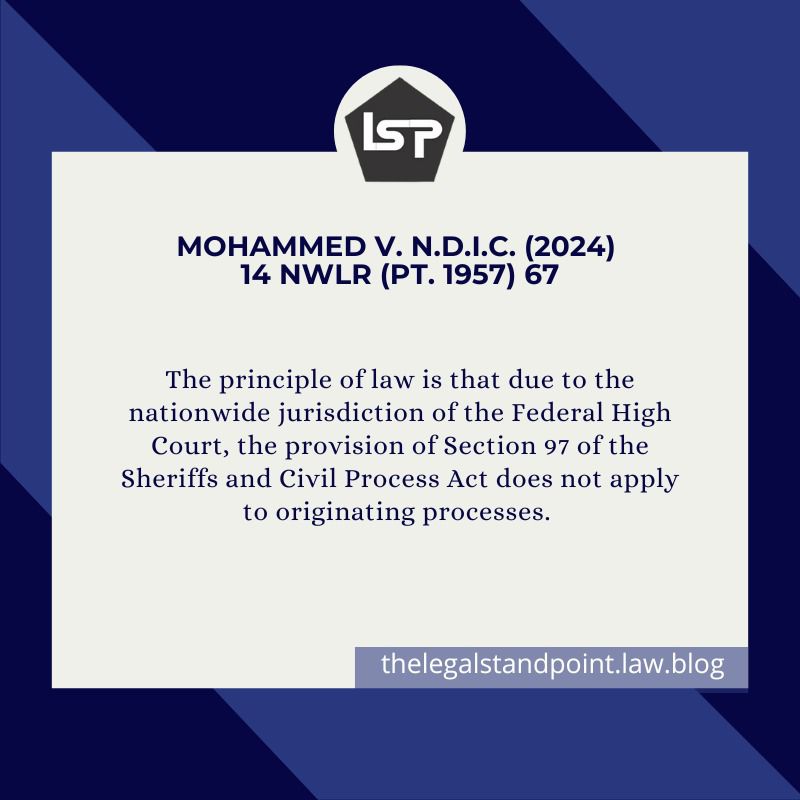
In conclusion, the principle of law is that due to the nationwide jurisdiction of the Federal High Court, the provision of Section 97 of the Sheriffs and Civil Process Act does not apply to the endorsement of a writ of summons for service to another state.
Thank you for reading ❤️. See you next week🙏
 THELEGALSTANDPOINT