Hello, my readers. How are you doing? Winter ❄️ is finally here. This week, we discuss the limitation period in land disputes, using the Supreme Court case of Adeniran v. Adio (2024) 16 NWLR (Pt. 1964) 351 as our guide. The decision provides valuable insights into how the law applies to time limits in land recovery actions.
In this case, the respondents sued the appellants at the High Court of Lagos State on March 11, 2009. They sought a declaration of title to a property at 52, Patey Street, Ebute-Metta, Lagos, damages for trespass, an injunction to prevent further trespass, and possession of the land. The respondents claimed their late father purchased the land in 1936 and built two houses on it, one of which was rented out to the appellants’ father. Over time, the appellants refused to pay rent and eventually demolished the rented structure in 2008, erecting a new building while asserting ownership of the land.
The appellants argued that their late father had acquired the land from the respondents’ family through deeds of conveyance. However, they presented a deed dated 1968, eight years after the respondents’ father’s death in 1960, casting doubt on its validity. Despite this, they claimed long possession and enjoyment of the property since 1960. Both the trial court and the Court of Appeal ruled in favor of the respondents, prompting the appellants to appeal to the Supreme Court. A key issue raised at this stage was whether the respondents’ claim was barred by the Limitation Law of Lagos State.
The Supreme Court affirmed both the trial and lower courts’ decisions, holding that the respondents’ suit was not statute-barred. Section 16(2) of the Limitation Law of Lagos State states that an action for recovery of land must be brought within 12 years from when the cause of action arises. The limitation period refers to the time allowed by law for a person to bring a legal action after their rights have been violated. If this time passes, the right to sue is permanently lost. In this case, the respondents’ right to sue began either in 2005 when the appellants stopped paying rent or in 2008 when they demolished the building. Since the suit was filed in 2009, it was well within the 12-year period.
To help readers understand better, a cause of action “accrues” when the facts that give someone the right to sue first happen. For instance, if a tenant stops paying rent, or a person occupies land without the owner’s consent, the owner’s right to sue starts at that point. This aligns with the principle in British Airways Plc v. Akinyosoye (1995) 1 NWLR (Pt. 374) 722, where time began to run from the date the claimant’s rights were first infringed.
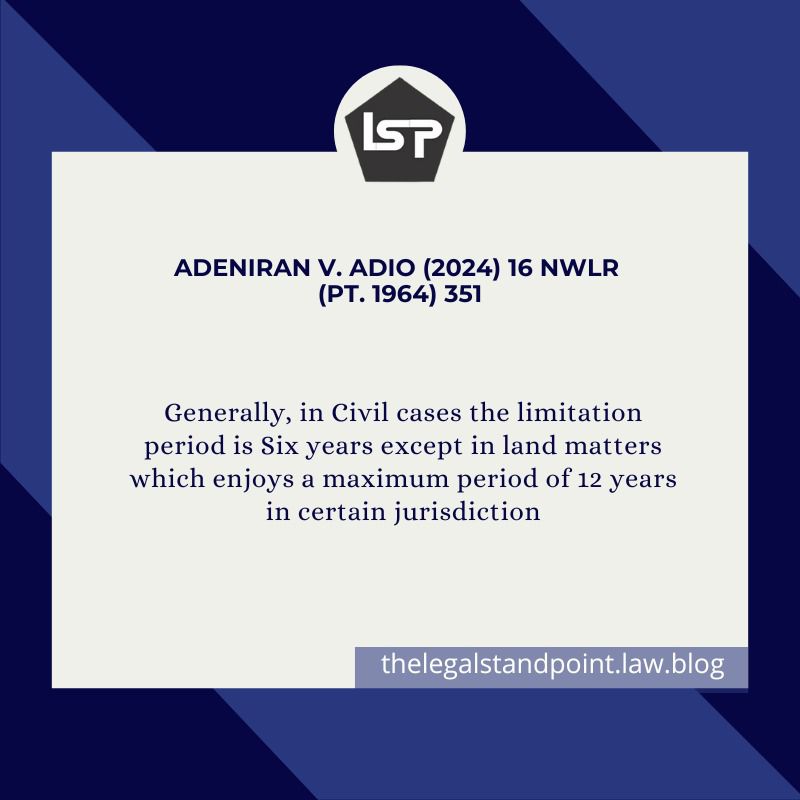
Limitation periods vary depending on the type of action. Generally, civil cases must be brought within six years, while land matters have a longer period of up to 12 years in some jurisdictions. This ensures that claimants act promptly and that evidence for both parties remains reliable.
A statute-barred action has severe implications. As held in Obiefuna v. Okoye (1961) 1 All NLR 357 and Egbe v. Adefarasin (No. 2) (1985) 1 NWLR (Pt. 3) 549, if the limitation period expires, the right to sue is extinguished. Courts determine whether an action is statute-barred by comparing the date the wrongful act occurred with the date the case was filed.
In conclusion, knowing when your right to sue begins and acting promptly can make all the difference in protecting your rights or else as the colloquial saying “oti lor”
Hello, dear readers! How are you? For me, last week was a proud moment. I attended my convocation at the University of Ibadan, where I graduated with a First Class. It’s been an incredible journey, and I’m thankful for the support I’ve had along the way from my LSP Tribe.
Today, we’ll be discussing an interesting case, Dike Geo Motors Ltd. v. Allied Signal Inc. (2024) 10 NWLR (Pt. 1946) 201. The question we’ll tackle is whether registering a trademark provides a complete defence in cases of infringement and passing off.
From basics, a trademark is a symbol, name, or design that distinguishes the goods or services of one company from those of another. It protects brand identity and assures consumers of the source of their purchases. Think of the Nike swoosh or the Coca-Cola logo – these trademarks are instantly recognizable and convey trust and quality. But what happens when someone uses a trademark in a way that confuses or misleads people? That’s where trademark law steps in.
In this case, Allied Signal Inc., an American company, owned several trademarks under which it sold brake and clutch fluids, including the names “Allied,” “Bendix and Device,” “DBA with Parallel Lines Design,” and “e5.” These products were manufactured by its French subsidiary and sold in Nigeria in distinctively designed black, red, and white cans. Over time, Nigerian customers began associating these designs with the respondents’ products.
On the other hand, Dike Geo Motors Ltd., a Nigerian company, later entered the market, selling brake and clutch fluids under the name “Allied.” The problem? The cans of Dike Geo Motors’ product looked remarkably similar to those of the respondents. Allied Signal Inc. argued that this imitation led to confusion, causing people to believe the Nigerian product was theirs or came from the same source.
Dike Geo Motors denied these claims, stating that they only sold the “Allied” products, which they sourced from Dom Frank Nigeria Limited, a separate company. They argued that Dom Frank owned the trademark “Allied and Device,” which had been registered in Nigeria under No. TP 188856. According to them, this registration meant their use of the trademark was lawful and could not infringe on the respondents’ rights.
Interestingly, the appellants registered the same “Allied and Device” trademark under No. 53200 in October 1996 after the respondents had already sued them for infringement and passing off. Two years into the trial, the appellants attempted to dismiss the case, arguing that their registration of the trademark made the respondents’ claims frivolous and an abuse of court process. The trial court rejected this argument, and both the Court of Appeal and Supreme Court upheld that decision.
At the supreme court, one of the issues for determination was whether the Court of Appeal considered the effect of the provisions of sections 3, 4, 5(1) & (2), 20, and 38 of the Trade Marks Act, Cap. 436, LFN 1990, on the viability of the respondents’ claims in their determination of the appeal.
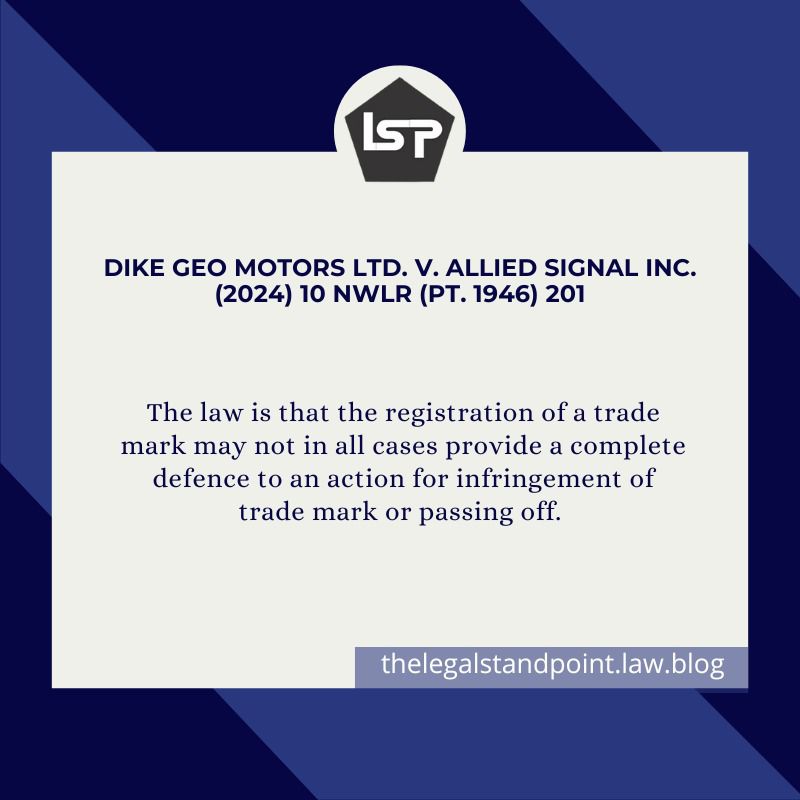
The Supreme Court held that registering a trademark does not give the owner a blanket defence against claims of infringement or passing off. The law protects businesses and consumers from deception. Even if a company registers a trademark, it cannot use that mark to confuse or mislead people into believing their goods are those of another. The court further emphasized that the registration of the “Allied and Device” trademark by Dike Geo Motors after the suit began could not automatically invalidate the respondents’ claims.
Simply put, registering a trademark after a lawsuit starts cannot erase the actions that led to the lawsuit in the first place. The court also pointed out that honest concurrent use (a situation where two companies lawfully use similar trademarks) must be supported by solid evidence, such as proof of honest and independent sales. Dike Geo Motors failed to provide such evidence in this case.
In my view, the Supreme Court got it right. This decision reinforces the importance of fair competition and consumer protection. Businesses must not misuse the trademark system to justify deceptive practices. It also serves as a warning to companies that registering a trademark is not a shield if your actions mislead the public.
In conclusion, trademarks are powerful tools for building brand identity, but they come with responsibilities. They should be used to represent quality and trust, not to create confusion.
Good afternoon, amazing Readers. Today, we are addressing an important Supreme Court decision in the case of State v. Sabagi (2024) 15 NWLR (Pt. 1961) 295. This case addresses a crucial procedural issue regarding the validity of a charge in criminal trials and underscores how the absence of a signed charge can affect the jurisdiction of the trial court.
Moving on to the background of the case, the incident occurred on January 18, 2017, in Kadamum village, Adamawa State. While grazing cattle near a river, herders encountered an individual operating a generator. Alarmed by his presence, one of the herders, Mohammed Siddi, mistakenly believed the man intended to harm them. They quickly fled, but in the commotion, a 10-year-old boy named Adamu Bello was left behind and subsequently apprehended by the pursuers. After hearing Adamu’s cries followed by a gunshot, Mohammed notified his father, who then reported the incident to the police. At the scene, police discovered bloodstains, signs of dragging, and Adamu’s bloodied cap, though his body was never recovered.
Following this, five suspects, including the respondent (Tari Sabagi), were arrested and charged with crimes like criminal conspiracy, homicide, and causing the disappearance of evidence. They all pleaded not guilty. The trial court found them guilty and sentenced them to death and imprisonment. Dissatisfied with this ruling, the appellant appealed to the Supreme Court, arguing that the lower court’s decision to discharge and acquit the respondent due to an unsigned charge was incorrect. The main issue for determination in this case is whether the lower court erred in declaring the trial futile and acquitting the respondent due to a failure to initiate the case through a properly signed charge.
In criminal procedure, a Charge denotes a formal accusation of an offence as a preliminary step to prosecution. See Idi v. State (2019) 15 NWLR (Pt.1696) 448. In the southern region of Nigeria, it is called a “charge,” while in the northern region, it is referred to as “information.” The primary purpose of a charge is to give an accused person good, sufficient, and clear notice of the case against them. See Olatunbosun v. State (2013) 17 NWLR (Pt. 1382)167. It serves as the foundation for all other processes and proceedings in a criminal matter.
The appellant’s counsel argued that the lower court erred in law in discharging and acquitting the respondent. They asserted that the respondent failed to timely object to the charge, as required by law. The appellant further argued that the respondent was not misled by the defect in the charge and that there was no miscarriage of justice. They contended that the case should have been retried, referencing cases such as Ologunpese v. State (2018) LPELR-44135 (CA), Amadi v. F.R.N. (2008) 12 SC (Pt. II) 15, (2008) 18 NWLR (Pt.1119) 259. They emphasized that objections to formal defects in a charge must be raised immediately and urged the court to resolve the issue in their favor.
In response, the respondent contended that jurisdictional issues, particularly those involving a fundamental defect like an unsigned charge, could be raised at any stage of the proceedings. The Supreme Court, per Ogbuinya, JSC, opined that “Where the defect in a charge is so fundamental that it goes to the jurisdiction and competence of the court, the doctrine of waiver of right to objection vaporizes and takes to flight. Interestingly, the case of Ologunpese v. State (supra), upon which the appellant placed high premium on the point, recognizes this rider to the timely objection to a defect in a charge. The reasons for the exception are rooted in the wide belly of the case-law. An issue of jurisdiction, which is the blood, lifeline, and heartbeat of adjudication, can be raised at any stage of the proceeding, even for the first time in the Supreme Court. Indubitably, the parties cannot by waiver, consent, collusion, indolence, compromise, acquiescence, or estoppel, or any guise, vest jurisdiction on court where none exists or oust the court of jurisdiction which is bestowed on it.”
Futhermore, the Supreme Court emphasized the importance of a signed charge as essential in criminal proceedings. The appellant argued that the respondent had waived any objection to the defect in the charge by failing to raise it promptly when the charge was read. This assertion is based on the principle that a defect in a charge must be objected to at the earliest opportunity, particularly before the plea is entered. However, the Supreme Court noted that this principle does not apply when the defect is so fundamental that it affects the jurisdiction of the court to hear the case.
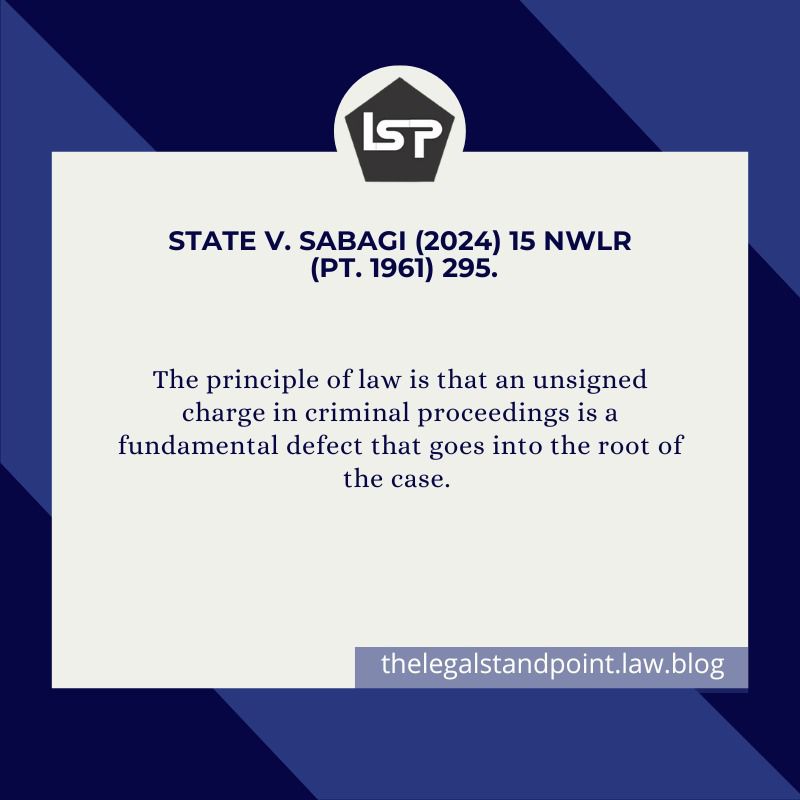
In this case, the Supreme Court observed that the charge, although drafted by officials of the state prosecution, lacked the signature of a legal practitioner. This failure to sign the charge rendered the process a nullity. Drawing from established case law, such as SLB Consortium Ltd. v. NNPC (2011) 9 NWLR (Pt. 1252)317 at 337, the Court emphasized that an unsigned charge is not a mere technicality but a serious defect that strips the trial court of jurisdiction. Without a properly signed charge, there can be no legitimate proceedings, and all actions based on it are null and void.
Additionally, in State v. Isijola (2023) 7 NWLR (Pt. 1884) 417 at 449, Garba, JSC, incisively proclaimed: “The law remains, though, generally, that a criminal charge which is not signed by the Hon. Attorney General or an authorized officer in his department would be fundamentally defective for the purpose of initiating criminal proceedings before the trial High Court by the cumulative effect of section 211(1)(a) and (2) of the Constitution, and sections 185(b) and 200 of the CPC, Niger State.”
The Supreme Court then turned its attention to the lower court’s decision to discharge and acquit the respondent. While the Court agreed with the lower court’s finding that the trial was an exercise in futility due to the invalid charge, it found the ultimate order—discharging and acquitting the respondent—was legally inappropriate. The Court explained that since the respondent had not been tried on the merits of the case, and the proceedings were based on a charge that was legally non-existent, the proper legal action would have been to strike out the case for lack of jurisdiction, rather than to discharge and acquit the respondent.
Despite acknowledging this error in the lower court’s judgment, the Supreme Court applied the principle of de minimis non curat lex—meaning “the law does not concern itself with trifles.” It held that while the discharge and acquittal order was technically incorrect, it did not significantly affect the outcome of the case. The Court thus chose to ignore this trivial error and proceeded to strike out the case due to the fundamental jurisdictional flaw in the proceedings.
In light of this, the Supreme Court concluded that the appellant’s appeal lacked merit. The error committed by the lower court, while acknowledged, did not alter the outcome. The Court therefore dismissed the appeal and affirmed the lower court’s judgment, which had set aside the trial court’s decision on the grounds of lack of jurisdiction. The judgment of the lower court, delivered on March 25, 2020, in Appeal No. CA/YL/137C/2018, was upheld, and the appeal was dismissed.

 THELEGALSTANDPOINT