
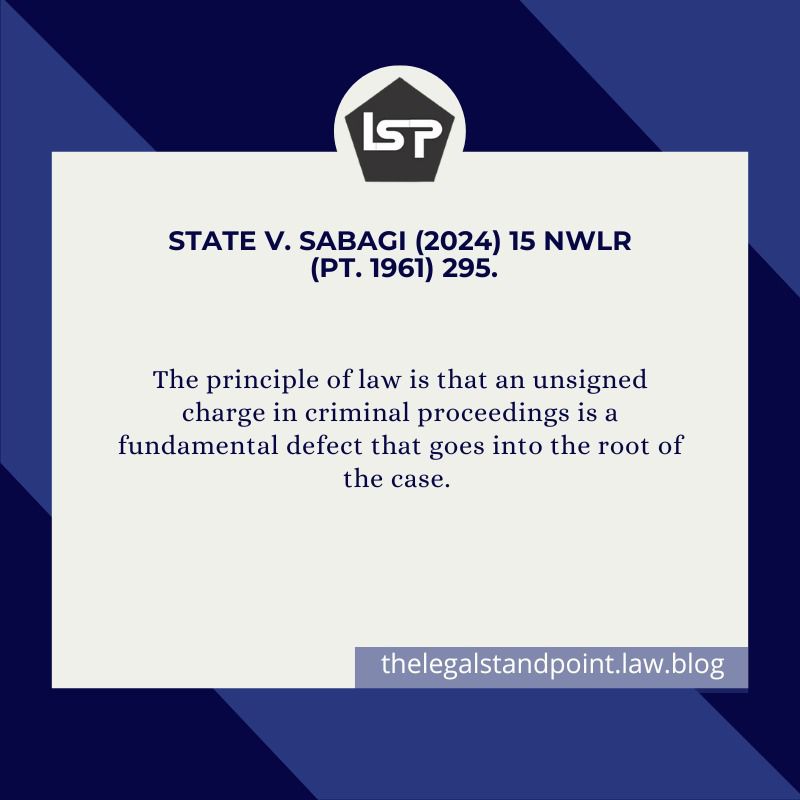
Good afternoon, amazing Readers. Today, we are addressing an important Supreme Court decision in the case of State v. Sabagi (2024) 15 NWLR (Pt. 1961) 295. This case addresses a crucial procedural issue regarding the validity of a charge in criminal trials and underscores how the absence of a signed charge can affect the jurisdiction of the trial court.
Moving on to the background of the case, the incident occurred on January 18, 2017, in Kadamum village, Adamawa State. While grazing cattle near a river, herders encountered an individual operating a generator. Alarmed by his presence, one of the herders, Mohammed Siddi, mistakenly believed the man intended to harm them. They quickly fled, but in the commotion, a 10-year-old boy named Adamu Bello was left behind and subsequently apprehended by the pursuers. After hearing Adamu’s cries followed by a gunshot, Mohammed notified his father, who then reported the incident to the police. At the scene, police discovered bloodstains, signs of dragging, and Adamu’s bloodied cap, though his body was never recovered.
Following this, five suspects, including the respondent (Tari Sabagi), were arrested and charged with crimes like criminal conspiracy, homicide, and causing the disappearance of evidence. They all pleaded not guilty. The trial court found them guilty and sentenced them to death and imprisonment. Dissatisfied with this ruling, the appellant appealed to the Supreme Court, arguing that the lower court’s decision to discharge and acquit the respondent due to an unsigned charge was incorrect. The main issue for determination in this case is whether the lower court erred in declaring the trial futile and acquitting the respondent due to a failure to initiate the case through a properly signed charge.
In criminal procedure, a Charge denotes a formal accusation of an offence as a preliminary step to prosecution. See Idi v. State (2019) 15 NWLR (Pt.1696) 448. In the southern region of Nigeria, it is called a “charge,” while in the northern region, it is referred to as “information.” The primary purpose of a charge is to give an accused person good, sufficient, and clear notice of the case against them. See Olatunbosun v. State (2013) 17 NWLR (Pt. 1382)167. It serves as the foundation for all other processes and proceedings in a criminal matter.
The appellant’s counsel argued that the lower court erred in law in discharging and acquitting the respondent. They asserted that the respondent failed to timely object to the charge, as required by law. The appellant further argued that the respondent was not misled by the defect in the charge and that there was no miscarriage of justice. They contended that the case should have been retried, referencing cases such as Ologunpese v. State (2018) LPELR-44135 (CA), Amadi v. F.R.N. (2008) 12 SC (Pt. II) 15, (2008) 18 NWLR (Pt.1119) 259. They emphasized that objections to formal defects in a charge must be raised immediately and urged the court to resolve the issue in their favor.
In response, the respondent contended that jurisdictional issues, particularly those involving a fundamental defect like an unsigned charge, could be raised at any stage of the proceedings. The Supreme Court, per Ogbuinya, JSC, opined that “Where the defect in a charge is so fundamental that it goes to the jurisdiction and competence of the court, the doctrine of waiver of right to objection vaporizes and takes to flight. Interestingly, the case of Ologunpese v. State (supra), upon which the appellant placed high premium on the point, recognizes this rider to the timely objection to a defect in a charge. The reasons for the exception are rooted in the wide belly of the case-law. An issue of jurisdiction, which is the blood, lifeline, and heartbeat of adjudication, can be raised at any stage of the proceeding, even for the first time in the Supreme Court. Indubitably, the parties cannot by waiver, consent, collusion, indolence, compromise, acquiescence, or estoppel, or any guise, vest jurisdiction on court where none exists or oust the court of jurisdiction which is bestowed on it.”
Futhermore, the Supreme Court emphasized the importance of a signed charge as essential in criminal proceedings. The appellant argued that the respondent had waived any objection to the defect in the charge by failing to raise it promptly when the charge was read. This assertion is based on the principle that a defect in a charge must be objected to at the earliest opportunity, particularly before the plea is entered. However, the Supreme Court noted that this principle does not apply when the defect is so fundamental that it affects the jurisdiction of the court to hear the case.
In this case, the Supreme Court observed that the charge, although drafted by officials of the state prosecution, lacked the signature of a legal practitioner. This failure to sign the charge rendered the process a nullity. Drawing from established case law, such as SLB Consortium Ltd. v. NNPC (2011) 9 NWLR (Pt. 1252)317 at 337, the Court emphasized that an unsigned charge is not a mere technicality but a serious defect that strips the trial court of jurisdiction. Without a properly signed charge, there can be no legitimate proceedings, and all actions based on it are null and void.
Additionally, in State v. Isijola (2023) 7 NWLR (Pt. 1884) 417 at 449, Garba, JSC, incisively proclaimed: “The law remains, though, generally, that a criminal charge which is not signed by the Hon. Attorney General or an authorized officer in his department would be fundamentally defective for the purpose of initiating criminal proceedings before the trial High Court by the cumulative effect of section 211(1)(a) and (2) of the Constitution, and sections 185(b) and 200 of the CPC, Niger State.”
The Supreme Court then turned its attention to the lower court’s decision to discharge and acquit the respondent. While the Court agreed with the lower court’s finding that the trial was an exercise in futility due to the invalid charge, it found the ultimate order—discharging and acquitting the respondent—was legally inappropriate. The Court explained that since the respondent had not been tried on the merits of the case, and the proceedings were based on a charge that was legally non-existent, the proper legal action would have been to strike out the case for lack of jurisdiction, rather than to discharge and acquit the respondent.
Despite acknowledging this error in the lower court’s judgment, the Supreme Court applied the principle of de minimis non curat lex—meaning “the law does not concern itself with trifles.” It held that while the discharge and acquittal order was technically incorrect, it did not significantly affect the outcome of the case. The Court thus chose to ignore this trivial error and proceeded to strike out the case due to the fundamental jurisdictional flaw in the proceedings.
In light of this, the Supreme Court concluded that the appellant’s appeal lacked merit. The error committed by the lower court, while acknowledged, did not alter the outcome. The Court therefore dismissed the appeal and affirmed the lower court’s judgment, which had set aside the trial court’s decision on the grounds of lack of jurisdiction. The judgment of the lower court, delivered on March 25, 2020, in Appeal No. CA/YL/137C/2018, was upheld, and the appeal was dismissed.
Thank you for reading. See you next week.
 THELEGALSTANDPOINT