
Hello, dear readers! How are you? For me, last week was a proud moment. I attended my convocation at the University of Ibadan, where I graduated with a First Class. It’s been an incredible journey, and I’m thankful for the support I’ve had along the way from my LSP Tribe.
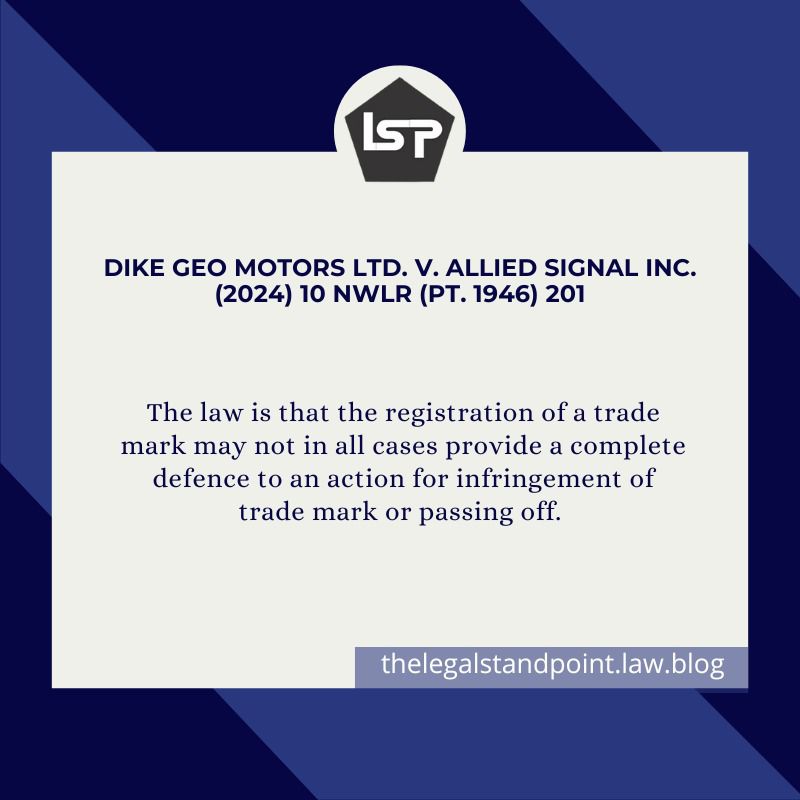
Today, we’ll be discussing an interesting case, Dike Geo Motors Ltd. v. Allied Signal Inc. (2024) 10 NWLR (Pt. 1946) 201. The question we’ll tackle is whether registering a trademark provides a complete defence in cases of infringement and passing off.
From basics, a trademark is a symbol, name, or design that distinguishes the goods or services of one company from those of another. It protects brand identity and assures consumers of the source of their purchases. Think of the Nike swoosh or the Coca-Cola logo – these trademarks are instantly recognizable and convey trust and quality. But what happens when someone uses a trademark in a way that confuses or misleads people? That’s where trademark law steps in.
In this case, Allied Signal Inc., an American company, owned several trademarks under which it sold brake and clutch fluids, including the names “Allied,” “Bendix and Device,” “DBA with Parallel Lines Design,” and “e5.” These products were manufactured by its French subsidiary and sold in Nigeria in distinctively designed black, red, and white cans. Over time, Nigerian customers began associating these designs with the respondents’ products.
On the other hand, Dike Geo Motors Ltd., a Nigerian company, later entered the market, selling brake and clutch fluids under the name “Allied.” The problem? The cans of Dike Geo Motors’ product looked remarkably similar to those of the respondents. Allied Signal Inc. argued that this imitation led to confusion, causing people to believe the Nigerian product was theirs or came from the same source.
Dike Geo Motors denied these claims, stating that they only sold the “Allied” products, which they sourced from Dom Frank Nigeria Limited, a separate company. They argued that Dom Frank owned the trademark “Allied and Device,” which had been registered in Nigeria under No. TP 188856. According to them, this registration meant their use of the trademark was lawful and could not infringe on the respondents’ rights.
Interestingly, the appellants registered the same “Allied and Device” trademark under No. 53200 in October 1996 after the respondents had already sued them for infringement and passing off. Two years into the trial, the appellants attempted to dismiss the case, arguing that their registration of the trademark made the respondents’ claims frivolous and an abuse of court process. The trial court rejected this argument, and both the Court of Appeal and Supreme Court upheld that decision.
At the supreme court, one of the issues for determination was whether the Court of Appeal considered the effect of the provisions of sections 3, 4, 5(1) & (2), 20, and 38 of the Trade Marks Act, Cap. 436, LFN 1990, on the viability of the respondents’ claims in their determination of the appeal.
The Supreme Court held that registering a trademark does not give the owner a blanket defence against claims of infringement or passing off. The law protects businesses and consumers from deception. Even if a company registers a trademark, it cannot use that mark to confuse or mislead people into believing their goods are those of another. The court further emphasized that the registration of the “Allied and Device” trademark by Dike Geo Motors after the suit began could not automatically invalidate the respondents’ claims.
Simply put, registering a trademark after a lawsuit starts cannot erase the actions that led to the lawsuit in the first place. The court also pointed out that honest concurrent use (a situation where two companies lawfully use similar trademarks) must be supported by solid evidence, such as proof of honest and independent sales. Dike Geo Motors failed to provide such evidence in this case.
In my view, the Supreme Court got it right. This decision reinforces the importance of fair competition and consumer protection. Businesses must not misuse the trademark system to justify deceptive practices. It also serves as a warning to companies that registering a trademark is not a shield if your actions mislead the public.
In conclusion, trademarks are powerful tools for building brand identity, but they come with responsibilities. They should be used to represent quality and trust, not to create confusion.
Thank you for reading❤️. See you next week🙏.

 THELEGALSTANDPOINT
✍️✍️✍️
LikeLike