
It’s another Thursday, and today we’ll discuss what the law says about excessive speeding. To do this, we’ll look at the case of Fan Milk Ltd. v. Edemeroh (2000) 9 NWLR (Pt. 672) 402, which highlights key legal principles on the issue.
In this case, the respondent, on behalf of his family, sued Fan Milk Ltd., the company that owned the vehicle involved in the fatal accident. On September 30, 1988, the appellant’s vehicle, a Fiat lorry driven by Alfred Edekhionta, collided with a bus carrying the respondent’s two sons, Festus and Edward Edemeroh, who tragically died in the accident.
The respondent claimed that the driver, an agent of Fan Milk Ltd., acted negligently and recklessly by driving on the wrong side of the road and at excessive speed. He relied on the doctrine of res ipsa loquitur, arguing that the circumstances of the accident spoke for themselves, showing negligence. The respondent sought compensation for various losses, including his sons’ educational expenses, medical costs, funeral expenses, and the loss of their future life and potential.
In defense, Fan Milk Ltd. denied negligence and pointed to the driver of the bus, Urban Bus No. LA 3519 AJ, as the one responsible for the accident. The appellant further argued that if the bus driver had been more cautious, the collision could have been avoided. After reviewing the evidence and arguments, the trial court ruled in favour of the respondent. Dissatisfied with the decision, Fan Milk Ltd. appealed to the Court of Appeal, questioning whether the respondent had proven the negligence of their driver, particularly since no witness testified to the specific manner in which the driver was driving at the time of the accident.
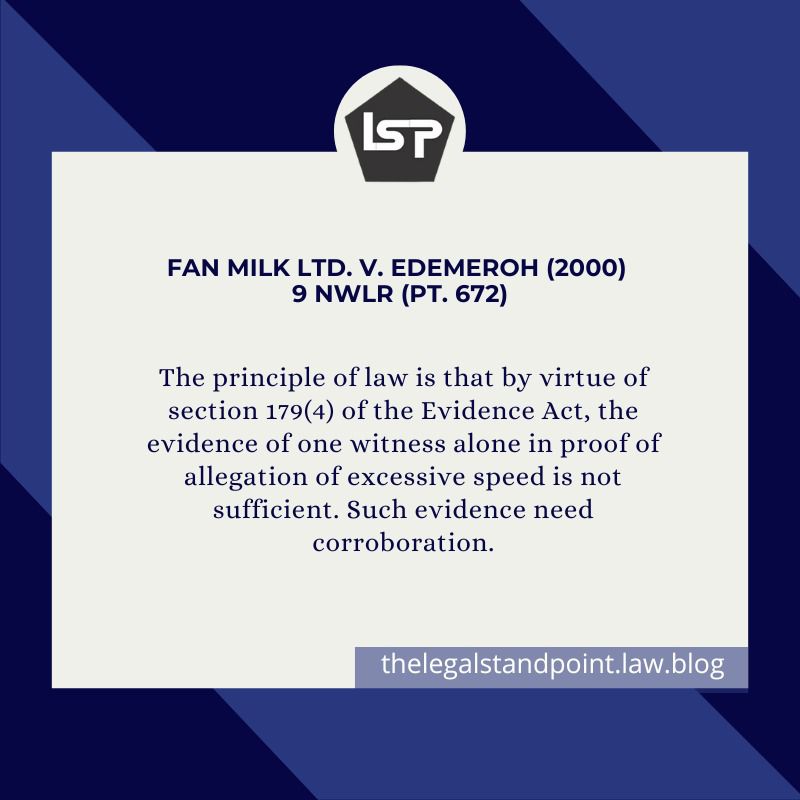
In this case, the issue of excessive speed was central to the respondent’s claim. However, by virtue of Section 179(4) of the Evidence Act, the evidence of a single witness alone is insufficient to prove allegations of excessive speed. Such evidence must be corroborated. The rationale behind this is that serious allegations like excessive speeding should be backed by reliable and sufficient evidence to prove their veracity. A similar principle was also held in Agbonavbare v. Ogbebor (2007) 8 NWLR (Pt. 1037) 605.
The evidence of P.W.6, Sergeant Effiong Emmanuel, the police officer who investigated the accident, was crucial. Sergeant Emmanuel testified that, had the driver of the appellant’s vehicle not died, he would have been charged with manslaughter and dangerous driving. He also introduced Exhibit “G”, a sketch he drew based on the scene of the accident.
Exhibit “G” played a pivotal role in corroborating the allegations of negligence. The sketch clearly showed that the two vehicles involved in the collision were positioned on the same side of the road, indicating a head-on crash on a section of the Ibadan/Lagos expressway, which was meant to be a single-lane road at that point. The absence of representatives from either party when the sketch was drawn did not undermine its credibility, as it was based on the physical positions of the vehicles at the scene. Thus, Exhibit “G,” along with the testimony of P.W.6, provided the necessary corroboration to substantiate the allegation of excessive speed and the negligent driving of the appellant’s vehicle.
Another key principle concerns the presumption of negligence when a driver is found on the wrong side of a dual carriageway. In general, a driver who operates a vehicle on the wrong side of the road and causes an accident is presumed negligent. The exception to this presumption arises only when there is a road diversion, forcing vehicles from the opposite direction to share one side of the road. In this case, the impact occurred on the side of the road where the respondent’s children had the right of way. Since the appellant’s driver was on the wrong side of the dual carriageway, the court held that the driver was primarily negligent.
Finally, there is the principle that places the burden of proof on the party alleging a road diversion in cases of accidents on dual carriageways. If a defendant claims that a road diversion was the cause of an accident, it is their responsibility to provide evidence of this diversion. As such, the appellant failed to present sufficient evidence to prove that a road diversion had occurred, and this further weakened their defense.
Moving on, a significant distinction in this case is that the accused driver had died. Had he been alive, he would have been charged under criminal law for causing death by dangerous driving. As held in Adeyemo v. State (2015) 16 NWLR (Pt. 1485) 311, the elements of the offense of causing death by dangerous driving include the recklessness or dangerousness of the driving, the causal link to the death, and the accident occurring on a Federal Highway. This principle was also discussed in Amusa v. State (2003) 4 NWLR (Pt. 811) 595 and Aruna v. State (1990) 6 NWLR (Pt. 155) 125.
Funnily enough, had the driver survived, he would have faced a criminal trial for manslaughter and dangerous driving. Nevertheless, nothing would have prevented the family of the deceased children from bringing a civil claim against Fan Milk Ltd. based on the doctrine of vicarious liability, holding the company responsible for the actions of its employee.
Omooo! What a year it has been. Thanks for staying with us all through. We go again next year.❤️
 THELEGALSTANDPOINT