
Law

LSP025: The Doctrine of Last Seen

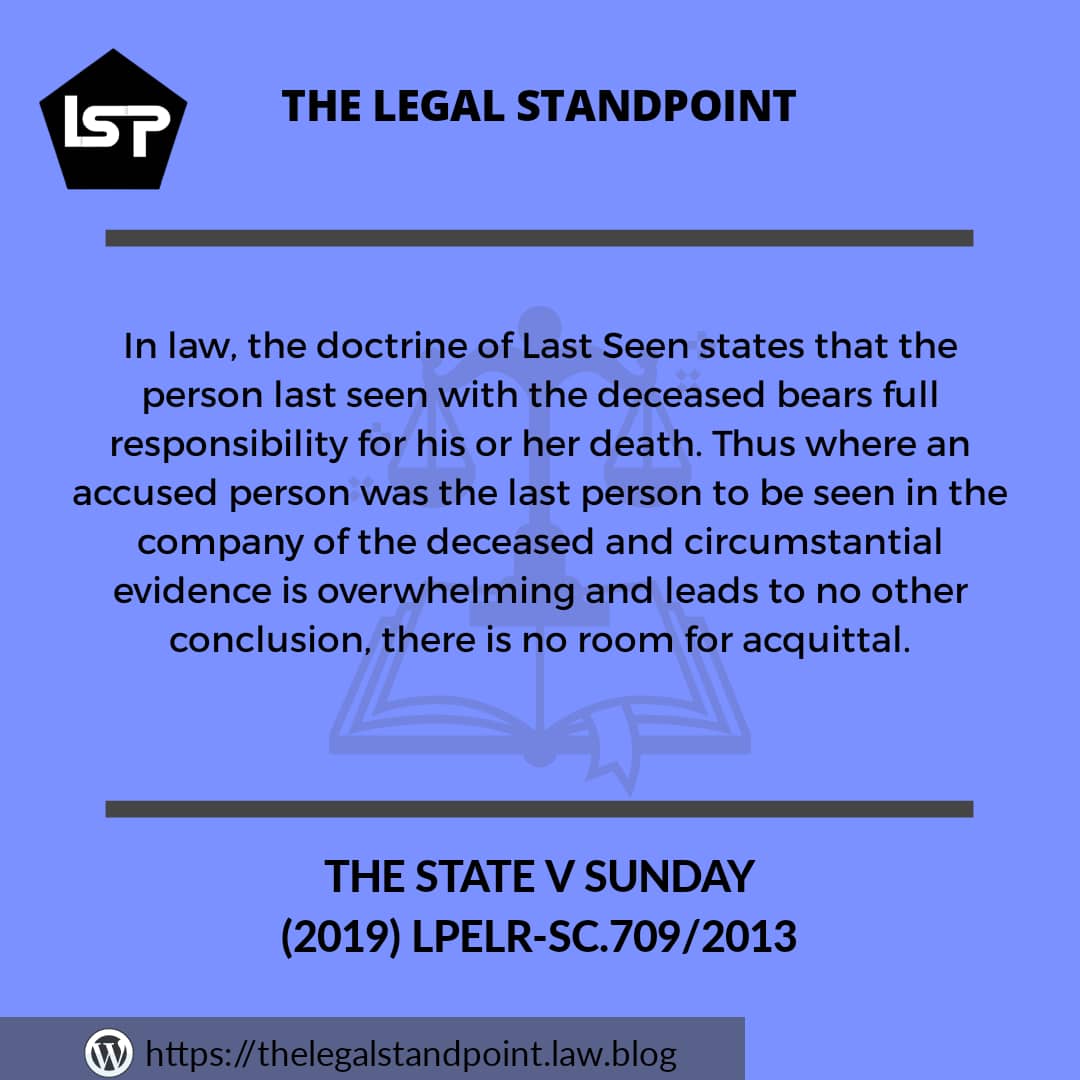
The Doctrine of Last Seen states that the person last seen with a deceased bears full responsibility for his or her death. For example, if Mrs. Katharina Rostova was last seen alive with or in the company of Mr. Raymond Reddington and the next thing that happened was the disappearance of Katharina, the irresistible inference is that she was or had been killed by Reddington.

This doctrine is one of the fundamental principles of the Nigerian Criminal Jurisprudence and it is mostly used in murder and manslaughter cases. By extension, this theory is not restricted to the Nigerian Criminal Jurisprudence alone. It is a principle of universal application. See the Indian case of Rajashkhanna v State of A.P. (2006) 10 SCC 172.

Although the Nigerian statutes and laws do not provide for this doctrine, it has, nevertheless, gained notoriety in the criminal jurisprudence through various judicial pronouncements.

Commenting on this doctrine, the Apex court per Adekeye, J.S.C, (as he then was) in Haruna v. AG of Federation (2012) LPELR-SC.72/2010,(Pp. 30-31, paras. F-B) held that: “The doctrine of “last seen” means that the law presumes that the person last seen with a deceased bears full responsibility for his death. Thus where an accused person was the last person to be seen in the company of the deceased and circumstantial evidence is overwhelming and leads to no other conclusion, there is no room for acquittal. It is the duty of the appellant to give an explanation relating to how the deceased met her death in such circumstance. In the absence of a satisfactory explanation, a trial court and an appellate court will be justified in drawing the inference that the accused person killed the deceased.

The Doctrine of Last Seen thrives on presumption and like every presumption in law, it is rebuttable. Generally, the trite principle of law is that the burden of proof is always on the prosecution to prove the guilt of the accused person beyond reasonable doubt through credible and reliable evidence in proof of the case against the accused person. See Section 135 of the Evidence Act 2011. However, under the Doctrine of Last Seen, this general principle changes, and the burden of proof thus shifts from the prosecution to the accused to adduce credible evidence to show that he or she was not the one who killed the deceased.

In the case of Madu v. State (2012) LPELR-SC.12/2009, the court held: “If it turns out that the person last seen with the deceased is dead, the doctrine, therefore, lays a burden on the accused to give an explanation on how the deceased met his or her death.”

It is pertinent to state that in determining the guilt or otherwise of the accused, attention is heavily placed on the time gap by the Courts. if the time when the accused and the deceased were last seen alive and the deceased is found dead is so infinitesimal that the possibility of any person other than the accused coming in contact with the deceased becomes impossible, the doctrine may likely be applied. However, it would be difficult in some cases to successfully establish that the deceased was last seen with the accused when there is a long gap and existence of the possibility of other persons coming in between.

Furthermore, this doctrine is not meant to be applied in isolation. In addition to it, there must also be overwhelming circumstantial evidence pointing to the guilt of the accused. Circumstantial evidence in criminal law is the proof of circumstances from which according to the ordinary course of human affairs, the existence of some fact may reasonably be presumed.

Owing to this, the principle was not applicable in the 2019 recent case of State v. Sunday (2019) LPELR-SC.709/2013 involving the alleged murder of a father by his son while it was applicable in Anyasodor v. State (2018) LPELR-SC.655/2015 involving the death of a man through his estranged lover. Hence, the applicability depends on the facts of each case and the circumstantial evidence. The rationale behind this is to avert the miscarriage of justice.

Thank you for reading. See you next week.
Law

LSP024: The Language of the Superior Courts of Records in Nigeria

One of the indisputable facts is that Nigeria is a multilingual country. With over Two Hundred and Fifty Languages (250) across the nation, the Giant of Africa conspicuously ticks the first requirement of a multilingual speech community.

Despite the plethora of these languages, the official language of the country is English. The English language is at the apogee stage of importance. It occupies a marquee function due to its constant usage as a medium of expression in Education, Administration, Workplace, Media, Judiciary, etc.

The superior Courts in Nigeria also use English Language as a medium of expression. This principle has received judicial approvals in cases such as Madu v. State (1997) 1 NWLR (pt. 482) pg 403 para B, Ogunye v. The State (1999) LPELR-SC.47/1997, etc.

In Babarinde & Ors. v. The State (2012) LPELR-CA/IL/C.18/2010, the Court held that it is a cold fact that Yoruba vernacular has never been the official language in the Nigerian courts. As such, Africa Magic Yoruba conducting Court proceedings using the Yoruba language is, in law, wrong. ‘Lori iro‘.

However, does that mean that all Courts in Nigeria employ the English Language as a medium of proceeding? No. This principle only applies to the Court of Superior Records. These courts are The Supreme Court, The Court of Appeal, The Federal High Court, Sharia Court of Appeal Abuja, The Federal High Court Abuja, The Customary Court of Appeal Abuja, The State High Court, The Sharia Court of a State, The Customary Court of a State.

Hence, any local language can be used as a medium of expression in Areas and Customary Courts. See Onyia v. The State (2008) LPELR-SC 232/2006 (P.28, Paras F-G).

AN INTERPRETER
It is possible that a party to a proceeding does not understand the English language. The law already envisages this situation and makes a provision for the Right of such a person to an Interpreter. This is enshrined in Section 36(6)(E), Constitution of the Federal Republic of Nigeria, 1999 (as amended).

The Court held in Akeem v. The State (2017) LPELR-SC.589/2014, that The law is trite that where an accused person does not understand the English language which is normally, the language of the Court, it is his responsibility to tell the Court, at the earliest opportunity, that he did not understand the English language which is the language of the Court or ask his lawyer (if any) to inform the Court of that challenge.

EVIDENCE TENDERED IN OTHER LANGUAGES
In Damina v. The State (1995) 9 SCNJ 254, it was held that a court of law is presumed to be an illiterate in any document written in any Nigerian local language as it cannot comprehend its content no matter the dexterity of the Judex in that language.

Ergo, any document sought to be relied upon by a party which otherwise is not written in the English Language must be translated by the party seeking to rely upon it in evidence into the English Language. It is entirely the responsibility of the party that intends to rely on such documents to translate that document from that language to the language of the Court. The Court cannot call for its translation or interpretation suo motu (on its own) as to do that will amount to making a case for the appellant which is not the duty of the court. See the case of Ojengbede v Esan (2001) 18 Part 746 Page 771 at 790 para A-B.

Thank you for reading. See you next week.
Law

LSP023: Liability for Keepers of Animals

Animals are all around us. Some are for commercial purposes; some are reared, while some are kept either for entertainment or study purposes. Over the years, numerous stories have inundated the media about people who were attacked or injured by animals.

On few unfortunate occasions, the attacked persons also doubled as the narrators.Just like cars, buildings, inventions, etc, animals are also properties belonging to certain people.

Since they are properties, the law may hold the owner answerable to actions caused by them. Generally, one of the classifications of animals by type is Wild and Domestic Animals.

The law of Torts classified the former as Animals Ferae Naturae and the latter as Animals Mansuetae Naturae. Animals Ferae Naturae

The position of law is that individuals that keep naturally dangerous animals, for example, Lion, Tiger, Liger, etc as exotic pets, are strictly liable for any harm it may cause and it is immaterial whether such a pet had not attacked anyone in the past or done any damage.

Thus, the keeper of a wild animal keeps it at his own detriment. In the case of Behrens v Bertram Mills Circus Ltd 2 QB 1 (1957), Bertram Mills Circus Ltd. (Defendant) granted Whitehead (Plaintiff’s manager) a license to have Mrs. J. H. W. Behrens (Plaintiff) and her husband work at Defendant’s circus. Defendant forbade the presence of dogs. Plaintiff’s husband ignored the prohibition and brought his dog to the circus. The dog barked at one of Defendant’s trained elephants, which began to chase the dog. Consequently, the elephant injured Plaintiff and damaged her booth. The plaintiff brought a suit and the court ruled in his favour.

Animals Mansuetae Naturae
In Nigeria, the common domestic animals we find around are Cats, Goats, and most especially Dogs. In fact, dogs are generally regarded as man’s best friend.

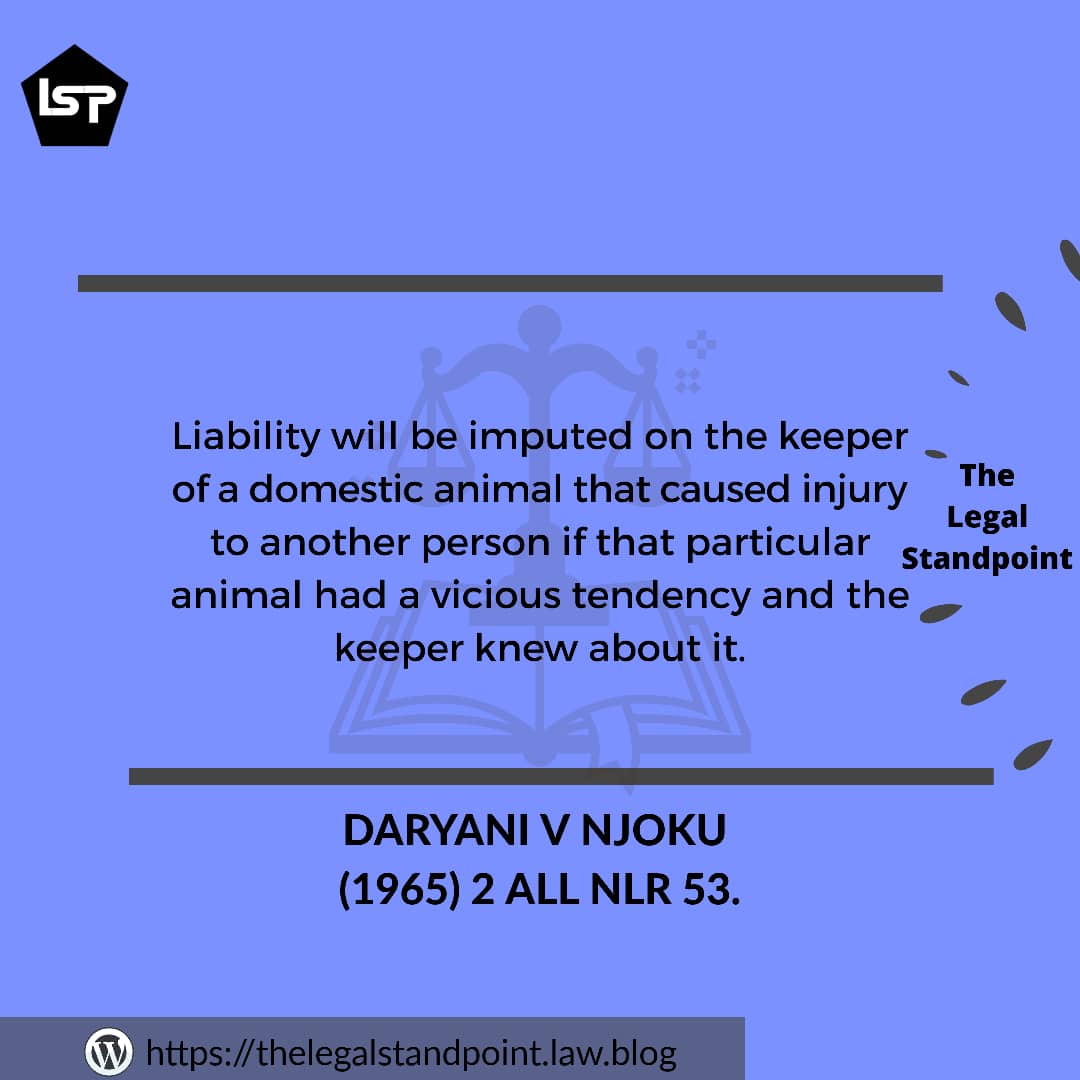
Generally, these animals are normally tame and they do not cause injuries. But happen if they do? The position of the law is that liability will only arise if:

(a) The particular animal had a vicious tendency; and

(b) The keeper knew of that tendency. In the Nigerian case of Daryani v Nwoku (1965) 2 ALL NLR 53, the plaintiff was attacked and injured by the defendant’s dog. Evidence was given that the dog had on a previous occasion attacked a housemaid and the incident was reported to the wife of the defendant. Since the knowledge of the vicious tendency of the dog was known by the wife, the Court held the defendant to be liable because she should have told her husband.

However, the position of the court in this aforementioned case would have been different had it been the dog in this particular case had it the past attacked other animals and not humans.

As established in Glanville v Sutton (1928) 1 K.B. 5.7.1, it was held that because a horse bit other horses in the past was insufficient to show a vicious tendency when a person was bitten.

Defences

Just like every law, there are always exceptions. One of the exceptions to this rule is when the plaintiff is at fault. This occurs when the plaintiff, at the time he was injured, was trespassing on the defendant’s land. See the case of Sarch v Blackburn 1830 172 ER.

Another noticeable defence is violenti non fit injuria, which means that if someone willingly places himself in a position where harm might result, knowing that some degree of harm might result, he will not be able to bring a claim against the other party. This defence applies where persons whose employment is to deal with dangerous animals such as zookeepers and animal trainers and they injured in the cause of their work. They won’t be able to bring a claim because of the violenti non fit injuria principle.

It is the 23rd post. Alexa play me Burna Boy’s 23.Thank you for reading. See you next week.