
Good day, readers. Today, we’ll explore the concept of novation, which occurs when a new contract replaces an existing one, either by introducing new parties or altering the terms. This process discharges the old obligation and establishes a new, legally binding one. To prove novation, you need to show four key elements: a previous valid obligation, agreement from all parties to the new contract, extinguishment of the old obligation, and validity of the new obligation N.N.P.C. v. Klifco (Nig.) Ltd. (2011) 10 NWLR (Pt.1255) 209.
To illustrate the principle, we have examined the 2024 supreme court case of Heritage Bank Limited & Anor v. Ajugwo. (2024) 12 NWLR 473
In this case, the 1st appellant (formerly African Continental Bank) had a customer, Jerome Ajugwo (the respondent’s father), who acted as a guarantor for a loan of N10,000 given to S.B.C. Maduakolam, another customer of the bank. Ajugwo used his property as collateral for the loan. However, the borrower, Maduakolam, failed to repay the loan and later relocated to another town. He also took another loan from the bank’s Owerri branch, and his accounts were merged.
Upon realizing the complication, Ajugwo requested that the merged accounts be separated so he could repay the loan linked to his property and redeem it. The bank agreed to this under certain terms, and Ajugwo accepted. Afterward, he promptly repaid the loan as agreed. Despite this, the bank went ahead and sold Ajugwo’s property to a third party (the 2nd respondent), ignoring Ajugwo’s fulfillment of the repayment terms. This led to a lawsuit, which was later consolidated with a separate claim by the 2nd respondent( Sydney Obi), who purchased the property.
For ease of comprehension, the exhibits are:
• Exhibit J: Original deed of legal mortgage between Spring Bank Plc, S.B.C. Maduakolam, and Jerome Ajugwo.
• Exhibit C: Letter agreeing to separate Maduakolam’s accounts and waive interest on the loan.
• Exhibit D: Ajugwo’s acceptance of the new repayment terms.
• Exhibit E: Request for payment details under the new repayment plan.
• Exhibit F: Ajugwo’s response detailing his payments.
• Exhibit H: Letter requesting reconsideration of the property sale due to Ajugwo’s compliance with repayment terms.
The appellants didn’t go down without a fight. They brought up two contentions. First , they argued that there was no novation since S.B.C. Maduakolam was not a party to the subsequent agreements (Exhibits C, D, E, and F). This highlights the technicality the appellants relied on. Secondly, the appellant argued that the respondent’s father was not a guarantor but rather an equal partner in the block-making business with S.B.C. Maduakolam. This argument aimed to deny that there could have been a novation since the respondent’s father had equal responsibility and could not be treated as merely a party trying to protect his mortgaged property.
Deciding this matter, the trial court found that the bank had effectively replaced the original mortgage contract with a new agreement based on the repayment terms agreed between Ajugwo and the bank. As a result, the sale of the property was declared void, and the court ordered that the property title documents be returned to Ajugwo’s family.
On appeal, the Court of Appeal upheld the trial court’s decision, affirming that a Novation had taken place, where the original mortgage agreement was replaced by the new repayment terms. The appellants challenged this at the Supreme Court .
The Supreme Court found no merit in the appellants’ argument that novation could not have taken place because Maduakolam was not a party to the new agreements. As explained by Kekere-Ekun JSC (now CJN), the original mortgage agreement (item 2 of the exhibit J) allowed either the borrower or the mortgagor to repay the debt. Since the respondent’s father had fulfilled the repayment terms, the property should have been returned to him. The appellants could not exercise their rights under the original mortgage agreement (Exhibit J) because it had been replaced by the new terms in Exhibit C.
In conclusion, this case illustrates how novation can modify contractual obligations and the importance of adhering to agreed terms. Thank you for reading ❤️. See you next week🙏
Author: Kiki
LSP154: Doctrine of Recent Possession

Hello dear readers. Today, we are going to talk about the Doctrine of Recent Possession in law, a concept often used in criminal cases that involve stolen property. The idea behind this doctrine is pretty straightforward: if someone is found with stolen goods not long after they were stolen and can’t give a good reason for why they have them, the law assumes they were involved in the theft or were aware that the goods were stolen.
To successfully utilize this doctrine, four elements need to be in place: first, it must be proven that the goods were indeed stolen; second, the accused person must have been caught with the goods; third, they must have been caught shortly after the goods were stolen; and lastly, the accused can’t provide a reasonable explanation for why they had the stolen property. This doctrine is captured under Section 167(a) of the Evidence Act, 2011. It has been consistently applied and refined through various judicial interpretations. Let’s now explore how it has played out in some notable judgments
In Asuquo v. State of Lagos (2024) LPELR-62817(CA), the prosecution claimed that Asuquo was part of a group of young men who robbed a house in the early hours of the morning. A few hours later, Asuquo was found in possession of two laptops that had been stolen during the robbery. The prosecution tried to use the Doctrine of Recent Possession, arguing that Asuquo must have been one of the robbers. However, Asuquo explained that he found the laptops on the street while on his way to work and planned to turn them over to the police. His defense of alibi – that he wasn’t even near the scene of the crime – was not investigated by the police. Because of this, the Court of Appeal found his explanation reasonable and the doctrine wasn’t successfully applied. Asuquo was discharged and acquitted
On the other hand, in Yisa v State(2019) LPELR-47474(CA), the doctrine was applied successfully. In this case, the appellant was caught driving a car that had been stolen in a robbery just five hours earlier. The proximity of time between the robbery and the appellant’s possession of the stolen car left little room for doubt, and the court applied the Doctrine of Recent Possession, presuming the appellant to be either one of the robbers or someone who knowingly received stolen goods. The appellant failed to provide a satisfactory explanation for his possession, and the presumption stood, leading to his conviction
However, this doctrine isn’t absolute. In Ogogovie v. State (2016) LPELR-40501(SC), for example, the Supreme Court made it clear that if someone can give a reasonable and believable explanation for how they came to possess stolen property, the presumption doesn’t apply. In other words, just because someone has stolen goods doesn’t automatically mean they are guilty, especially if they can explain their possession in a way that makes sense.
In conclusion, the Doctrine of Recent Possession can be a powerful tool in criminal law when there’s no other explanation for why someone has stolen goods. But it’s also important to remember that it’s not foolproof. If the person can explain how they got the goods, like in Asuquo’s case, the doctrine won’t work against them. On the flip side, as seen in Yisa’s case, when no explanation is provided, the presumption of guilt is strong enough to secure a conviction.
Thank you for reading ❤️. See you next week🙏
LSP153: Provisional Status of JAMB Admission Offer
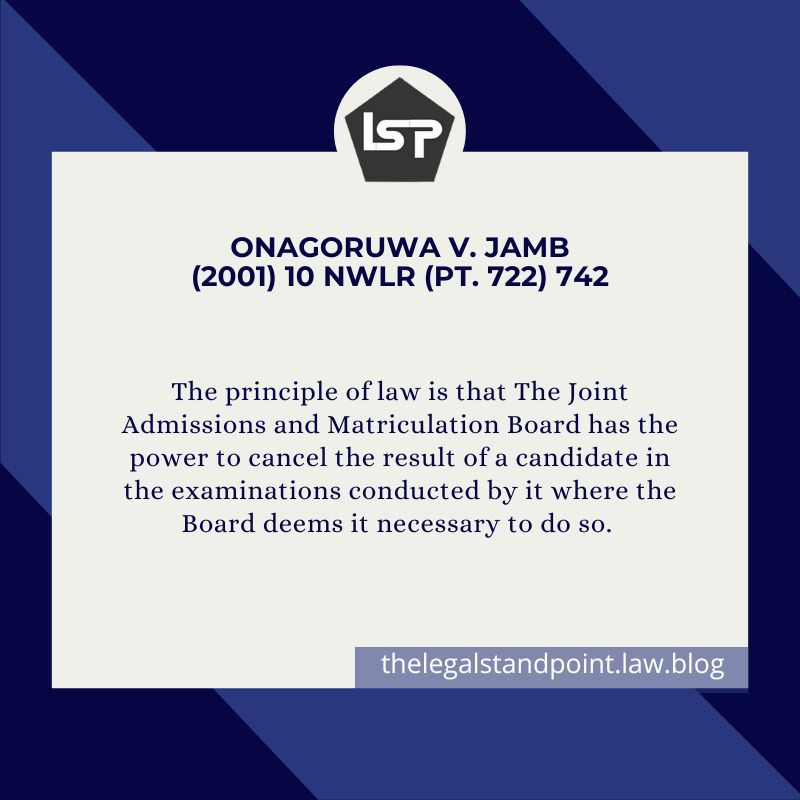
Hello, dear readers. This week, we’ll be discussing the status of provisional admission offered by the Joint Admissions and Matriculation Board (JAMB).
In Onagoruwa v JAMB (2001) 10 NWLR (Pt. 722), the appellant sat for the 1993/94 JAMB examination and ‘successfully’ passed. As a result, he received a letter of provisional admission to pursue a first-degree program in Electrical Engineering at the University of Ilorin. He accepted the offer, registered, and began his studies. However, the situation took an unexpected turn when JAMB informed the University that it had cancelled the appellant’s exam results and urged the institution to withdraw Onagoruwa’s admission.
Feeling aggrieved, the appellant took legal action against JAMB at the Federal High Court, seeking declaratory reliefs, an injunction to continue his studies, and N5 million in damages. Initially, the court granted an interlocutory injunction that allowed him to continue his studies while the case was being decided. However, JAMB defended its actions by explaining that after the initial release of the examination results, they conducted a post-exam review of 401,791 candidates. Among these, 1,706 candidates, including the appellant, were found to have discrepancies in their marks, leading to the cancellation of their results and subsequent withdrawal of their provisional admissions.
Further complicating the case, it was noted that the appellant did not contest the defense’s claim that his original score was inaccurate. During cross-examination, evidence was presented showing that the score indicated on his notification of results as 214 was incorrect and that his actual score was 112. This lower score was not enough to secure him admission on merit.
Since the principle of law, as held in Pascutto v Adecentro (Nig.) Limited (1997) 11 NWLR (Pt.529) 467 is that where evidence given by a party to any proceedings was not challenged by the other party who had opportunity to do so, it is open to the court seized of the matter to act on such unchallenged evidence before it, and owing to that fact that the appellant did not challenge this evidence, the court acted on it.
In addition, the trial court, after considering the evidence, dismissed the appellant’s claims entirely. Dissatisfied with the outcome, the appellant took the matter to the Court of Appeal. One of the issues for determinations during the appeal was the nature of a valid contract. For a contract to be binding, there must be a mutual understanding and agreement between the parties involved. In this case, JAMB argued that the post-examination review revealed that the appellant did not meet the minimum entry requirements for admission. Therefore, there was no valid contract between him and the University since the conditions for a final admission were not fulfilled.
Furthermore, Section 5 of Joint Admissions and Matriculation Board Act empowers the authority to regulate admissions into Nigerian tertiary institutions, including the power to cancel results. While JAMB can cancel a candidate’s results, this power must be exercised fairly and justly, without any form of arbitrariness. The court examined whether JAMB had acted within its rights and found that the cancellation of the appellant’s results was within their legal authority
A significant aspect of this case centered around the meaning of “provisional” in the context of the admission letter issued by JAMB. The term “provisional” is defined as something temporary, preliminary, or tentative. In legal terms, it implies that the offer of admission is not final and may be withdrawn if certain conditions are not met. In the appellant’s case, the court held that since the admission was provisional, JAMB was within its rights to rescind it upon discovering the discrepancies in his examination results.
Finally, the court addressed the duty of a party seeking declaratory relief. It emphasized that the burden is on the claimant to present evidence proving their entitlement to such relief. In this instance, the appellant failed to provide evidence to support his claim that he was not involved in any examination malpractice, leading the court to deny the declaratory relief he sought.
Moving on, I think while the court’s decision that the appellant should prove that he did not engage in exam malpractice is legally sound, practically achieving this is incredibly challenging. How would one gather evidence to prove that especially in such a scenario? Would the appellant have to call his exam seatmates as witnesses or request CCTV footage? Even then, JAMB controls such footage, and what happens in rural centers where CCTV wasn’t used? These practical hurdles make discharging the burden of proof an onerous task. In the Onagoruwa’s case, it seems the appellant lost because he may have indeed been involved in exam malpractice. Otherwise, why didn’t he challenge the evidence against him? The lack of a challenge raises questions and implies that the appellant might not have been entirely innocent.
In conclusion, Onagoruwa’s case underscores the temporary nature of provisional admissions and the significant power JAMB holds in ensuring that only candidates who meet all criteria are granted final admission into Nigerian universities
 THELEGALSTANDPOINT