Law

LSP152: Proof of Adultery under Islamic Law and the Marriage Act

Good afternoon, amazing readers. This week, we will be exploring the topic of proof of adultery under two distinct legal systems: the Marriage Act and Islamic Law. Our discussion will center around how adultery is defined, the standards of proof required, and the consequences under these systems, with particular emphasis on the cases of Alabi v. Alabi (2007) 9 NWLR (Pt. 1039) 297 and Rungumawa v. Rungumawa (2002) 1 NWLR (pt 747).

In Alabi v. Alabi, the appellant married the respondent on January 3, 1999. By 2002, the appellant sought a divorce, citing the respondent’s behaviour as intolerable and the marriage has irretrievably broken down. He also sought custody of their only child. The respondent countered with allegations of adultery, claiming the appellant had been involved with one Aramide Babatunde even before their marriage. This relationship allegedly resulted in the birth of two children, one conceived before the marriage and the other after. The respondent further described the appellant as a man of unstable character, with a disregard for their marriage and an insatiable appetite for women. After the appellant drove the respondent away in June 2002, she filed a cross-petition seeking dissolution of the marriage, damages for adultery, custody of their child, and monthly maintenance.

In Rungumawa v. Rungumawa, the appellant sought to dissolve her six-year marriage under Islamic law, citing her husband’s failure to pray, neglect to provide for her, and false accusations of adultery that led to her arrest and detention. The respondent denied the allegations but admitted to reporting the supposed adultery to the police. During the trial, the respondent was unable to provide witnesses to substantiate his claims. The Sharia Court dissolved the marriage and reprimanded the respondent for his unfounded accusations. Dissatisfied, the respondent appealed, leading to a series of appeals that ultimately upheld the dissolution of the marriage.

On definition, adultery is a consensual sexual intercourse between two persons of opposite sexes, where at least one of the parties is married to someone else. The act must occur after the marriage has been celebrated. When proving adultery, the burden lies on the party making the allegation to establish it to the court’s reasonable satisfaction. The standard of proof in adultery cases is on the preponderance of evidence, usually a little bit higher than that of civil cases. This principle was upheld in cases such as Ikpi v. Ikpi (1957) WRNLR 59, where the court emphasised that the evidence must be compelling but not to the level required in criminal matters.

To establish adultery,  circumstantial evidence often plays a crucial role since direct evidence is rare. Circumstantial evidence can include situations where the parties were alone in compromising circumstances, the contraction of a venereal disease, visits to a brothel, or confessions and admissions, though the latter must be treated cautiously. In Alabi v. Alabi, the birth of two children by Aramide Babatunde, one conceived before and one after the marriage, was sufficient evidence of adultery.

When assessing damages for adultery, the court considers the harm done to the petitioner’s honor, family life, and emotional well-being, rather than merely compensating for the petitioner’s loss. In Alabi v. Alabi, the court highlighted the severe impact on the respondent’s honor and family life, noting that the damages awarded were conservative given the circumstances.

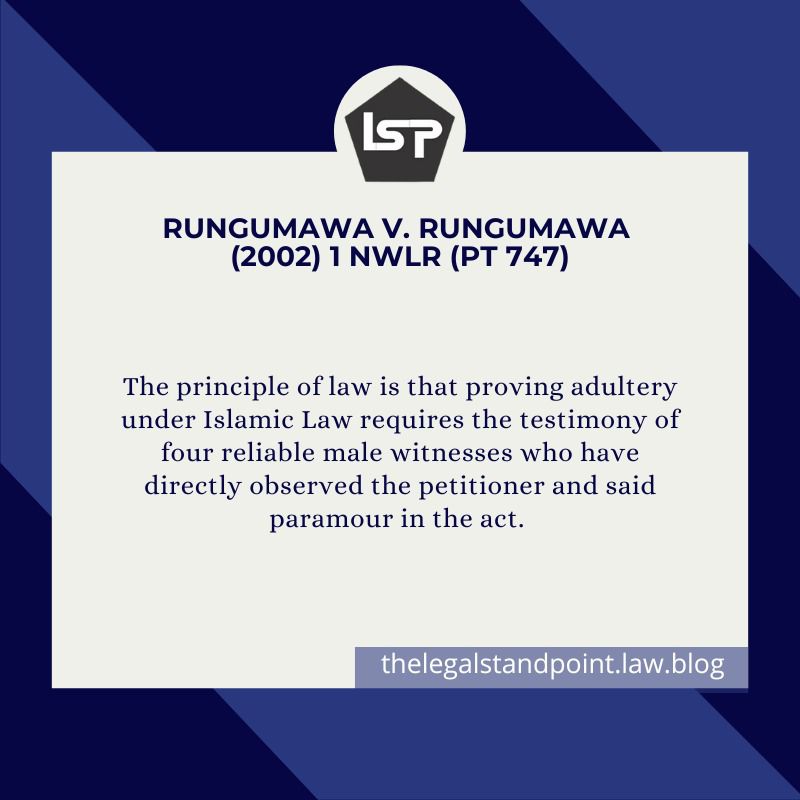
In contrast, under Islamic law, proving adultery (Zina) requires the testimonies of four unimpeachable male Muslim witnesses who have seen the act. Now it gets serious in the sense that if even one witness provides a different version, the accused will be acquitted, and the other witnesses will be punished severely for giving false testimony. This high standard of proof underscores the gravity of such accusations in Islamic law. Moreover, in cases of “Lia’n,” where a husband will swear that he saw his wife making love with another man directly,  the husband must take a special oath five times before the court or a large gathering. Had he declined to take that multiple oath the punishment of Qazf, defamation, must be meted out on him. That is eighty lashes of cain.

In Tukurwa v. Kwa-Kwa (1992) 2 NWLR (Pt. 224) 449, the court reiterated that while adultery or fornication requires the testimony of four male witnesses under Islamic law, other cases can be proven with the testimony of at least two credible witnesses.

In conclusion, proving adultery under the Marriage Act and Islamic Law highlights the different approaches each system takes. While the Marriage Act relies on a preponderance of evidence and often circumstantial evidence, Islamic Law imposes a much stricter burden of proof, requiring the testimony of four unimpeachable male witnesses or the invocation of Lian.

Thank you for reading. See you next week.
Law

LSP151: Is NYSC Compulsory?

Good afternoon, Readers. Our discussion today is divided into two parts. First, we will explore whether NYSC service is compulsory for eligible graduates. Second, we will examine whether a serving corps member can participate in partisan politics. To better understand these issues, the case of Modibbo v. Usman (2020) 3 NWLR (Pt. 1712) 470 is relied upon. This issue is particularly relevant to many young Nigerians who are navigating their obligations under the NYSC scheme while considering their political ambitions.

On the first issue, the National Youth Service Corps (NYSC) scheme is compulsory for all eligible Nigerian graduates. According to Section 2(3) of the National Youth Service Act, any person called upon to serve in the NYSC must do so for a continuous period of one year from the date of their call-up. Failure to report for service or refusal to make oneself available for the entire service year is considered an offense under Section 13(1) of the Act. The penalties for such an offense include a fine of N2,000 or imprisonment for a term of twelve months, or both.

Furthermore, Section 13(3) of the Act makes it an offense for any person to cause, aid, or abet another to contravene the provisions of the Act. This section specifically targets employers or organizations that might attempt to lure individuals away from fulfilling their mandatory service. The penalty for such an offense is a fine of N5,000 or imprisonment for a term of three years, or both. The law is clear that disobedience to the NYSC Act is not merely a matter of indiscipline but constitutes a criminal act.

The case of Modibbo v Usman revolves around a political dispute in the lead-up to the 2019 general elections. Both the appellant, Modibbo, and the respondent, Usman, were aspirants seeking to be the All Progressives Congress (APC) candidate for the House of Representatives seat representing Yola North/Yola South/Girei Federal Constituency of Adamawa State. On October 7, 2018, the APC conducted its primary election, in which Modibbo emerged victorious with 293 votes, while Usman, the respondent, secured 124 votes. Despite acknowledging his loss, Usman initiated legal action on November 5, 2018, challenging Modibbo’s eligibility to contest the primary election.

Usman claimed that Modibbo, at the time of the primary election, was still a serving corps member under the NYSC scheme. He argued that Modibbo’s participation in the primary election violated the NYSC Act and its Bye-Laws, which prohibit corps members from engaging in partisan politics. Usman also alleged that Modibbo provided false information about his age and educational qualifications in the forms submitted to the Independent National Electoral Commission (INEC).

The court considered the core issue: whether a serving corps member could lawfully engage in partisan politics. According to Section 4 of the NYSC Act Bye-Law (Revised 2011), every member of the NYSC is expressly prohibited from participating in partisan politics. The law defines partisanship as any action that favours one political group or party over another, which includes active involvement in political contests.

The court emphasized that the rationale behind this prohibition is to prevent corruption and political thuggery, particularly among young people serving the nation under the NYSC scheme. The court noted that being a member of the NYSC is a public office, and the responsibilities associated with it are incompatible with holding a political position. This is because public officers, including corps members, are expected to maintain political neutrality during their service.

In Modibbo’s case, the court found that his participation in the primary election while still a serving corps member was a clear violation of the NYSC Act and Bye-Laws. It further held that the essence of the law is not merely to impose penalties but to prevent corps members from engaging in partisan political activities altogether. The court highlighted that a lawbreaker, such as someone violating the NYSC regulations, should not be allowed to become a lawmaker.

The court also addressed whether a person could benefit from their own illegality. It was established that no one is permitted to benefit from their own wrongdoing. Modibbo had concealed material facts in his INEC Forms CF001 and CF002, fraudulently stating that his Senior Secondary Certificate was his highest qualification, despite being a graduate with a B.Sc. in Public Administration. This deliberate falsehood was intended to deceive both the APC and INEC. The court found that Modibbo’s actions constituted a serious breach of legal and ethical standards. As established in cases such as Brosette Manufacturing Nig. Ltd. v. Ola Ilemobola Ltd. (2007) All FWLR (Pt. 379) 1346 and B.Manfag (Nig.) Ltd. v. M/S. O.I. Ltd. (2007) 14 NWLR (Pt. 1053) 109, such acts of deception invalidate any claims to benefit from the resultant positions or opportunities.

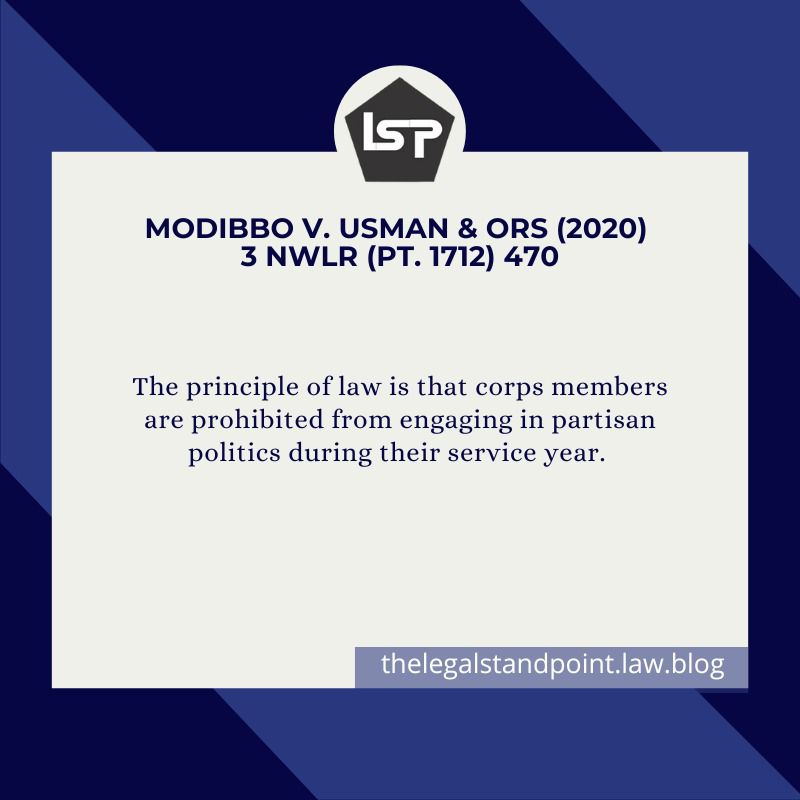
In conclusion, the principle of law is that NYSC service is compulsory for eligible graduates, and during this period, any engagement in partisan politics is strictly prohibited.

Thank you for reading❤️. See you next week🙏

Law

LSP150: AG Prosecutorial Power and obtaining Leave of court

In Nigeria, the role of the Attorney-General (AG) is fundamental in ensuring the proper administration of justice, particularly in criminal proceedings. A critical issue that often arises is whether the AG of a state needs to seek the leave of the court before initiating criminal charges. This question was addressed in the case of State v. Egigia [2024] 11 NWLR 1949 which offers valuable insights into the scope of the AG’s prosecutorial powers and the necessity of obtaining leave before filing charges.

The Attorney-General, as the Chief Law Officer of a state, is constitutionally empowered under Section 211 of the Constitution of the Federal Republic of Nigeria, 1999 (as amended), to institute and undertake criminal proceedings against any individual in respect of any offence under any law of the state. Given the vast responsibilities associated with this role, the AG cannot personally handle every criminal case. Therefore, the Constitution allows the AG to delegate these powers to law officers within their department. These law officers, acting as agents of the AG, perform their duties on behalf of the AG and are vested with the same prosecutorial powers.

In the case under review,  the respondent, a policeman, was involved in an incident in February 2006 that led to the death of an individual named Ismaila Dodo. While investigating a case in Ayama village, Jigawa State, the respondent and another officer severely beat Dodo, resulting in a fractured leg. Dodo later died from this injury. The respondent was charged with culpable homicide not punishable by death under Section 244 of the Penal Code. The charge was prepared and filed by a Principal State Counsel in the Ministry of Justice, Jigawa State, rather than by the AG personally.

During the trial, the prosecution presented evidence and witnesses to support the charge. However, the trial court found that while the respondent’s actions caused Dodo’s death, there was no sufficient evidence to prove that the respondent intended to kill him. As a result, the court convicted the respondent of serious assault under Section 224 of the Penal Code and sentenced him to five years imprisonment

The respondent appealed this decision, and the Court of Appeal ruled that although the AG had the constitutional power to file charges without seeking the court’s leave, the Principal State Counsel who filed the charge was required to obtain such leave as a condition precedent. The Court of Appeal held that the failure to obtain leave deprived the trial court of jurisdiction, rendering the trial a nullity. However, since the respondent had already served the sentence, the Court of Appeal did not order a retrial but set aside the trial court’s judgment.

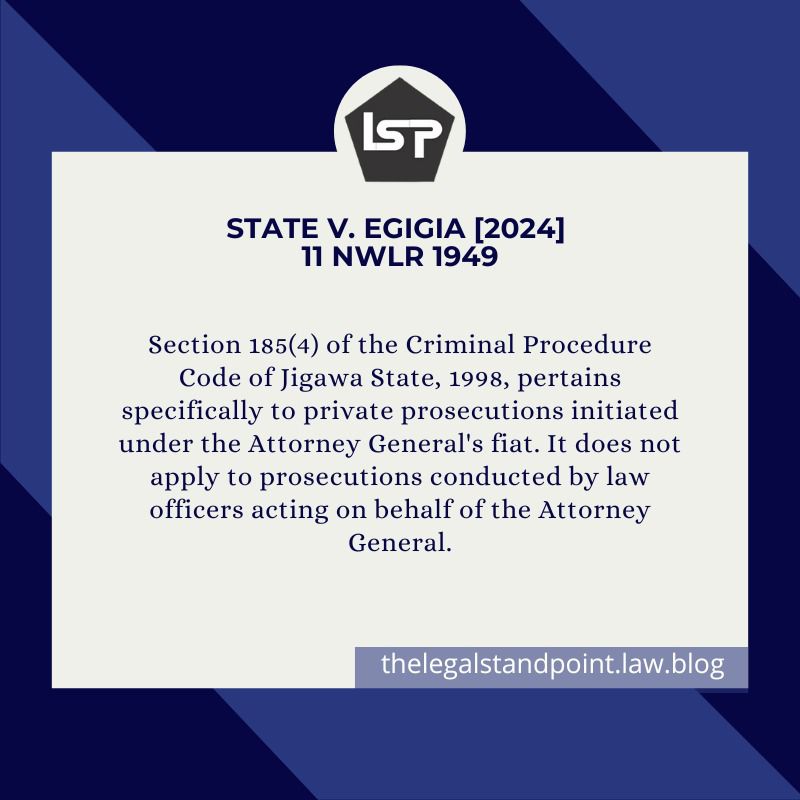
The Supreme Court, however, provided a crucial clarification on this issue. It emphasized that under Section 211(2) of the Constitution, the AG’s prosecutorial powers could be exercised either by the AG personally or through officers in their department. The Court further explained that the requirement for leave under Section 185(4) of the Criminal Procedure Code of Jigawa State, 1998, applies to private prosecutions initiated under the AG’s fiat, not to prosecutions carried out by law officers acting on behalf of the AG. The Supreme Court concluded that the prosecution was validly initiated without the need for leave and that the Court of Appeal had misinterpreted the law.

Moreover, the Supreme Court highlighted the principle of agency in this context. It noted that when the AG delegates prosecutorial authority to a law officer, that officer acts as the AG’s agent. Therefore, the actions of the law officer, taken within the scope of their delegated authority, are considered the actions of the AG. This principle is encapsulated in the Latin maxim qui facit per alium facit per se (he who acts through another acts himself). Consequently, the law officer who filed the charge on behalf of the AG was not required to seek leave before doing so, as the officer was operating under the AG’s delegated powers.

An important aspect of the Supreme Court’s decision in State v. Egigia involved the issue of the repealed law. Justice Abba Aji JSC, concurring with the lead judgment of Ogunwumiju JSC, emphasized that a repealed law no longer holds legal validity and cannot be cited as if it still exists. He referred to the earlier decision in Bature v. State (1994) 1 NWLR (Pt.320) 267 which relied on Section 185(b) of the Criminal Procedure Code Cap. 30 of the Laws of Northern Nigeria, 1963, and the Criminal Procedure (Application for Leave to Prefer a Charge in the High Court) Rules, 1970. These laws had been repealed long before the current case was initiated. The Supreme Court criticized the Court of Appeal for relying on the Bature’s case, stating that using repealed laws to influence current legal arguments is incorrect and misleading. The current case was initiated under the Criminal Procedure Code of Jigawa State, 1998, which is the applicable law, and the Court of Appeal erred in not recognizing this distinction.

Thank you for reading. See you next week.