
Law

LSP143: Burden of Proving the Existence of a Certificate of Incorporated

Good Afternoon, Readers. It’s a new week and we are here to discuss the burden of proof of the Certificate of Incorporation and the alleged negligence of the Corporate Affairs Commission (CAC) using the 2024 case of A. Dikko & Sons v CAC [2004] 8 NWLR (Pt 1939).

Evidence that a company has been registered is its certificate of incorporation. Just as every individual in Nigeria has a certificate of origin to show their state of origin, companies have a certificate of incorporation to verify their registration status. The Corporate Affairs Commission (CAC) is the body responsible for registering companies and issuing these certificates. According to the Companies and Allied Matters Act 2020 (CAMA), which is the principal legislation guiding companies affairs in Nigeria, the CAC has the authority to regulate and oversee company registrations.

The facts of the case under review was that the appellant, A. Dikko and Sons Ltd, was registered by the CAC as a private limited liability company on September 4, 2008, with Registration No. 771050. However, the CAC negligently registered another company with a similar name, A. Dikko and Sons Nigeria Limited, on December 17, 2008, with Registration No. 791987. This was a breach of Section 30 of CAMA, which prohibits the registration of a company by a name identical to an existing one or so similar that it could deceive.

Consequently, cheques meant for A. Dikko and Sons Ltd were deposited into the account of A. Dikko and Sons Nigeria Limited, and the promoter of the latter company withdrew and made off with the money. The appellant argued that the CAC’s negligence in registering a company with a nearly identical name caused their financial losses.

Both the Federal High Court and Court of Appeal needed the appellant to provide evidence of the existence of the second company to support their claim. While A. Dikko and Sons Ltd produced its certificate of incorporation, it failed to present the certificate of incorporation for A. Dikko and Sons Nigeria Limited. The Court stressed that the certificate of incorporation is essential as prima facie evidence of a company’s registration under Section 36(6) of CAMA. Without this certificate, the appellant could not prove that the second company existed. 

On appeal to the Supreme Court, the court ruled that, under the law of evidence, the appellant must prove its case based on its strength, not the weakness of the respondent’s case. The appellant’s inability to produce the certificate of incorporation for A. Dikko and Sons Nigeria Limited meant it could not establish the necessary facts to support its claim of negligence against the CAC.

The judgment is consistent with legal principles and statutory requirements. Section 30(1) of CAMA 2020 clearly states that no company shall be registered with a name identical to an existing company’s name or so similar that it could deceive. However, to prove such negligence, the existence of the allegedly negligent registration must be established through the production of the certificate of incorporation.

In legal precedents such as Odinaka & Anor v Moghalu (1992) 4 NWLR (Pt. 233) 1 and Heaven v Pender (1883) 11 QBD 503 at 507, negligence is defined as the failure to exercise the care which the circumstances demand. Similarly, Reptico S. A Geneva v. Afribank Plc (2013) 14 NWLR (Pt. 1373) 172 confirms that the certificate of incorporation serves as prima facie evidence of a company’s registration. Moreover, in NNPC v. Lutin Inv. Ltd. & Anor (2006) LPELR-2024(SC), the court also held that the conclusive proof of a company’s incorporation is through its certificate of incorporation.

On personal stuff yeah? I feel that had there indeed been an identical company and the appellant truly lost their money, the appellant should have sued that second company alongside the CAC. Additionally, the appellant could have requested the court, in the interest of substantive justice, to compel the production of the second company’s certificate of incorporation. While this approach might seem like a stretch, as it essentially shifts the burden of proof, introducing this additional step could have made the appeal more robust and intriguing. It might have even led to a new position in company law, thereby advancing our jurisprudence.

However, since this was not done, the position of the law is clear. Given the appellant’s failure to provide the second company’s certificate of incorporation, it did not meet the burden of proof required by law. Therefore, the court’s decision to dismiss the appeal is justified, as the appellant could not substantiate its claims of negligence against the CAC.

Thank you for reading❤️. See you next week🙏. And Happy Eid al-Adha Mubarak in advance to our amazing muslim readers. Send meat👍

Law

LSP142: Loan Contracts

Good morning, Readers! This week’s article will be presented in a question-and-answer format focusing on loans.


• What’s a loan?
Loan signifies a sum of money lent to a borrower with interest. Olowu v Building Stock Ltd. (2018) 1 NWLR (Pt. 1601) 343. A loan contract is an agreement by which one party (“the lender”) agrees to pay money to another (“the borrower”), or to a third party at the borrower’s request, on terms that the borrower will repay the money together with any agreed interest. For the agreement to constitute a loan, the payment must be made with a view to giving the borrower financial accommodation. Blackburn Building Society v Cunliffe Brooks & Co. (1882) 22 Ch.D. 61

• When does it become a loan contract?
A loan is not an offer but an invitation to treat. As such, when someone asks a bank for a loan or an overdraft (borrowing more money than they have), the bank decides if they will offer it. If they agree, they lay out the terms and conditions clearly. If the person agrees to these terms and communicates that clearly back to the bank, a legal contract is formed, and the loan is valid. An unqualified acceptance of the offer duly communicated to the bank by the customer in respect of all the terms and conditions thereof, would result in a valid and binding legal contract between them on the loan facility. Omega Bank Nigeria PLC v O.B.C LTD. (2005) 8 NWLR (PT. 928) 547 AT 583 PARAS C-E

• Is demand necessary when a bank seeks to recover a loan?
The law is that demand is not necessary in law when a bank seeks to recover a loan unless there is an agreement to that effect. U.B.A. Ltd. v. C Michael O. Abimbola (1995) 9 NWLR (Pt. 419) P. 371.

• Whether a party who benefitted from a loan contract/facility can turn around to deny taking the loan because a condition wasn’t fulfilled?
It would be morally despicable for the Appellants after benefiting from the loan facilities granted by the Bank to turn around to deny taking the loan merely on the ground of non-proof of a condition precedent to drawing down the loan. The Appellant’s cannot, after admitting disbursement of the loan and utilizing the same contend that they did not access the facility because the documents necessary to perfect the loans were not executed. The law is clear on this. If a contract isn’t outright illegal, like in the case of Sodipo v Lemninkainen (1986) 1 NWLR (PT. 15) 220, a person who benefits from a contract can’t argue it’s void or illegal later on, especially when the other party has fulfilled their part of the deal. Doing so would be unfair and unjust. Hydro Hotoles Ltd & Anor v Amcon (2020) LPELR-50740(CA)

5. Is the lender required to give pre-action notice to a borrower before suing to recover a debt?
In Mabon Ltd & ors v Access Bank (2021) LPELR-53261(CA), the agreement between the lender and borrower includes a clause that requires the borrower to give a 90-day prior written notice to the lender before initiating any legal action against the lender. This clause does not require the lender to provide any pre-action notice to the borrower before suing to recover a debt. The Court of Appeal held that it would be unreasonable to require a lender to notify a borrower before suing to recover an unpaid debt. The lender has a legal right to take action to recover its money without providing such notice. The borrower’s obligation to provide notice is meant to prevent frivolous lawsuits against the lender that could delay the recovery process. As such, while borrowers may be required to notify lenders before suing, lenders are not similarly required to notify borrowers before taking legal action to recover debts. The ruling protects lenders’ rights to promptly recover owed funds without unnecessary delays caused by pre-action notices.

• What are the borrower’s Defenses in Loan Recovery Actions?
There are limited defenses a borrower can use in court when sued by a lender for debt recovery:
The borrower has fully repaid the loan and can provide proof of payment.
The borrower never took the loan or the documents related to the loan are forged. Okoli v Morecab Finance (Nig.) Ltd (2002) All FWLR (pt. 369) p. 1164 @ 1184

• Whether the failure of a finance company to comply with the Central Bank of Nigeria (CBN) Guidelines regarding the display and quoting of interest rates renders a loan contract illegal.

No. The court in ProsperFunds Ltd v. Ray-Sam Elite Security & Safety Ltd & Anor (2019) LPELR-50685(CA)  held that the failure to comply with the CBN Guidelines regarding the display and quoting of interest rates does not render the loan contract illegal. The guidelines are not primary legislation, and the proper consequence for non-compliance is the imposition of fines, not the nullification of the contract. The borrower, having benefited from the loan, cannot escape repayment by arguing that the contract is void due to non-compliance with these guidelines.

• Whether a bank has the right to recover a loan facility granted to a customer from any available funds belonging to such customer.
Yes, it does. The court upheld the bank’s right to recover the loan facility from the appellants’ available funds, specifically from their cash collateral. General Housing & Products Ltd v Access Bank (2022) LPELR-58897(CA)

•When will the relationship between a bank and the guarantor of a loan exist?
When the borrower defaults, the guarantor steps into the shoes of the creditor (the bank). This means that the guarantor takes on the rights and responsibilities of the bank concerning the loan. Upon stepping into the shoes of the creditor, the guarantor enjoys the same relationship with the bank as the original borrower. This relationship is defined under Section 251(1)(d) of the Constitution, which pertains to the jurisdiction of the Federal High Court over matters involving the operation of banking and other financial institutions. Royal Exchange Assurance (Nig.) Ltd. v. Aswani Textile Ltd. (1992) 3 NWLR (Pt. 227)  Eboni Finance & Securities Ltd v. Wole-Ojo Technical Services Ltd & 2 Ors (1996) 7 NWLR (Pt. 461) 464

•What’s the effect of write off in Loan?
The primary aim of writing off a debt is to provide investors and auditors with an accurate representation of the bank’s financial health. This accounting action reflects that the bank acknowledges the difficulty or near impossibility of recovering the debt. Despite the debt being written off in the bank’s books, the debtor’s obligation to repay the loan remains intact. Writing off a debt does not equate to forgiving or canceling the debt. Tade Abimbola Nig Ltd v FBN PLC. (2021) LPELR-55773(CA)

For example, suppose Kolagba Stairs Nig Ltd borrowed ₦500,000 from First Bank of Nigeria (FBN) PLC, and over time, it became clear to FBN that recovering this debt was extremely difficult. The bank decides to write off the debt to present a more accurate financial statement to investors and auditors. Despite this accounting decision, Kolagba Stairs Nig Ltd still owes ₦500,000 to FBN. The write-off does not cancel or forgive the debt. FBN retains the right to sell the debt to a collection agency or to file a lawsuit to recover the amount owed. The write-off does not eliminate these rights.


Thank you for reading. See you next week


Law

LSP141: Defence of Intoxication using Imasuen v State

In society, insanity is often recognized by outward appearances such as tattered clothes and unkempt hair. However, in law, insanity is defined differently and does not necessarily align with medical definitions or societal perceptions of madness. Legally, insanity can encompass various conditions, including sleepwalking as seen in R v Burgess [1989] 1 QB 92 (CA); epilepsy as held in R v Sullivan [1904] 1 AC 156 (HL) and other similar states. This explains why cases on this matter that come before the court are always considered in the legal sense. After all, no one expects otherwise. who wan go sue madman whey dey street?


Moving on, the general principle of law is that the law presumes every human being is sane until the contrary is proven, as stated in Section 27 of the Criminal Code. Under our criminal law jurisprudence, the defense of insanity is statutorily provided for in both Section 28 and Section 29(2)(b) of the Criminal Code. While the defense of insanity under Section 28 pertains to mental disease or natural mental infirmity, the defense of insanity under Section 29(2) is founded on involuntary intoxication. There is a common bond in these two defenses: in either case, the accused must establish that at the relevant time, they were deprived of the capacity to understand what they were doing, to control their actions, or to know that they ought not to do the act or make the omission. Involuntary intoxication occurs when someone becomes intoxicated without their knowledge or against their consent, such as through spiked drinks, forced consumption, or unexpected medication reactions.

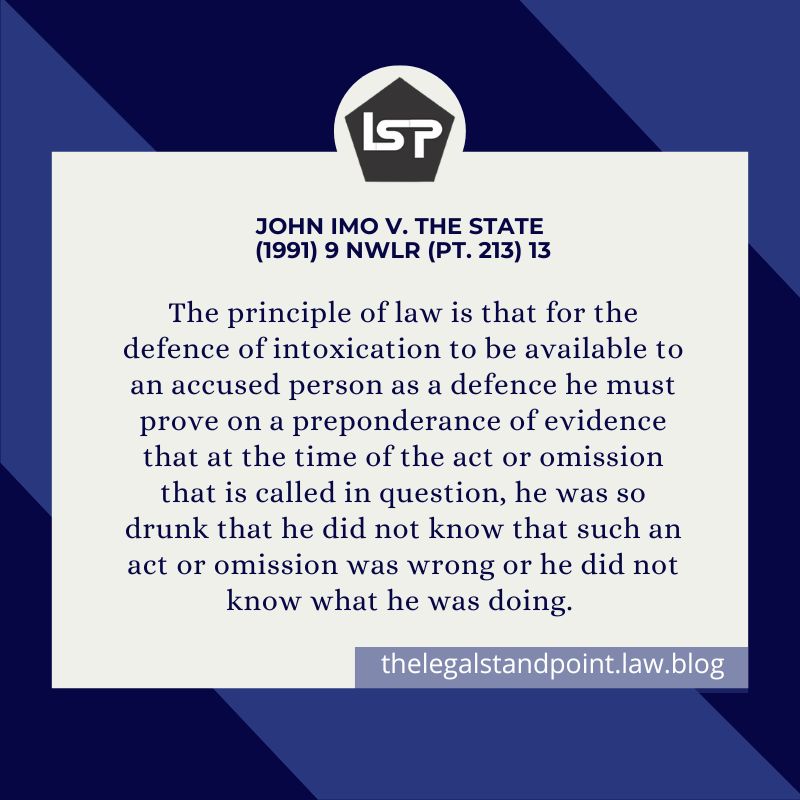
Furthermore, the law is settled and beyond dispute that the onus of establishing the defense of drunkenness, which amounts to insanity and unsoundness of mind such that the accused did not know what they did, rests squarely on the accused person. The burden is discharged on a preponderance of evidence led by and for the accused person, as established in John Imo v. The State (1991) 9 NWLR (pt. 213) 13. The surest way of establishing insanity is through medical evidence or compelling evidence from eyewitnesses, particularly relatives of the appellant, relating to their general conduct, family medical history, and behavior before, during, and after the incident in question, as seen in Anthony Ejinima v. The State (1991) 722.

Thus, when an accused person relies on the provision of Section 29(2)(b), they assume a burden of proof analogous to a person who relies upon a defense of insanity simpliciter under Section 28. They must prove that as a result of the intoxication, they were in a similar state of mind as an insane person, i.e., that they did not know what they were doing or that they did not know that what they were doing was wrong. This was highlighted in Imasuen v. State (2014) LPELR-22193(CA), where the appellant was convicted on a charge of the murder of a nine-year-old girl, Favour Ihoeghilan, under Section 319(1) of the Criminal Code Laws of Bendel State of Nigeria, 1976, applicable in Edo State. The prosecution’s facts indicated that the appellant took the young girl under the pretext that her mother needed her in the market, lured her to the bush, raped her, and then set her ablaze.

He raised the defense of insanity by intoxication under Section 29(2)(b), claiming that he was involuntarily intoxicated by inhaling the smoke of Indian hemp, which was caused by a group of boys at a canteen in Urora village on April 5, 2003. He argued that he became confused and did not know what happened until he found himself at the police station the next day. However, the court rejected this defense. The court held that, based on his confessional statements (Exhibits ‘A’ and ‘D’), he was conscious of his actions before and after the incident. His actions, such as drinking four bottles of Guinness stout, buying a bottle for a girl and the barman, and purchasing and smoking Indian hemp, were all deliberate and unsolicited decisions.

Therefore, the court concluded that his intoxication could not be attributed to the malicious or negligent acts of others, and as a result, sentenced the appellant to death by hanging.

Being dissatisfied with the decision of the trial court, the appellant appealed to the Court of Appeal. Dismissing the appeal, the court, per Yakubu JCA, held that the appellant’s consumption of Indian hemp and Guinness stout on April 5, 2003, boosted rather than impaired his sexual appetite. This led to his sexual encounter with a girl and subsequent assault of a nine-year-old, indicating he was a sex maniac rather than insane. Additionally, the learned justice opined that the appellant did not establish, on a preponderance of evidence, that he was “out of his mind.” The justice suggested that had the appellant instead gone to his own family compound and committed the same acts on a young relative, such as a sibling, niece, or cousin, it would have unequivocally demonstrated his insanity. Since this was not the case, the court rejected his insanity defense.

In conclusion, the defense of insanity, whether due to mental disease or involuntary intoxication, requires substantial evidence to prove that the accused was deprived of the capacity to understand their actions or know they were wrong. In the case under review, the appellant’s actions were found to be deliberate and conscious, thereby failing to meet the legal standard for insanity.

Thank you for reading. See you next week.