
Upon being called to the Bar, an individual becomes a lawyer and enters the legal profession. Within this profession, certain standards of conduct are not just encouraged but mandated. These standards are delineated by the Rules of Professional Misconduct for the legal profession (RPC), a foundational legal framework that prescribes the accepted code of behavior for lawyers.
The principle of law, as held in NBA v Iteogu (2006) 13 NWLR (Pt. 996) 219 is that what amounts to professional misconduct is not defined in the rules of professional conduct (RPC). The court further held that any conduct of any legal practitioner in relation to his practice of the profession in relation to his client that runs contrary to rules or any breach of the rules may amount to misconduct, and any conduct that constitutes an infraction of the acceptable standard of behavior or ethics of the legal profession, or any conduct which connotes conduct so despicable and morally reprehensible as to bring the legal profession into disrepute, will amount to professional misconduct.
The general responsibility of a lawyer, as provided in Rule 1 of the Rules of Professional Conduct for Legal Practitioners, is that a lawyer shall uphold and observe the rule of law, promote and foster the cause of justice, maintain a high standard of professional conduct, and shall not engage in any conduct which is unbecoming of a legal practitioner. This responsibility includes attending to the client’s inquiry.
Category: Law
LSP136: Charm Testing and Consent in Criminal Law

This week’s article centers on an interesting topic: the legal implications surrounding the criminal liability of someone who tests the effectiveness of a gun charm on an individual with that individual’s consent, resulting in the individual’s death. This scenario is not uncommon in our society, often portrayed in Nollywood movies where herbalists test the potency of their charms on the person who commissioned them.
The legal issues in this scenario are: Is the accused liable for murder in such a situation? Does the victim’s consent serve as an exclupatory defense against the charge of murder? This scenario is modelled after the case of State v Okezie (1972) 2 E.C.S.L.R. 419. In that case, the defendant, a native doctor, crafted some charms for the deceased. Subsequently, the deceased invited the defendant to assess the efficacy of the charm by testing it on him, specifically by firing a shot. Tragically, the defendant complied and shot the deceased in the chest, resulting in his death. As a consequence, the defendant was convicted of murder.
The legal principle at play here is that consent given by a person to cause their own death does not absolve any individual who causes that death from criminal responsibility. Hence, the principle of volenti non fit injuria(to the willing, no injury is done) doesn’t apply in this circumstance. This principle also underpins the criminalization of voluntary euthanasia in Nigeria.
Thank you for reading. See you next week.
LSP135: Confession of a Co-accused
In criminal law jurisprudence, the law is trite that there are three ways for the prosecution to prove its case against an accused person, and these are: (a)direct evidence; (b)circumstantial evidence; or (c)his confessional statement. Fatilewa v State (2008) 12 NWLR (Pt. 1101) 518; Ogedengbe v.State (2014) 12 NWLR (Pt. 1421) 338; Egboghonomev. State (1993) 7 NWLR (Pt. 306) 383.
A confession, whether made extrajudicially or judicially, is an admission by the accused suggesting their guilt. Confessions carry significant weight in court, often considered stronger evidence than other forms of proof. Adebayo v State (2014) LPELR-22988(SC) and Oseni v. State (2012) 5 NWLR (Pt. 1293)351.
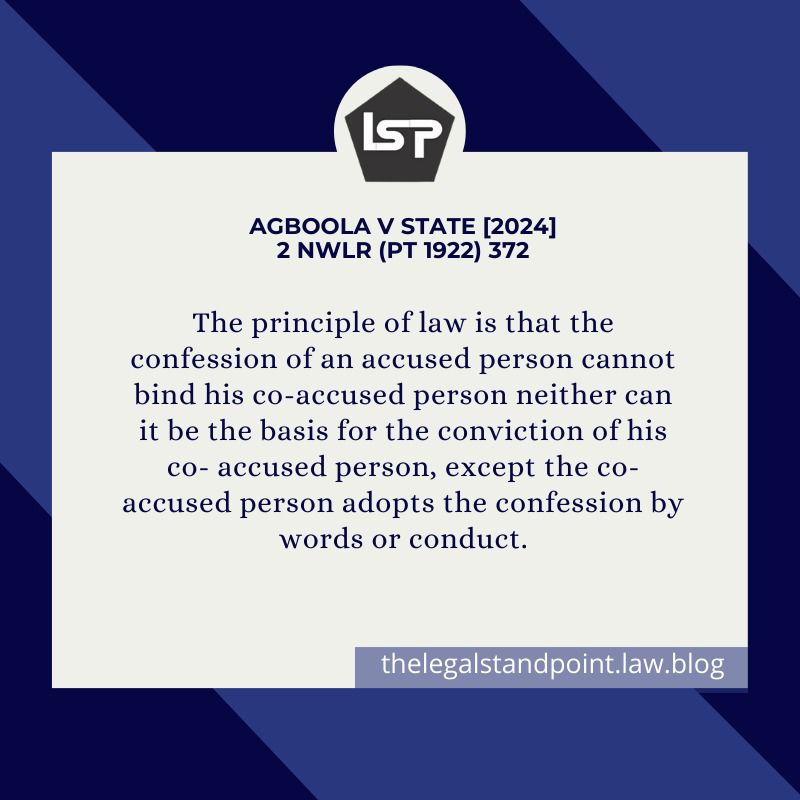
However, a crucial question arises when considering jointly committed crimes: can a person be convicted based on the confession of a co-accused? The law is settled that The confession of an accused person cannot bind his co-accused person neither can it be the basis for the conviction of his co- accused person, except the co-accused person adopts the confession by words or conduct. Agboola v State [2024] 2 NWLR (pt 1922) 372(P. 409, paras. A-F).
Section 29(4) of the Evidence Act 2011 further emphasizes this point, stating that if one co-accused makes a confession in the presence of others, it cannot be used against those others unless they explicitly adopt it. Failure to comply with this provision renders such confessions inadmissible against the non-adopting co-accused. Thus in Nwamiro v State (2023) LPELR-60423(CA), the court held that: “Accordingly, I agree with the appellant that Section 29(4) of the Evidence Act was not complied with by the respondent, nor was there any title of evidence to establish that the appellant adopted the confessional statement of the co-defendant by word or conduct, consequently, the lower Court erred in relying on the confessional statement(s) of the co-defendant as one of the planks in convicting the appellant.”
In conclusion, while an accused’s confession can be damning evidence against themself, it cannot automatically implicate a co-accused but where the prosecution or the police intends to use the statement against a co-accused then the prosecution or the police is bound to make a copy of the incriminating statement available to the co-accused and the co-accused then adopts the statement.
Thank you for reading. See you next week
 THELEGALSTANDPOINT