Law

LSP134: Prosecution of Sex Trafficking in Nigeria

Trafficking encompasses the transportation, trading, or dealing with illegal goods or people. There are various forms of trafficking, but our focus in this week’s article is on sex trafficking. This abhorrent crime violates the fundamental right to human dignity as contained in Section 34 of the Constitution of the Federal Republic of Nigeria (1999) as amended. Despite being clandestine, sex trafficking is rampant in Nigeria, exacerbated by widespread economic hardship. In fact, recently, Mo Abudu’s film, Òlòturé, vividly portrays the grim reality of sex trafficking, shedding light on its pervasive nature.

In Nigeria, the legislation addressing this crime is the Trafficking in Persons (Prohibition) Enforcement and Administration Act of 2015, which repealed the earlier Trafficking in Persons (Prohibition) Law Enforcement and Administration Act of 2003. However, the two cases under discussion here were decided using the 2003 Act.

Section 5 of the 2015 Act assigns the National Agency for the Prohibition of Trafficking in Persons (NAPTIP) with the responsibility of overseeing and coordinating all activities related to human trafficking. NAPTIP’s investigative department is authorized to collaborate with law enforcement agencies such as the police, Immigration Service, Customs Service, and others to prevent and detect offenses outlined in the Agency’s enabling Act. While the agency holds the power to prosecute offenders, it also has the discretion to collaborate with other security agencies.

In Mohammed v AG Federation (2021) 3 NWLR (Pt. 1764) 397, the supreme court held that before a conviction could be secured for human trafficking offense, the prosecution is required to prove that:
1. the accused person participated in the procurement of the victim for the purpose of prostitution;
2. the accused person organized the travel of the victim for the said purpose; and
3. there was deceitful inducement of the victim by the accused.

In Oshi v State (2022) LPELR-58105(CA), one of the victims (PW3) testified that she, along with PW1 and another girl, was promised a job as a salesgirl in Lagos for a monthly salary of N10,000 by Madam Nnabuke. However, they were taken to Ogbomosho by the Appellant’s son. There, the Appellant informed them they would be used for prostitution, instructing them to give her N5,000 daily from their earnings. PW3 worked at a hotel, sleeping with about twenty clients daily and charging N3,000 per round. The Appellant collected N5,000 daily, and on days PW3 earned less, she was beaten. The trial Judge found PW3’s testimony credible and convicted the Appellant based on this evidence. The Court of Appeal affirmed this decision.

In Mohammad’s case, the appellant and one Eunice Owoyele were alleged to have engaged in the trafficking of individuals to Libya, where they were subjected to sexual molestation, sold, and forced into prostitution. They faced charges related to inducement, procurement, and organizing travel for prostitution, contravening the Trafficking in Persons Prohibition Law Enforcement and Administration Act, 2003 (as amended), punishable under the same section of the Act.

It’s pertinent to state that where a statute prescribes a mandatory sentence in clear terms, the courts are without jurisdiction to impose anything less than the mandatory sentence as no discretion exists to be exercised. Rather, it is a duty imposed by law and the sentence must be pronounced without any reservation. Hence, in Mohammad’s case, the supreme court said that the provisions of sections 15(a), 16, and 19(b) of the Trafficking in Persons Prohibition Law Enforcement and Administration Act, 2003 under which the appellant was charged give no discretion to the Judge to mitigate sentence. Having found the accused guilty under those sections of the Act, the court was bound to impose the mandatory sentence. The trial court and the Court of Appeal were therefore wrong to impose and affirm a sentence of 3 years imprisonment for count 3, whereas the statute prescribes a mandatory term of 10 years imprisonment or a fine which must not exceed N200,000.00, or both.

Thank you for reading. See you next week.
Law

LSP133: Issuance of Dishonouring Cheques

Cheque is an order to a bank to pay a stated sum from the drawer’s account, written on a specially printed form. In Bolanle Abeke v State SC. 271/2005, the court defines a cheque as “a written order to a bank to pay a certain sum of money from one’s bank account to oneself or to another person.”

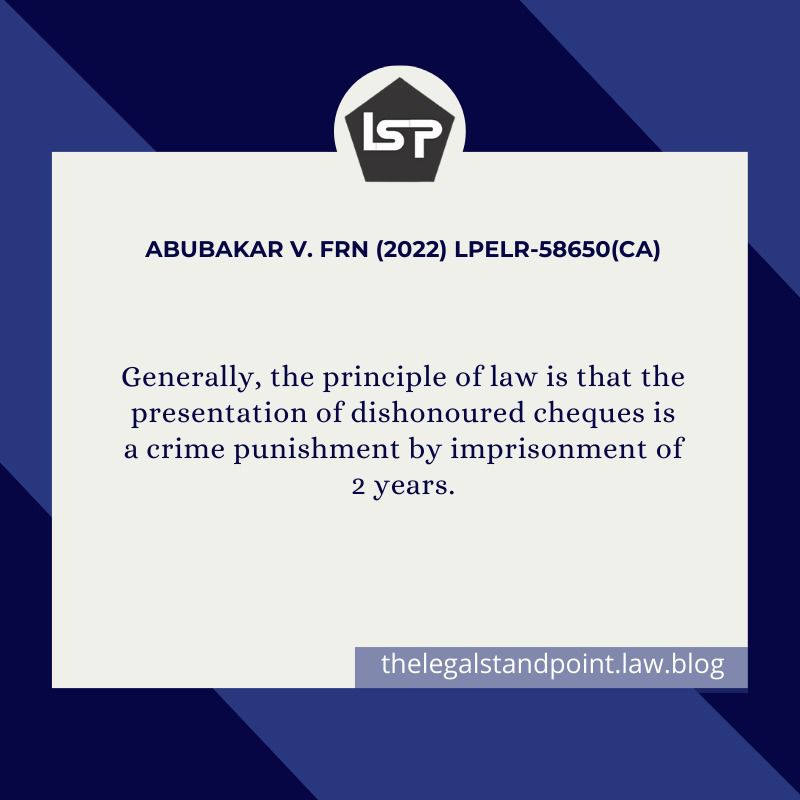
Cheque becomes valuable only when there’s enough money in that account. If someone writes a cheque without having sufficient funds, resulting in a bounce (commonly called a Dud Cheque), it’s a criminal offense in Nigeria under the Dishonoured Cheques (Offences) Act. In Abubakar v Federal Republic of Nigeria (2022) LPELR-58650(CA), the court held that the rationale was that The Dishonoured Cheque (Offences) Act was enacted to safeguard the integrity of banking operations involving cheques. It aims to reinforce the security and confidence associated with cheque payments, ensuring that any breach of trust is penalized to maintain the reliability of banking transactions.

When a cheque is dishonored, it means that the bank refuses to honor the payment stated on the cheque. This can occur for various reasons, such as insufficient funds, a mismatched signature, or an expired cheque. The non-payment indicates a failure to fulfill the financial obligation specified in the cheque.

Section 1(1) of the Act outlines that an individual who, through deceit, acquires something that could be stolen or obtains credit using a cheque that bounces due to insufficient funds within three months of issuance, commits an offense. Upon conviction, an individual faces a two-year imprisonment without the option of a fine, and a corporate entity could be fined a minimum of N5,000. By virtue of section 3 of the act, The High Court of a State is the only Court with jurisdiction to try the offence of issuance of dud cheque. The Act also stipulates that the offence of issuance of dud cheque should be tried summarily.

Furthermore, the law allows a three-month window before someone can be deemed guilty of issuing a dud cheque. If a cheque is presented for payment after this period and is dishonored, the issuer cannot be considered to have committed an offense.

In the case of Abubakar v FRN (Supra), the appeal challenges the judgment of the Federal Capital Territory High Court in Charge No. FCT/HC/CR/7/2012, issued on October 2, 2020, by Hon. Justice M. E. Anenih. The trial court convicted the Appellant, Mr. Abubakar, who is the owner and Chief Executive Officer of Foot Trip Oil & Gas Ltd, for issuing a dud cheque. The sentence was 2 years of imprisonment without the option of a fine. The Appellate court upheld the decision of the trial court, affirming the conviction and sentencing of the Appellant.

Thank you for reading. See you next week

Law

LSP132: Disconnection of Electricity

The Electric Power Sector Reform Act 2005 (EPSRA) is the primary legislation guiding the Nigerian power sector. The Nigerian Electricity Regulatory Commission (NERC), established by EPSRA, has the authority to create regulations for the Nigerian Electricity Supply Industry (NESI). One such regulation is the Connection and Disconnection Procedures 2007 (NERC Connection Regulations).

According to Section 5 of NERC Connection Regulations, a Distribution Company (Disco) is permitted to disconnect a customer only if the customer has not paid the correct amount billed for the supply address by the specified payment date. The section outlines prerequisites for disconnection, including a clear payment date on the bill, a minimum of 10 working days from bill delivery to the payment date, and a three-month period between the payment date and disconnection. Importantly, the Disco must verify from its records that the bill remains unpaid, provide a written warning to the customer before disconnection, and include details such as the warning date, supply address, and contact information for assistance with bill payment.

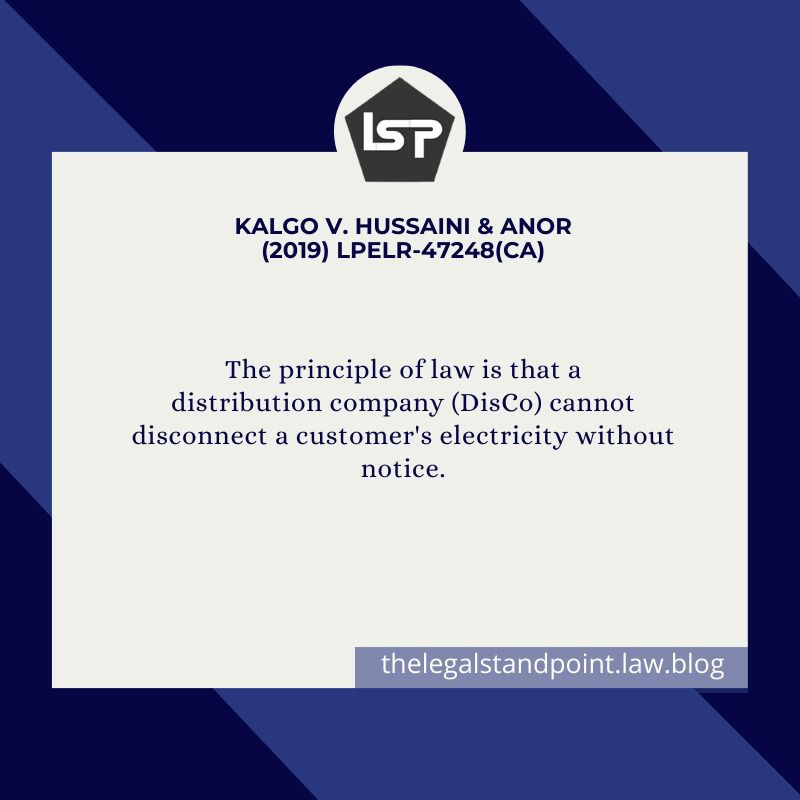
In Kalgo v Hussaini & Anor, (2019) LPELR-47248(CA), in that case, the 1st Respondent, accompanied by personnel of the 2nd Respondent, Kaduna Electricity Distribution Company PLC (Kadeco), disconnected the Appellant’s electricity supply from August 26 to August 29, 2016. The Appellant contested this action, asserting its illegality and violation of the Nigerian Electricity Regulatory Commission’s Regulations, 2007. The Appellant also claimed discrimination, alleging that the 1st Respondent disconnected their residence while leaving others connected, even those who hadn’t settled their August 2016 bills.

Despite the Appellant’s multiple correspondences to the Respondents, demanding compliance with the Nigerian Electricity Commission’s Regulations, 2007, and receiving no response, the Appellant sought judicial review through the Court below. The Appellant pursued declaratory reliefs, damages of ₦11,000,000.00 against the Respondents, and an Order of Mandamus compelling the 2nd Respondent to adhere strictly to Sections 5 & 9 of NERC’S Procedures & Rules, 2007. The Appellant’s contention was centered on being disconnected without the mandatory three-month pre-disconnection notice, contrary to the provisions of Section 5 (i) (d), (e) & (f) and Section 9 of the Nigerian Electricity Regulatory Commission’s Connection & Disconnection procedures for Electricity Services, 2007 (NERC Rules).

Justice Oziakpono JCA reversed the high court’s decision, disagreeing with its interpretation. Oziakpono JCA argued that having a debt or unpaid bills doesn’t automatically cancel the protection, specifically the notice, granted to the customer by Sections 5(1)(d)(e) and (f) of the NERC’s Connection and Disconnection Procedures for Electricity Services, 2007. Therefore, the disconnection was deemed illegal, and the appellant was granted damages.

In his words, the Justice held that: “The provisos no doubt carry a number of safeguards, which must be complied with before the Respondents could lawfully so to speak, go on a frenzy of disconnecting customers’ electricity supply to their homes. This Court has noted with clear disappointment that the production and distribution of Electricity supply in this Country has, for over time, fallen on evil days. A situation where the distributors of Electricity would brazenly flout the Regulations governing their activities in the midst of persistent and perennial epileptic supply of Electricity to homes and institutions is clearly unacceptable.

Nevertheless, there are situations where a customer’s electricity can be cut off without prior notice. These include:
1. If a customer is illegally connected to the DisCo’s network, the company has the authority to disconnect the power supply without giving notice. (Have you done this before? Lol)

2. If a customer’s installation is considered hazardous to the DisCo’s network or could affect the quality of supply to other customers, it is justified to disconnect the electricity supply without prior warning.

3. Also if a consumer attempts to outsmart the DisCo by hiding his meter, the electricity supply could be disconnected. Section 6(3) specifies that if, due to the customer’s actions or omissions, a meter in the customer’s premises goes unread for three consecutive times, the respective DisCo has the authority to disconnect the power supply. However, there are conditions outlined in proviso of section 6. The DisCo can only proceed with disconnection after informing the customer about the meter’s inaccessibility through written notice or telephone contact. This notification should request the customer to arrange for meter access. Additionally, the regulation mandates the DisCo to issue a warning notice to the customer, stating that unless access is granted within a minimum of 10 working days, electricity will be disconnected.

Nevertheless, in a 2021 Court of Appeal of Kaduna Electricity Distribution Co PLC v Raji (2021) LPELR-58347(CA), that Court disturbed the settled principle of law by holding that notice is not needed before disconnection. The court per Affen JCA held that: “This provision of Section 9 of the NERC Rules seems to me quite plain: it does not require a distribution company (such as the Appellant) to give notice to its customers as a precondition for disconnecting electricity supply. The obligation to leave notice of disconnection arises when, and only when, the distribution company disconnects electricity supply, but not prior to disconnection as held, erroneously, by the lower Court”

For emphasis, section 9 states that whenever a distribution company disconnects electricity supply to a customer’s premises, the distribution company shall leave a written notice of disconnection advising the customer the following: (a) date and time of disconnection; (b) reason for disconnection; (c) action to be taken by the customer to have the electricity supply reconnected; and (d) contact address and telephone number of the distribution company.

It’s my opinion that the court erred in law. This is because section 9 only takes effect after the disconnection, not before. The headline of the section in the act reads: “Notice that electricity has been disconnected.

As such, the principle of law still remains that notice must be given before disconnection can take effect.

We have a work to do. JCI2024 award is here. Can you nominate Kikiowo’s LSP for the category of *SELFLESS CONTRIBUTION to a worthy cause*

How to nominate:

👉🏻Click on the link https://bit.ly/FOPA2024Nomination

👉🏻Put in your email address

👉🏻 Go to the 3rd page (Selfless Contribution) and fill the following:
Name: The Legal StandPoint
Alias: LSP
Department and level: Law 500 level
The reason: write something true on how LSP has been beneficial to the community.

If you don’t have anybody else to nominate for other categories, click on the NEXT option till the last page and submit.


Thank you.