
Law

LSP131: Order of forfeiture of property

This week’s article addresses whether property forfeiture can occur without a conviction for an offense.

Forfeiture is the loss of certain rights, privileges, property, or honors as a consequence of committing an offense, crime, violation of conditions, or other wrongful acts. In Bokinni v Olaleye (1994) LPELR-22960(CA). and A-G Bendel State v Agbofodoh (1999) 2 NWLR (PT. 592) 476 the courts defined forfeiture as the relinquishment of something due to the commission of a crime, akin to a penalty or fine paid to expiate the wrongdoing.

Embezzlement often precedes forfeiture. When a government official misuses public money, the EFCC in Nigeria is responsible for taking legal action to recover the assets. The main law guiding this process is the Advance Fee Fraud and Other Fraud Related Offences Act, 2006. According to Section 17(3) of this law, the request for an interim forfeiture order should be made without involving the other party (ex parte). To obtain this order, the applicant only needs to provide enough initial evidence that the property might be linked to illegal activities or a crime and could eventually be taken away.

At this juncture, the case of Alison Madueke v. E.F.C.C (2024) 1 NWLR (Pt. 1918) 101 comes in handy. In that case, the Economic and Financial Crimes Commission (EFCC) accessed the appellant’s residence, recovering jewelry worth about $40 million. The EFCC then obtained an interim forfeiture order from the Federal High Court based on evidence suggesting the jewelry’s value exceeded the appellant’s legitimate income during her time as Minister of Petroleum Resources. The appellant argued that the jewelry were gifts received during her service, spanning nearly 50 years. However, the trial court, unconvinced, ordered the final forfeiture of the jewelry to the Federal Government of Nigeria. Dissatisfied, the appellant appealed to the Court of Appeal.

In this case, the trial court, by granting the ex parte application for interim forfeiture, acknowledged that the respondent had made a strong case for seizing the jewelry under the Advance Fee Fraud and Other Fraud Related Offences Act. This shifted the burden to the appellant to explain why a final forfeiture order shouldn’t be issued. The appellant had to prove, on a balance of probability, how she obtained the jewelry. The law places the burden on her since this information is within her knowledge, as stated in Section 140 of the Evidence Act and Section 36(5) of the Constitution.

The Court held that there is no need to prove any crime in forfeiture of property under Section 17 of the Act , as civil forfeiture is a unique remedy that rests on the legal fiction that the property, not the owner, is the target. Therefore, it does not require a conviction or even a criminal charge against the owner as it is not a punishment nor is it for criminal purposes.

The rationale behind this is that civil forfeiture proceedings are intended to cause the forfeiture of proceeds of unlawful activity and are targeted at the property, not the person, thus constituting in rem proceedings, not in personam proceedings. Oti v. EFCC (2020) 14 NWLR (P1743) 48.


In simple terms, sometimes if something valuable, like a house or money, seems to be connected to a possible wrongdoing, the law allows authorities to take it away temporarily. They don’t have to prove someone did something wrong; it’s just a precaution. This rule focuses on the thing itself, not necessarily the person who owns it. So, even if there’s no proof someone committed a crime, the authorities can still take away the valuable thing to make sure everything is okay.

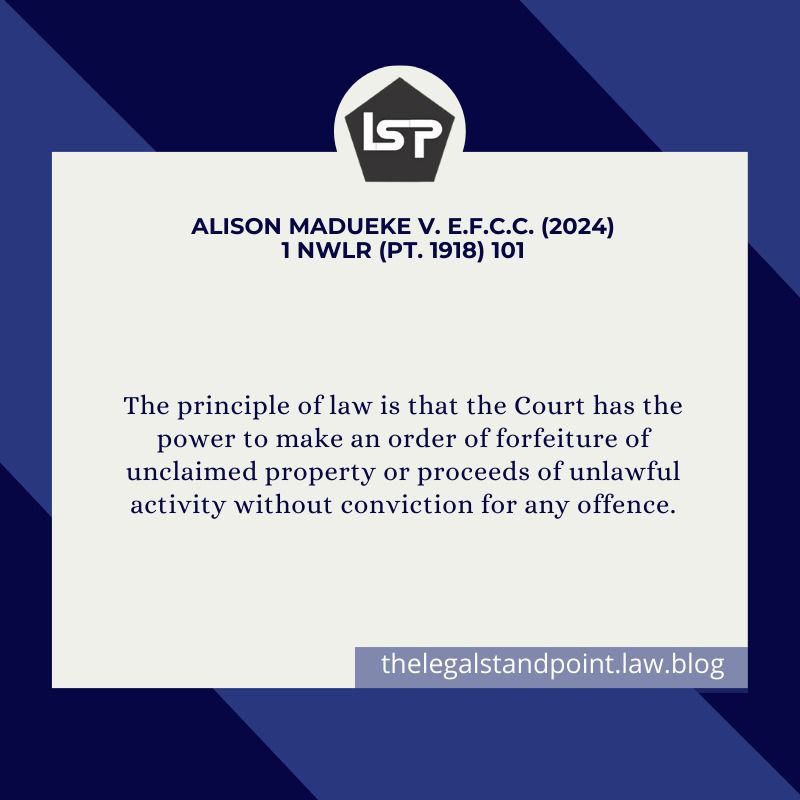
In the case of Dame Patience Ibifaka Jonathan v. Federal Republic of Nigeria (supra) (2019) 10 NWLR (Pt. 1681) 533, the Supreme Court held that the Court has the power to make an order of forfeiture of unclaimed property or proceeds of unlawful activity without conviction for any offense.

In conclusion, the principle of law is that a property forfeiture action doesn’t require the conviction of an offense. The reasoning behind this is that it operates as an action against the property itself (in rem) rather than being dependent on the conviction of an individual.

Thank you for reading. See you next week
Law

LSP130: Conferment of Degree by the University


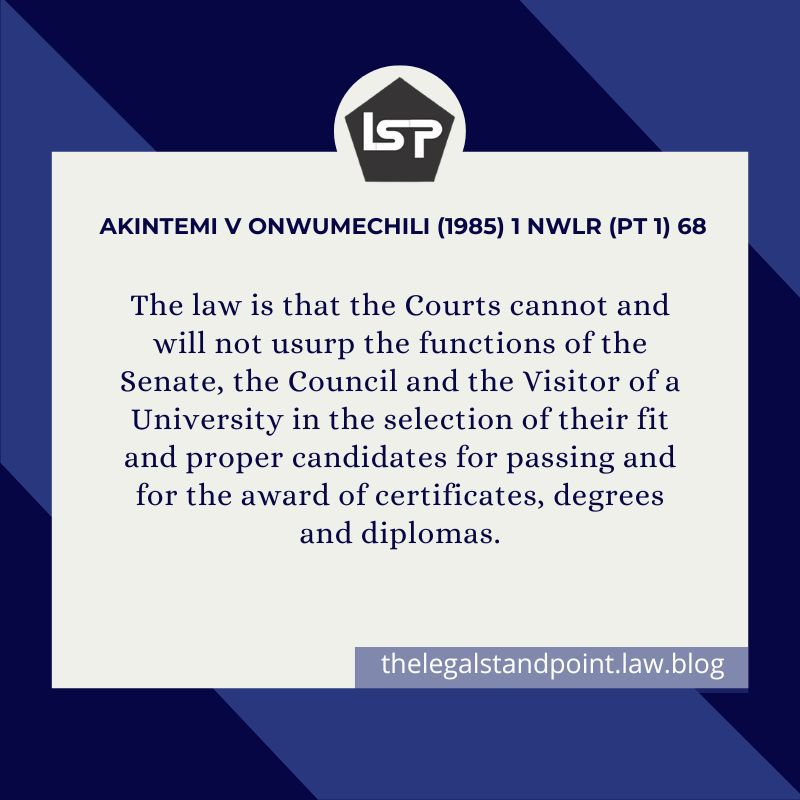
When students complete their studies, it’s the university’s senate that awards degrees, based on character and learning criteria outlined in the regulatory handbook. The Courts typically don’t intervene in this process.

So the fundamental legal principle here is that a court cannot intervene and force a university to grant a degree to a student. The exclusive authority for determining a student’s fitness in character and learning, as well as their eligibility for a degree, lies with the university’s senate, not the court. The regulatory handbooks of schools or faculties typically outline the criteria for character evaluation.

In University of Ilorin v Akinrogunde (2001) 3 NWLR (PT. 755) 626 at 646 PARA B-C, the court held as follows: “We must not lose sight of the fact that the University exist to train future responsible leaders of our great nation and that one of the conditions which they must fulfill before being presented as graduates is that they must be found worthy in learning and character. Therefore, if the character of a student is doubtful due to his arrest and prosecution by relevant agencies it is only reasonable for the University authorities to play safe by taking the necessary steps under the enabling enactment to save guard its reputation by not graduating a student who is later convicted and sentenced by a Court of competent jurisdiction or graduating an ex-convict.”

Similarly in Magit v University of Agriculture, Makurdi (2005) 19 NWLR (PT. 959) 211 at 245 PARA B-E where the Supreme Court held thus: “That in so far as the award of a degree or certificate to a student is concerned, in the discretion to award or refuse to award, the Courts have no jurisdiction in the matter. The Courts have no business flirting into the arena of a University deciding whether a thesis has met the standard of which it has been set. Any attempt by any Court, including this Court to dabble or encroach into the purely administrative and domestic affairs of a University including that of the 1st Respondent that may lead to undue interference nay, the weakening inadvertently so to speak of the powers and authority conferred on the Universities by statute as that conferred on the 1st Respondent will not be justifiable or justified.”

However, in ABU v Obanla (2021) LPELR-55101(CA), the court considered the circumstance(s) in which a Court can interfere with the domestic affairs of a University. In that case, Rashidat Suleiman Obanla, a former student of Ahmadu Bello University, graduated in Mathematics in 2012/2013. The Mathematics Department confirmed her graduation, but upon attempting to collect her certificate, she was informed of her expulsion in 2012 due to alleged cheating during an exam. The expulsion occurred without allowing her to explain, and she only discovered it when checking her results. Despite re-taking and passing the disputed course, completing her studies, and obtaining clearance, the university refused to issue her a graduation certificate, citing the prior expulsion. The respondent appealed to the Vice Chancellor but was unsuccessful. The university maintained she violated her Matriculation Oath, and the Mathematics Department was not informed of her expulsion by the Senate Standing Committee.


The court ruled that, since exam malpractice was alleged, it was the court’s responsibility, not the university’s, to determine whether the respondent was guilty or innocent. The court held that the university exceeded its authority by declaring the respondent guilty without legal proceedings. Talba JCA pointed out that the respondent was not arrested, prosecuted, or convicted by a competent court. The university, instead, assumed the court’s role by pronouncing guilt after an internal investigation, violating constitutional duties. Referring to Sofekun v. Akinyemi & Ors (1980) 5-7 SC 1 at 26, the Supreme Court emphasized the importance of safeguarding the court’s authority against interference to ensure fairness and protection against arbitrariness and oppression.


Given the evidence presented (Exhibit F) and the fact that the respondent was never arrested, prosecuted, convicted, and sentenced by a competent court, the court would be neglecting its constitutional duty if it doesn’t instruct the university to issue the degree certificate to the respondent.

Hence, the appellant’s argument that academic matters and degree awards fall exclusively under the university’s senate doesn’t hold in this case. This applies only when there is no allegation of a crime committed by a student. In instances involving alleged crimes, the university’s senate should permit relevant agencies to handle arrests and prosecutions in court, establishing guilt beyond reasonable doubt. Until this legal process is completed, the student should be presumed innocent by all authorities, including the university’s senate, as stipulated in Section 36(5) of the CFRN 1999 (as amended)

Thank you for reading. See you next week.

Law

LSP129: Recruitment of Constables in the Nigeria Police Force

This week’s article centers on the case of NPF & Ors v Police Service Commission & Anor (2023) LPELR-60782(SC) and seeks to answer the question on the authority that has the power to recruit Constables in the Nigeria Police Force and whether recruitment and appointment have the same meaning.

In that case, the dispute arose when the President of Nigeria approved the enlistment of 10,000 recruit constables by the 1st Appellant (NPF). The 1st and 2nd Appellants (IGP) began the recruitment process, but the 1st Respondent (Police Service Commission) raised concerns, leading to an originating summons before the Federal High Court. The NPF won at the trial court but lost at the Court of Appeal. Aggrieved by this, they further appealed to the Supreme Court.

For the core issue for determination, the senior counsel for the Appellants argued that the lower court’s reliance on the Public Service Rules, 2008, to equate the terms “recruitment” and “appointment” was a significant error leading to a miscarriage of justice. The learned senior Counsel asserted that Regulation 71 of the Nigeria Police Regulations 1968 clearly outlines the designated statutory officers responsible for enlisting recruit constables which is the 1st appellant. The enlistment, according to the argument, serves the purpose of identifying and training individuals before their potential appointment to offices within the Police Force (1st Appellant).

On the other hand, the senior counsel for the 1st Respondent (The Commission) contended that the argument suggesting a disparity between “appoint persons to offices in the Nigeria Police Force” and the “enlistment of recruit constables” misinterprets Section 153(2) of the Constitution and the Police Service Commission (Establishment) Act, 2001. Counsel argued that the legislative provisions grant the The Commission the authority to appoint, which inherently extends to the recruitment or enlistment of constables.

Make e no be like person whey dey explain with no evidence, He relied on Chapter 2, Section 2, Number 020201 of the Public Service Rules, 2008 Edition, which reads: “recruitment” means the filling of vacancies by the appointment of persons not already in the Public Service of the Federal Republic of Nigeria. It, however, excludes the transfer of officers from other Public Service in the Federal Public Service.

Sections 153(1) (M) of the 1999 Constitution provides for the Commission. For reference’s sake, Paragraph 30 of Part 1 of the Third Schedule to the Constitution provides as follows: “The Commission shall have the power to – a. appoint persons to offices (other than the office of the Inspector-General of Police) in the Nigeria Police Force.

To give effect to this provision, the legislature established the Police Service Commission through the Police Service Commission (Establishment) Act 2001as a body corporate with perpetual succession. The powers and functions of the 1st Respondent are enumerated in Section 6 of the Police Service Commission (Establishment) Act, 2001. Section 6(1) of the Act, states that “The Commission shall: a. be responsible for the appointment and promotion of persons to offices (other than the office of the Inspector-General of Police) in the Nigeria Police Force”.

In resolving this dispute, the Supreme Court, per Abubakar JSC started addressing the issues one after the other. Firstly, he opined that it is the duty of the Court to interpret the relevant provisions of the Constitution and determine the intention of the legislature is a fundamental aspect of constitutional jurisprudence.

To the issue at hand, the Supreme Court upholding the decision of the Court of Appeal and overturning the trial court’s decision, held that the power of appointment, vested in the Police Service Commission, inherently includes the authority to recruit constables. The court held that the 1st Respondent is constitutionally empowered to carry out the process of choosing or designating persons for positions or offices within the Nigeria Police Force, other than the office of the Inspector-General of Police. I am of the view that the word ‘appoint” used in Paragraph 30(a) Part 1 of the Third Schedule to the Constitution and Section 6(1)(a) of the Police Service Commissions (Establishment) Act is all-encompassing. It is wide enough to cover the recruitment, employment, or enlistment of recruit constables into the 1st Respondent.

On the appellant’s argument, the Appellants have laid claim to the provisions of Regulation 71 as the enabling legal regime which empowers the 2nd Appellant(IGP) to recruit constables into the 1st Appellant, and the said Regulations headed “recruitment officers” reads: “71. Subject to any necessary delegation of powers by the Nigeria Police Council and subject to the control of the Inspector-General, the officers responsible for the enlistment of recruit constables to the Force shall be – (a) The Commandant, Police College Ikeja, hereinafter called the recruitment officer, South, in respect of candidates from the Southern States; and (b) The Commandant, Police College Kaduna, hereinafter called the recruitment officer, North, in respect of candidates from the Northern States.”

The court held that without seeking aid or guidance from anywhere else, the above provision is, in my view, very clear and devoid of any ambiguity; the President, by the above Regulations, had designated the respective Commandant of the Police Colleges at the relevant time as the recruitment officers for the enlistment of constables. Even though the exercise of such power was subject to the control of the 2nd Appellant, the Inspector-General of Police, the power of enlistment nonetheless resided in the respective Commandants and not the 2nd Appellant, as alleged by the learned Senior Counsel for the Appellants.
In any event, even if it is determined that the exercise of control by the Inspector-General under Regulation 71, the relevant question will be whether this provision will stand in the face of the provisions of Paragraph 30 of Part 1 of the Third Schedule to the Constitution and the establishment and powers of the 1st Respondent under the Police Service Commission (Establishment) Act, 2001. As such, it was found that the 1968 regulation was contrary to the Constitution and other enabling act and for that reason, null and void.

In conclusion, the principle of law is that it’s the Police Service Commission that has the authority to recruit constables in the Nigeria Police Force not the Inspector General of Police.

Thank you for being with you all through 2023. See you in 2024.