Law

LSP128: Civil servants as Sureties in Criminal Charges

Hello, we’re back from the break. How are you doing? Let’s dive right in. This week’s article centers on whether or not a public or civil servant in Nigeria can be a surety. This question came up in the case of DASUKI v D.G, SSS & ORS (2019) LPELR-49182 CA.

Bail serves as a formal arrangement where an individual accused of a crime is released from custody, typically by providing financial security or securing a surety. In Nigeria, bail conditions often add a touch of irony, with stringent requirements becoming the norm. Obtaining bail can be challenging due to these tough rules. Imagine a regular farmer being told to find a government worker with a lot of money to stand as a surety. Where e wan see ham?

Consequently, these stringent conditions contribute to the overcrowding of correctional services, as many individuals awaiting trial find it challenging to meet these demands.
In that case, on March 15, 2018, the appellant filed a case at the Federal High Court, seeking to protect his right to freedom. The court ruled in his favor, granting him conditional release on bail but rejecting his claim for damages. Unsatisfied with this decision, the appellant appealed to the Court of Appeal, arguing that the bail conditions were too harsh and the denial of damages was unjust.

The initial bail conditions were that the appellant be granted bail in the sum of One Hundred Million Naira (₦100,000,000) and two sureties in the like sum, who shall be serving Public Servants not below the status of Level 16 officers in either the State or public service of the Federal or any of its agencies. They shall produce valid documentation of their status to the Registrar of the Court below. Each surety shall furnish evidence of ownership of property in the Federal Capital Territory (FCT) worth ₦100,000,000.00.

The court emphasized that bail, under our law, is not meant to be a mirage. Section 165(1) of the Administration of Criminal Justice Act states that the conditions for bail shall be at the discretion of the Court, with due regard to the circumstances of the case and shall not be excessive. The court can review conditions where there is a failure to find sufficient sureties or meet the bail conditions.

On the issue of involving civil servants or public officers in bail for people accused of criminal offenses, Adah JCA opined, “Let me express our concern that, as a Court, we must be ready and sensitive enough to avoid anything that would run afoul of the law. Involving civil servants or public officers in the Public Service of the Federation and the state in the bail of people accused of criminal offenses has never been the practice in Nigeria or any part of the civilized world. It was an oversight on our part to allow it. Our Civil and Public Service Rules do not provide any room for it. Expecting a Level 16 Servant to own property worth N100,000,000 would run counter to the Public Service Rules and, by extension, the fight against corruption. In this respect, I will act ex debito justitiae to ensure that the aspect of involving a serving Public Servant not below the status of Level 16 Officer in either the state or Public Service of the Federation or any of its agencies is removed, and I so order.”

As a result, the conditions of bail were modified by the court and these modifications set in new requirements which are: The applicant is granted bail in the sum of One Hundred Million Naira (₦100,000,000) with two sureties in the same amount and The sureties must reside within the jurisdiction of the trial court, with each being obligated to present evidence of property ownership in Abuja, FCT, to the lower court.
In conclusion, this judgment aligns with the economic and social conditions of the country. Unless overturned by the Supreme Court, the current legal stance in Nigeria is that a civil or public servant cannot serve as a surety for someone facing criminal charges.

In conclusion, this judgment aligns with the economic and social conditions of the country. Unless overturned by the Supreme Court, the current legal stance in Nigeria is that a civil or public servant cannot serve as a surety for someone facing criminal charges.

Thank you for reading. See you next week

Law

LSP127: Withdrawal of Complaints

The law generally provides unequivocal support to individuals who have valid reasons to report an offense to law enforcement agencies. This support extends to allowing law enforcement to exercise their discretion in various investigative processes, including making arrests, interrogating suspects, conducting searches, and detaining individuals.

This week’s article addresses a critical question: Can a complainant withdraw their complaint after reporting it to the police, and does such a withdrawal affect the ongoing law enforcement investigation?

The legal principle, as established in the case of SHONEYE v STATE (2015) LPELR-25862(CA), is that once someone reports a crime to the police, their role in the matter concludes. The victim or their family no longer has the right to withdraw the complaint, as a crime has been committed.

Ro further illustrate, the recent case of Erin & Anor v Diabakte(2023) LPLER-60473(CA) comes in handy. It is noteworthy that the “Anor” in this case refers to the Economic and Financial Crimes Commission (EFCC). In this case, the Respondent, initially the Applicant, filed a lawsuit under Fundamental Rights rules, alleging wrongful detention and a demand for a substantial sum of money by the Appellants (EFCC). In response, the Appellants claimed to have received a complaint related to a fraudulent contract and were investigating the Respondent’s involvement. They argued that the Respondent lacked the necessary work permit. This case revolves around the Respondent’s human rights claims and the Appellants’ investigation into a suspected fraudulent contract.

Furthermore, this case originated from a complaint against the company that the Respondent was doing business with, which had been accused of defrauding the complainant. This led to the Respondent’s invitation and subsequent detention, subject to bail conditions. Although the complainant later withdrew the petition, the Appellants’ Counsel rightly emphasized that the withdrawal does not invalidate the Appellants’ investigation and findings. The Appellants retain the authority to file charges against the suspects, should they choose to do so, regardless of the withdrawal.


In conclusion, the law firmly upholds the principle that once a crime is reported to the police, the complainant’s role in the matter ends, and they have no right to withdraw the complaint. The treated cases of serve as an important precedent, highlighting that even if a complaint is withdrawn, it does not nullify the ongoing investigation by law enforcement agencies. They retain the authority to pursue charges against suspects if they deem it necessary.

Thank you for reading. See you next week.

Law

LSP126: Ruling and Judgment

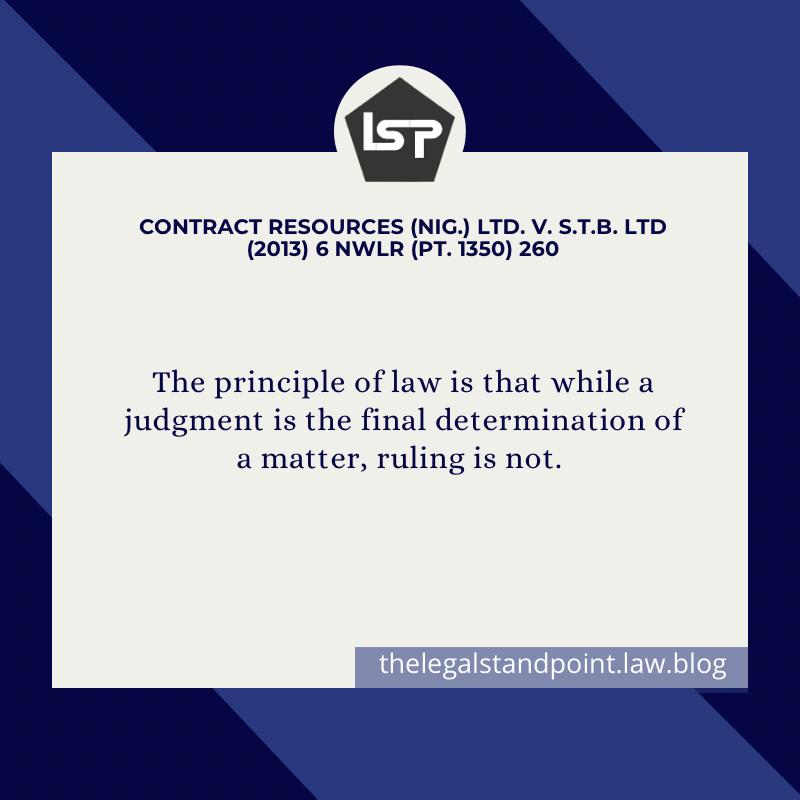
Rulings and judgments are fundamental concepts in the realm of justice and legal proceedings The term judgment is a decision or determination within the context of a court, similar to the concept of a ruling. However, it is crucial to distinguish between these two legal terms. A judgment, unlike a ruling, signifies the court’s ultimate and conclusive decision that effectively resolves the dispute at hand. In doing so, it also establishes the rights and obligations of the involved parties.

On distinction between judgment and ruling, the Supreme Court in Contract Resources (Nig.) Ltd. v. S.T.B. Ltd (2013) 6 NWLR (Pt. 1350) 260 held that: “The word judgment means a decision or determination in relation to a court just as ruling. However, in contradistinction to ruling, judgment represents a final decision of the court resolving the dispute and determining the rights and obligations of the parties

On the other hand, a ruling represents a decision or order issued by a judge or court that pertains to specific procedural or interlocutory matters during the course of a legal case. Rulings do not conclusively resolve the central issues of the case but address procedural, evidentiary, or other preliminary matters. These can include, but are not limited to:

Admissibility of Evidence: A judge may issue a ruling on the admissibility of certain evidence, determining whether it can be presented and considered in court proceedings. For example, in a criminal case, a ruling may decide whether a particular statement made by the defendant is admissible as evidence. Imagine you’re in a trial, and one side wants to use a letter as evidence. The judge has to decide if that letter is allowed in the game. This decision is a “ruling” because it’s about whether that move (the letter) is okay.

Motions: Rulings can also be related to motions filed by either party. For instance, a ruling might decide on a motion to dismiss a case, an application for leave of court to file a divorce proceeding within the two years of marriage etc.

Procedural Matters: Rulings can be made on procedural issues like the appointment of legal representatives, applications for adjournments, or requests for specific court procedures to be followed.

In conclusion, it is important to note that rulings are distinct from judgments. While rulings address specific issues within a case and can occur at various stages of the legal process, judgments represent the final, conclusive decisions that resolve the main dispute and establish the rights and obligations of the parties involved.

Thank you for reading. See you next week