
Law

LSP113: Certificate of Occupancy and Presumption of Title

The Land Use Act of 1978 categorizes lands within each state into two main types: Urban and Non-Urban land. Lands in urban areas are placed under the management and control of the Governor, as stated in Section 2(a) of the Land Use Act. On the other hand, Section 2(b) stipulates that all other lands, referred to as Non-Urban lands, shall fall under the control and management of the local government within the jurisdiction where the land is located.

The governor of a state has the power to grant a certificate of occupancy. In Nigerian law, a Certificate of Occupancy (C of O) is a crucial document that serves as evidence of lawful ownership and control of land or property. It is a formal land title issued by the appropriate government authority to an individual upon the fulfilment of the essential and formal validities required of him by law.

Generally, in some states, the initial validity of a C of O is 99 years from the date of issuance. However, this period can vary, and some states might grant C of O with shorter durations, such as 50 or 70 years.

By virtue of Section 9(1), the governor can issue a certificate of occupancy in the following circumstances:
• When granting a statutory right of occupancy to any person in pursuance of Section 5(1a).
• Where a person in occupation of land under a customary right of Occupancy applies to him.
• When any person is entitled to a statutory right of occupancy.

So the legal question is: does a Certificate of Occupancy (C of O) grant title to the holder? the principle of law is that a C of O does not confer title but acts as evidence, presuming the holder’s right to use and develop the land for a specified purpose, subject to terms and conditions outlined in the document.

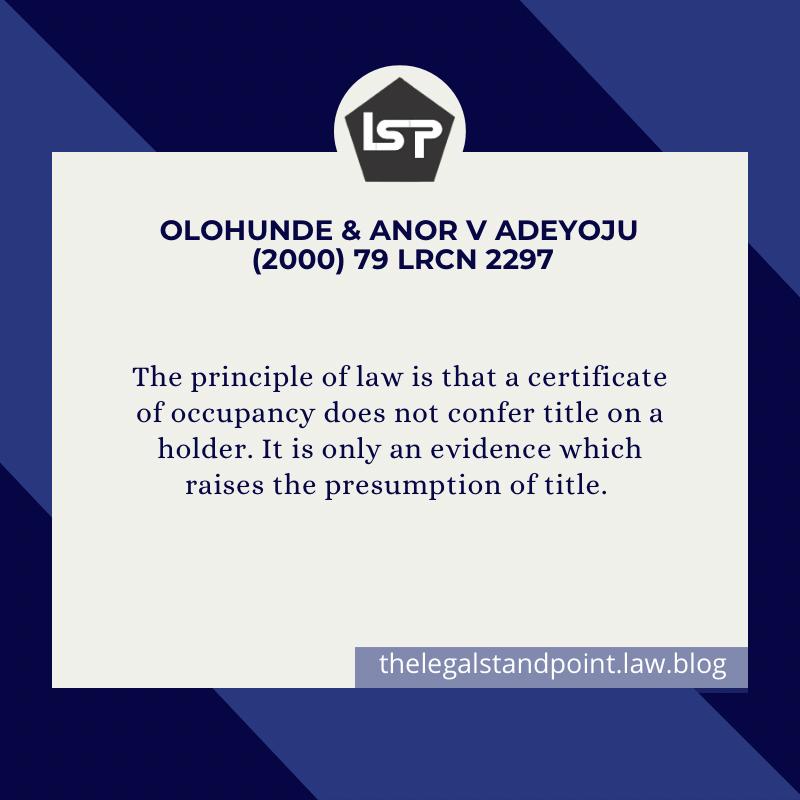
In Olohunde & Anor V Adeyoju (2000) 79 LRCN 2297 at 2328 paras D – E, the Court held that: “A certificate of statutory or customary right of occupancy issued under the Land Use Act, 1978; cannot be said to be conclusive evidence of any right, interest or valid title to land in favour of the grantee. It is at best, only a prima facie evidence of such right, interest or title without more and may in appropriate cases be effectively challenged and rendered invalid, null and void.”

Similarly, In the case of Chinye A. A. Ezeanah v. Alhaji Muhammed I. Attah (2004) 2 SCNJ 200, the court stated that “a properly issued Certificate of Occupancy (C of O) creates the presumption that the holder is the exclusive owner of the land and that no customary owner with unrevealed title existed at the time of issuance. However, this presumption can be challenged and revoked if evidence proves another person holds a superior title prior to the C of O issuance.

The underlying rationale is as follows: in a state, all lands, except those falling under specific exceptions like Federal lands, are entrusted to the Governor. Consequently, when the certificate of occupancy expires and the holder chooses not to renew it, the land returns to the state. This process ensures that the state retains control and ownership of the lands, safeguarding their proper management and utilization.

Having in mind that the Land Use Act was promulgated in 1978, what then happens to land vested in some families under customary law? Can a governor still issue a certificate of occupancy in respect of these lands? And if he does, what effect does it have in the eyes of the land? These questions were adequately answered in the 2023 Supreme Court case of Maza v. Awuna (2023) 2 NWLR (Pt. 1868) 207 244

The Court started by reemphasizing the principle of law that where land situated in an urban area had been vested in any person, prior to the commencement of the Land Use Act, such an individual shall continue to hold such land as though a statutory right of Occupancy had been granted to him by the governor. Section 34 of the Act

In this case, the appellant claimed that the respondent trespassed on the land after a dispute over a portion of it in 2004. The respondent, however, stated that he was aware of the appellant’s claim only in 2003 when the appellant presented a Certificate of Occupancy for the land. The respondent provided evidence of his ownership since 1959, conducting various acts of ownership, including selling parts of the land and cultivating economic trees. These actions preceded the issuance of the appellant’s certificate of occupancy in 1981. The supreme court held that the appellant evidence of title is void and the certificate of occupancy was revoked.

The purport of this is, for a Certificate of occupancy or any document of title to land under the Land Use Act, 1978, to be valid, there must not be in existence at the time the Certificate was issued, a statutory or customary owner of the land in issue who was not divested of his legal interest to the land prior to that Grant. Malami v. Ohikhuare (2019) 7 NWLR (Pt. 1670) 132

So in Dantsoho v. Mohammed (2003) 6 NWLR (Pt. 817) 457, the court ruled that once a valid grant or right exists over a piece of land, it can only be invalidated through lawful revocation, not by issuing another grant to a different person. In that case, the appellant’s Certificate of Occupancy, dated 7th October 1982, was deemed invalid as the respondent had an earlier Certificate of Occupancy, dated 11th August 1982, conferring title to the same land. Unless the respondent’s Certificate of Occupancy was lawfully revoked following the requirements of Section 28 of the Land Use Act, the Governor had no authority to grant another Certificate of Occupancy to someone else.

In conclusion, the principle of law is that a certificate of occupancy does not confer title on a holder. It is only evidencedence which raises the presumption of the title subject to existing ownership claims.


Thank you for reading. See you next week.
Law

LSP112: Absence of corpus delicti in Murder Convictions


Murder stands as a grave offense within the legal framework of Nigerian Criminal Law. It is categorized as a capital offense, thus carrying the severe consequence of the death penalty, as stipulated in Section 319 of the Criminal Code.

Moving on, it is a well-settled principle of law, having received judicial blessings in a plethora of cases, that in a charge of murder, the prosecution must prove the following beyond reasonable doubt: a) The deceased had died. b) The death of the deceased was caused by the accused, and c) The act or omission of the accused which caused the death of the deceased was intentional with the knowledge that death or grievous bodily harm was its probable consequence.

Today’s article seeks to answer the question: Whether the Court can convict for murder in the absence of a corpus delicti (dead body)? The concept of corpus delicti, which means “body of the crime” in Latin, refers to the evidence that a crime has been committed. While the presence of a dead body is often an important piece of evidence in murder cases, it is not always necessary for a court to convict someone of murder.

In Nigeria, a conviction for murder can be based on circumstantial evidence and testimony, even without the physical presence of a body. Over time, the courts may consider other evidence such as eyewitness testimonies, forensic evidence, DNA analysis, motive, and other supporting factors to establish the offence of murder.

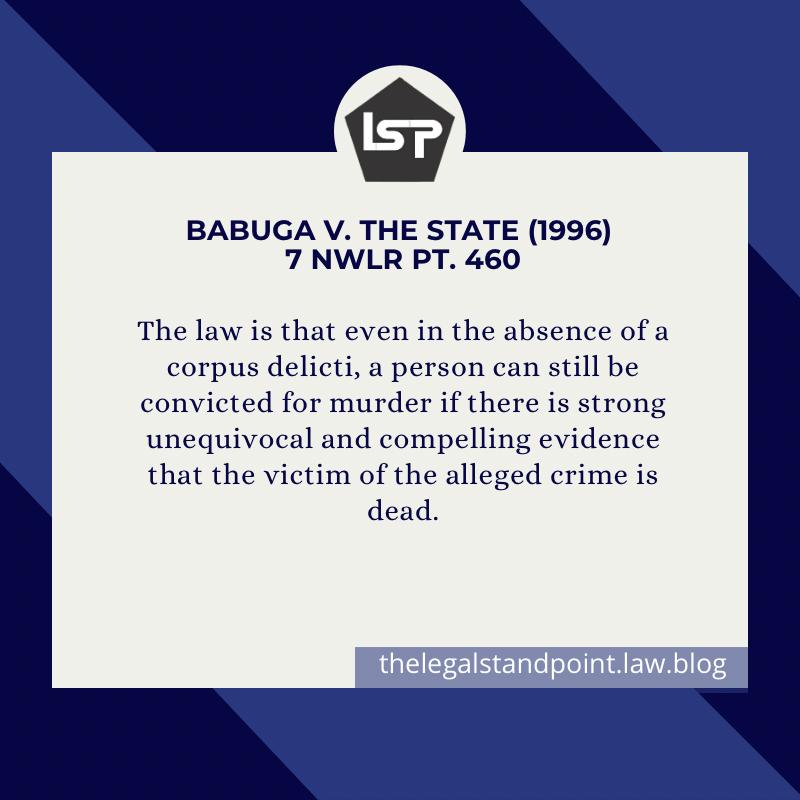
Clothing this with judicial approval, in Babuga v. The State (1996) 7 NWLR Pt. 460 pg. 279 at 296, per Onu JSC, that:- “as a matter of fact conviction can properly be secured in the absence of a corpus delicti where there is a piece of strong direct evidence. It is true that the body of the deceased has not been recovered. But it is settled that where there is positive evidence that the victim had died, failure to recover his body need not frustrate conviction.”

This principle of law is also held in Ubani v State(2003) 18 NWLR (Pt. 851) where death was inferred from the fact that the deceased was last seen with the Appellants three years ago. According to Edozie JSC on page 244 of the report: “having regard to the circumstances of this case, particularly the fact that three years after the incident, the deceased has not been found and there was no explanation from his assailants as to his whereabouts other than a bare denial of complicity in the crime, the inference is irresistible that he is dead; that it was the act of his assailants that caused his death and judging from the nature of the attack and the lethal weapons used, the attackers had the intention to kill or at least cause grievous bodily harm on the deceased. All the three ingredients of murder earlier enumerated having been established, the judgment of the trial Court convicting the 1st and 2nd appellants and the Court below affirming the conviction remains unassailable.”

In Joshua v State (2009) LPELR-8189(CA), the court per Sotonye Denton-West JCA held that in cases of extrajudicial killings, where the bodies of the victims are usually never found, the perpetrators cannot escape liability. The absence of the bodies does not absolve the murderers of responsibility

In conclusion, the principle of law is that even in the absence of a corpus delicti, a person can still be convicted of murder if there is strong unequivocal and compelling evidence that the victim of the alleged crime is dead.

Thank you for reading. See you next week.

Law

LSP111: The Position of Law on Expired NBA stamps

Generally, stamps serve as a means of identification, and this holds true in the legal profession where the same principle applies. Within the legal context, stamps act as a form of professional identification. When a lawyer attaches their stamp or seal to a legal document, it visually signifies their participation and confirms the document’s authenticity. Stamps also provide pertinent information about the lawyer, including their name, call number, and other relevant details.

In Nigeria, stamps for legal practitioners are issued by the Nigerian Bar Association (NBA). The purpose of the NBA stamp and seal is to ensure that legal practitioners who file processes in Court have their names on the roll of legal practitioners in Nigeria and that quacks, impostors and meddlesome interlopers do not infiltrate the legal profession and present themselves to litigants as legal Practitioners. 

Giving this rationale a judicial encomium, the Court in Rosolu v FRN, quoted in CBN v Eze & Anor (2021) LPELR-55554(CA) opined that ” The rationale behind this requirement in my view, is to checkmate quacks in the legal profession and ensure that legal processes are filed by genuine legal practitioners who are registered members of the Nigerian Bar Association and are truly qualified to practice law.” 

The issue of stamp and the validity of the originating processes go to the root of the case because if the originating processes are found to be invalid, then, there would have been nothing to activate the jurisdiction of the Court and consequently, the proceedings and whatever decision is reached would amount to nullity.

Having laid the background, the issue for determination is whether affixing an expired stamp on a Court process will render the same invalid and liable to be struck out. This issue has been reoccurring before the courts and an instance case is Emechebe v Ceto International (Nig) LTD (2017) LPELR-45365(CA). In that case, the Appellant contends that the Nigerian Bar Association stamp and seal affixed to the Originating Processes by the Respondent’s Counsel at the lower Court had expired and therefore the processes should be deemed irregular and that no application had been filed to regularize the said defective processes. The Respondent on the other hand argued that failure to use seal does not nullify Court processes and that in the instant case, there was in existence a valid seal of learned Counsel and that the Respondent filed an application to regularize the processes filed before the Court. 

The court Per Tijjani Abubakar, JCA  (Pp 15 – 18 Paras A – E) held that “in the instant case, since the Respondent’s Originating processes contain a stamp which bears the name and number of the Counsel who filed the said processes and it is not that the Respondent had failed to affix any stamp at all, and even if the Appellant’s contention is upheld herein, it is at best an irregularity, which can be remedied by affixing the unexpired stamp and seal, which from the records before us, learned Counsel for the Respondent no doubt has, having been clearly affixed to other Applications filed at the lower Court. Since the material constitutes part of records before us, I am bound to take judicial notice and hold that the submission of learned Counsel for the Appellant on this point lacks merit and must be and is hereby discountenanced by me.”

Furthermore, the courts have consistently held the view that dismissing an originating process solely based on an expired seal is an excessive emphasis on technicalities, which the courts disapprove of. In Emechebe’s case, the court also held that to hold as the learned Counsel for the Appellant strenuously urged us to do will amount to enthroning technicalities over substantial justice, no matter how ornamental, fancy and high-sounding submissions of Counsel may appear to be, we must elevate substantial justice over and above technicalities, it is a matter of duty for the Court to do. Similar principle of law was also held in the case of Today’s Car Limited v Lasaco Assurance PLC (2016) LPELR-41260 (CA) Pg. 6 – 86, Paras C – C. 

In conclusion, until and unless jettisoned by the Supreme Court, the judgment by multiple divisions of the Court of Appeal on this matter appears to be a positive and progressive step in the right direction. This is particularly relevant when considering situations where lawyers may experience delays in obtaining new stamps due to administrative issues. In such cases, the option of utilizing an expiry seal becomes necessary.

Thank you for reading. See you next week.