
Law

LSP097: Jurisdiction for Advanced Fee Fraud matters

From an unknown number sending a text that your BVN has been blocked to one Mr. Sunday who claimed ‘Chevron’ has given you an employment offer to several formal calculated scams, we live in a time where perpetration of fraud is on a spate. 

The offence of fraud in Nigeria is primarily governed by the Advance Fee Fraud and Other Fraud Related Offences Act. Advance fee frauds are crimes where a person or group of persons is promised a sum of money or any valuables once certain fees are paid in advance. The promise is always given with no intention of materialization. Examples of this scheme are loan scams, employment frauds, impersonation of officials, and the popular 419, among others.

Today’s analysis seeks to answer the court that has the jurisdiction to try advance fee fraud cases. 

By virtue of the provision of Section 1 of the Advance Fee Fraud and Other Fraud Related Offences Act (hereinafter referred to as the Act), any person who by false pretence, and with intent to defraud –

(a)obtain from any other person in Nigeria or in any other country, for himself or any other person induces any other person in Nigeria or in any 

(b)other country to deliver to any persons; or obtains any property, whether or not the property is obtained or its delivery is induced through the medium of a contract induced by the false pretence, is guilty of an offence under the Act.

By virtue of Section 1(3) of the Act, a person who commits an offence under Section 1(1) is liable on conviction to imprisonment for a term of not more than twenty years and not less than seven years without an option of a fine. Thus, this section gives a maximum sentence of twenty years and a minimum sentence of seven years imprisonment, both without an option of a fine.

Based on the statutory provision of Section 14 of the Act and judicial authorities enunciated in  Nweke v. FRN (2019) 10 NWLR (Pt. 1679) and Lawal v State (2020) 14 NWLR (Pt. 1744), the position of law is that Federal High Court or the High Court of the Federal Capital Territory and the High Court of the State have concurrent jurisdiction to try offences and impose penalties under the Act.

Happy new month, readers. Thank you for reading. See you next week.
Law

LSP096: Incorporated Bodies and Suit of Defamation

Every person has a right to the protection of his good name, reputation, and the estimation in which he stands in society. Therefore, whoever publishes anything injurious to that good name or reputation commits the tort of defamation. Sketch Publishing Co. Ltd. v. Ajagbemokeferi (1989) 1 NWLR (Pt.100)678. 

The tort of defamation is the act of harming the reputation of another by making either a written or oral false statement to at least a person other than the plaintiff. 

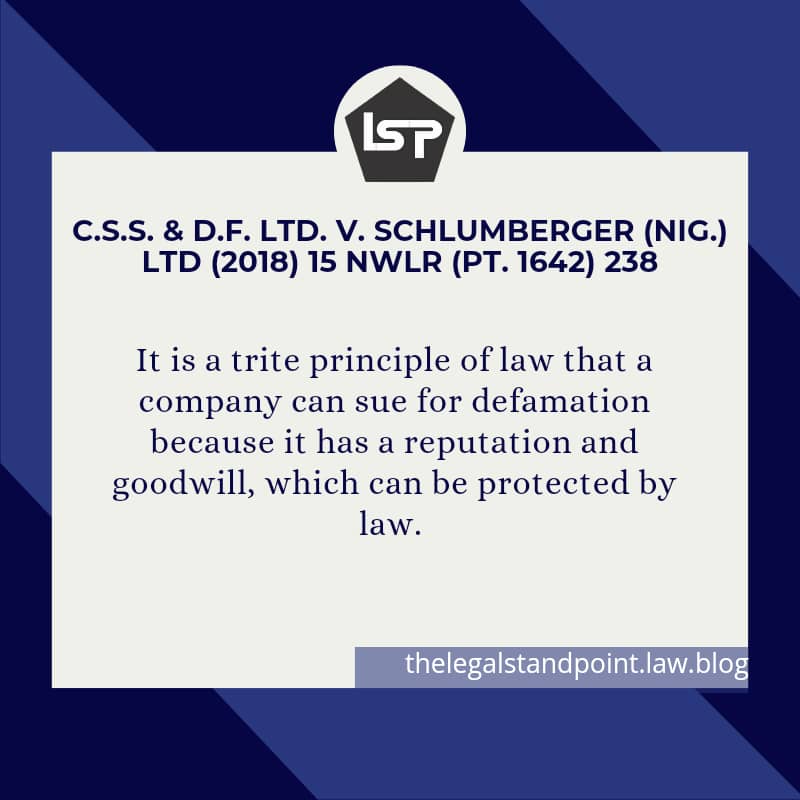
In today’s analysis, the legal question is whether or not the Tort of Defamation extends to companies in Nigeria. The Courts in a plethora of cases have held in the affirmative. 

In C.S.S. & D.F. Ltd. v. Schlumberger (Nig.) Ltd (2018) 15 NWLR (Pt. 1642) 238, the Court held that “A company can sue for defamation. It has a reputation and goodwill, which can be protected. An injury to its reputation can lead to the loss of its goodwill. The courts will, in appropriate cases, protect the reputation and goodwill of a company by an award of damages and injunction. Though a company, being an artificial person, is incapable of having natural grief and distress, this does not mean the same thing as its reputation in the way of its trade and business.

Similarly in Inland Bank (Nig.) Plc v. F.S. Co. Ltd. (2010) 15 NWLR (Pt. 1216) 395, the Court opined that  “A corporation or company can maintain an action for libel in respect of words which are calculated to injure its reputation in the way of its trade or business. Consequently, where a statement is made with regard to the mode in which a trading corporation or company conducts its business, such as to convey to right-thinking members of society generally that it conducts its business in a dishonest, improper, or inefficient manner, the corporation or company can maintain an action for defamation without proof of special damages as if it were a natural person.

It is noteworthy that a corporate body, unlike a human being, in suing for defamation can only seek damages for a pecuniary loss it has suffered and not for things only possible in personal feelings. Hence, it can sue for loss of profit, a shortfall in turnover, or anticipatory loss but not for natural grief and distress, and not for social disadvantage. Duyile v. OgunbayoSons Ltd (1988) 1 NWLR (Pt. 72) 601

Thank you for reading. See you next week.

Law

LSP095: Multiple Directorship

A director is a person duly appointed by the company to direct and manage the business of the company. Section 269(1) of Company and Allied Matters Act (CAMA) 2020

The principle of law, by virtue of Section 307(2) of CAMA 2020, is that a person shall not be a director in more than five public companies. At least one, and at most five.

In an instance where a person serves as a director in more than five public companies shall, the law is that such an individual to resign from being a director from all but five of the companies at the next annual general meeting of the companies after the expiration of two years from the commencement of this Company and Allied Matters Act. Section 307(3)

Section 307(4) laid down the penalty for non-observance of the aforementioned sections. It states that any person who acts as a director of a public company in contravention of the provisions of this section is liable to a daily penalty in such amount as the Commission shall specify in its regulations and shall refund to each of the companies every remuneration and allowances paid to him as a director in each of the companies.

Thank you for reading. See you next week.