The general principle of law is that the Supreme Court is the final court in Nigeria. It has appellate jurisdiction over appeals from the Court of Appeal.
However, there are instances where the decision of the Court of Appeal – which is the second highest court on the hierarchy of Courts in Nigeria – will be final. It’s pertinent to state that there is only one Court of Appeal in Nigeria but several judicial divisions for the sake of convenience and swift administration of justice.
One of the instances is that the decisions on appeals from the National Assembly or State House of Assembly Election Tribunals are final. This principle received statutory authority in Section 246(3) of the Constitution of the Federal Republic of Nigeria and was judicially reaffirmed in the case of Ogboru v President Court of Appeal & Anor(2005) LPELR-7473(CA)
Also, decisions of the Court of Appeal on appeals from the National Industrial Court are final. This explains why ASUU in its case with the Federal Government cannot appeal the Court’s decision to the Supreme Court. The finality of the Court of Appeal is constitutionally provided for by virtue of Section 243(4) and the case of Coca-Cola & Ors v Mrs. Titilayo Akinsanya (2013) 18 NWLR (Pt 1386).
Law and religion do overlap. This happens because an individual’s behaviour patterns and ways of life can be sometimes influenced by religion which in turn has a legal effect.
On this blog, we have discussed how these two concepts played out in a blood transfusion scenario here. Today, we shall be discussing whether the decision of a female corp member who refused to wear the mandatory NYSC trouser is valid in law.
The right to freedom of religion is one of the fundamental human rights recognized and guaranteed under the Constitution of the Federal Republic of Nigeria. Section 38 of the Constitution houses this right. Stating the scope of this right, the Court in Medical and Dental Practitioners Disciplinary Tribunal v Okonkwo (2001) 10 WRN 1 SC at 41 held that: the right to freedom of Thought, Conscience, and Religion implies a right not to be prevented, without lawful justification, from choosing the course of one’s life, fashioned on what one believes in, and a right not to be coerced into acting contrary to one’s religious belief. The limits of these freedoms, as in all cases, are when they impinge on the rights of others or where they put the welfare of society or public health in jeopardy.
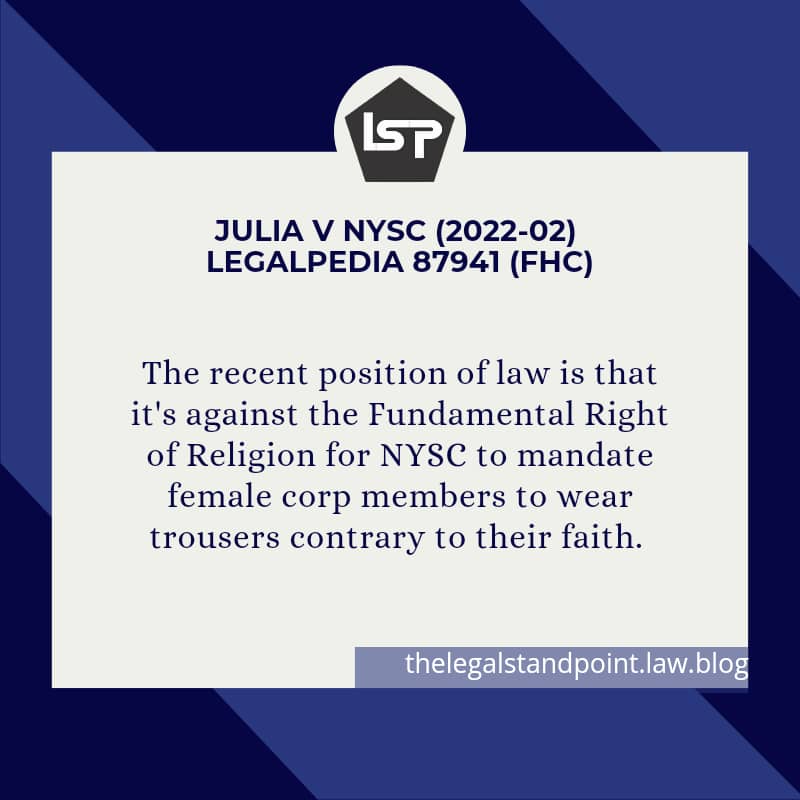
In the Federal High Court case of Julia v NYSC, Emeghoghena Julia and six others were Corp Members who graduated from the University of Ibadan in 2019. During their service, they were denied the use of a skirt as uniform by the agent of the defendant, thereby subsequently denying the plaintiff’s completion of service.
The applicants stated that the use of trousers by females was against their faith as Deuteronomy 22:5 forbids females from using/wearing male clothing such as trousers.
The applicants further stated that they were ostracized as a result of their stance and were finally de-kitted and decamped on the ground that they did not comply with the NYSC regulation for dressing.
Delivering the judgment, the Federal High Court of Nigeria, declared that the use of skirt by the applicant in National Youth Service Corps forms part of the fundamental Rights to freedom of Religion and Freedom to manifest same in practice and observance as contained in the Section 38(1) of 1999 Constitution (as amended).
The Court also ordered to recall of the applicants and restore all their entitlements in accordance with rights and benefits accorded their call mates including the issuance of call certificates of that year with damages in the sum of N1,000,000.00 (One Million Naira) each.
At this juncture, it is this writer’s opinion that this decision will likely be overturned at the higher court on the ground of public policy. However until and unless overturned, the principle of law in Nigeria is that the use of skirts during the NYSC year is permissible.
Thank you for reading. I’m wishing you a peaceful new month.
On a scale of one to ten, there is a huge possibility that you have witnessed a church marriage before. Or if you haven’t, you have heard it somewhere before now. Today’s gist is to examine the concept of a church marriage. What exactly is church marriage? Is it recognized under the law or is it a term that owes its usage to either convenience or ignorance?
The term Church Marriage usually arises when statutory marriage is considered. A statutory marriage is a voluntary union for life of one man and one woman to the exclusion of others. This form of marriage is regulated by the Marriage Act and the Matrimonial Causes Act. It is that type of marriage many Nigerians call Court marriage. As held in Motoh v Motoh (2011) 16 NWLR (Pt. 1274) 486, this type of marriage may be celebrated in one of these three ways:
(a)normal registry marriages;
(b)marriages by special licence;
(c) marriages in places of worship licensed for that purpose under section 6 of the Marriage Act.
It is pertinent to state that these three ways cannot exist cumulatively. As such, when couples visit the registry in the morning to celebrate their marriage, coming to church some other time is a mere formality and its absence will not invalidate the marriage celebration. It’s just a matter of norms and practices.
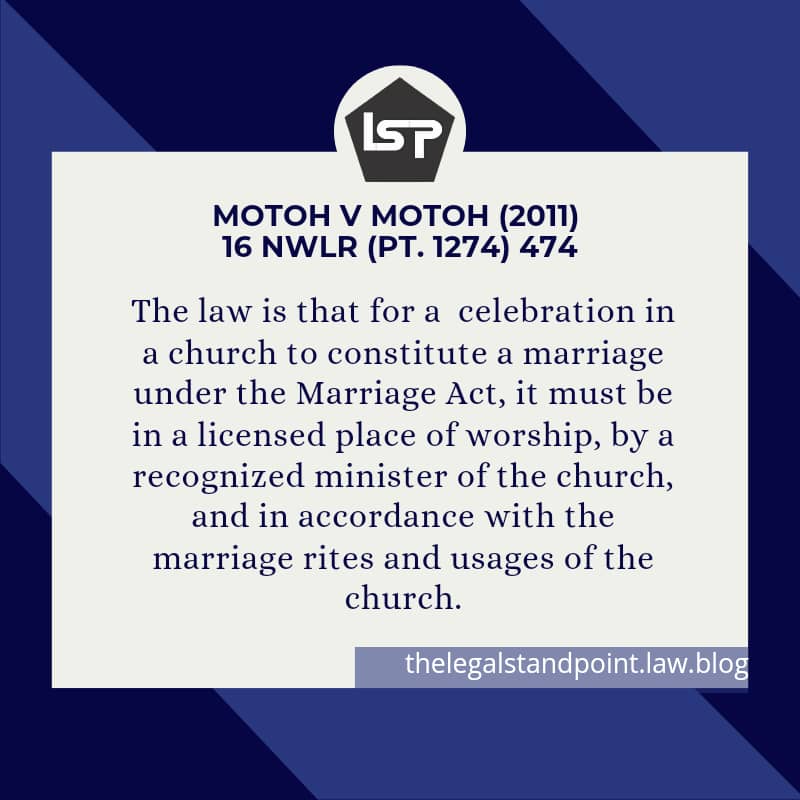
In relation to the third way, marriages can be celebrated in churches and such a marriage celebration will have the same effect as the one celebrated in the registry by the registrar. However, it is pertinent to state that not every church in Nigeria can validly celebrate a marriage. For such a celebration to be valid, the church must be a licensed place of worship.
For a celebration of marriage in a church to be valid, the requirements under Section 21 of the Marriage Act must be followed. In Ijioma v Ijioma (2009) 12 NWLR (Pt. 1156) 593, the Court of Appeal listed the requirements as follows:
The marriage must be celebrated with open doors between 8am to 6pm in the presence of at least two witnesses besides the officiating priest
Such celebration must be in accordance with the marriage rites and usages of the church and must be done by a recognized minister of the Church denomination or body to which such place of worship belongs. A celebration of a church marriage by a minister of another church makes the whole marriage null and void. For instance, it is contrary to law if a RCCG Pastor solemnises a marriage in a licensed Deeper Life church. It’s a marriage not the naming of a child.
Based on these requirements, once a church is not a licensed place of worship, any celebration of marriage and production of a marriage certificate issued will not be recognized in law as the marriage will be deemed void. At best, such a marriage will be described as a mere church blessing. Obiekwe v. Obiekwe (1963) 7 ENLR 196. Nwangwa v. Ubani (1997) 10 NWLR (Pt. 526) 559. And it’s immaterial that the celebration was well conducted. It’s the license that enables the church, not its aesthetic architectural design or size of the church.
In conclusion, church marriage is not legally one of the types of marriage in Nigeria. The term is just conveniently used to describe one of the places in which a statutory marriage can be celebrated. For a church to receive a license of celebration, certain procedures must be fulfilled. Once the license is gotten, then the celebration must compile with the provision of the law regulating it. If not, the celebration will be seen as a mere church blessing having no legal effect.


 THELEGALSTANDPOINT