
Law

LSP091: Resignation and Dismissal of an Employee

Nothing lasts forever. As such, a contract of employment could come to an end through the dismissal or retirement of an employee. However, the two are mutually exclusive. The principle of law is that once either dismissal or retirement has taken place, the other cannot follow because the two serve the same purpose. 

In Unity Bank PLC v Bako N. Chori 2021 LPELR l-55720(CA), the court per ONYEMENAM, J.C.A opined that “I acknowledge that, though the two serve the same purpose, that is, to bring to an end the life of a contract of employment, there is a clear difference. Dismissal is punitive, and usually without any terminal benefits to the employee. The employee stands disgraced and held in ignominy. On the other hand, when an employee is retired, he receives his terminal benefits under the contract of employment.”

In that case, the Respondent was an employee of the Appellant who rose to the position of a manager in one of the branches of the Appellant where he worked as a branch manager. The Appellant alleged that one of her customers applied for a facility of N5 Million but the sum of 10 Million was processed for him on the purported advice of the Respondent as the branch manager with the understanding that he will give the Respondent N5 Million to use and to later settle the account together. The Respondent responded to the said allegation and nothing was heard about it again until after his purported retirement. 

The Respondent by the policy of the bank was retired on grounds of age along with other staff. Pursuant to the said retirement, the entitlement of the Respondent was calculated and paid into his account but was withdrawn by the Appellant the same day on ground of error. The Appellant thereafter dismissed the Respondent on the ground of misconduct.

The Court held that an employer cannot legally dismiss an employee who had earlier retired since, after his retirement, such an individual ceases to be his employee. The Respondent earlier retired on 23rd July, 2012 before the purported dismissal on 1st August 2012. Since dismissal and retirement cannot exist side by side nor follow each other, the first in time which is retirement prevails after having ended the contract of employment already.

In conclusion, this principle reflects the general principle of nature that one cannot place something on nothing and expect it to stand. Given that the said individual has retired and ceased to be an employee, an employer can’t then dismiss him. Oti lor

Thank you for reading. See you next week.
Law

LSP090: Age of Criminal Responsibility in Capital Offences

Generally, capital offences are offences punishable by death. It could be committed by both adults and young persons. Where an accused person in a criminal trial is considered an adult, there is no duty on the court to inquire into his age. 

However, the duty to make an inquiry into the Age of the accused only arises when he appears to the trial court to be a juvenile. Okoro v State 1998) 4 NWLR (Pt. 544) 115 C.A. For the purpose of criminal responsibility, a juvenile person in this context is someone less than Seventeen (17) years old. 

The law, as statutorily provided for in Section 272 (1)of the Criminal Procedure Code, is that where a person is convicted of an offence punishable with death and it appears to the court by which he is convicted that he was under the age of seventeen years when he committed the offence, the court shall order that he be detained during the Governor’s pleasure. 

A juvenile detained by virtue of this provision must be placed in legal custody and may be discharged by the Governor on license provided that certain requirements are met. Section 303 of the CPC. 

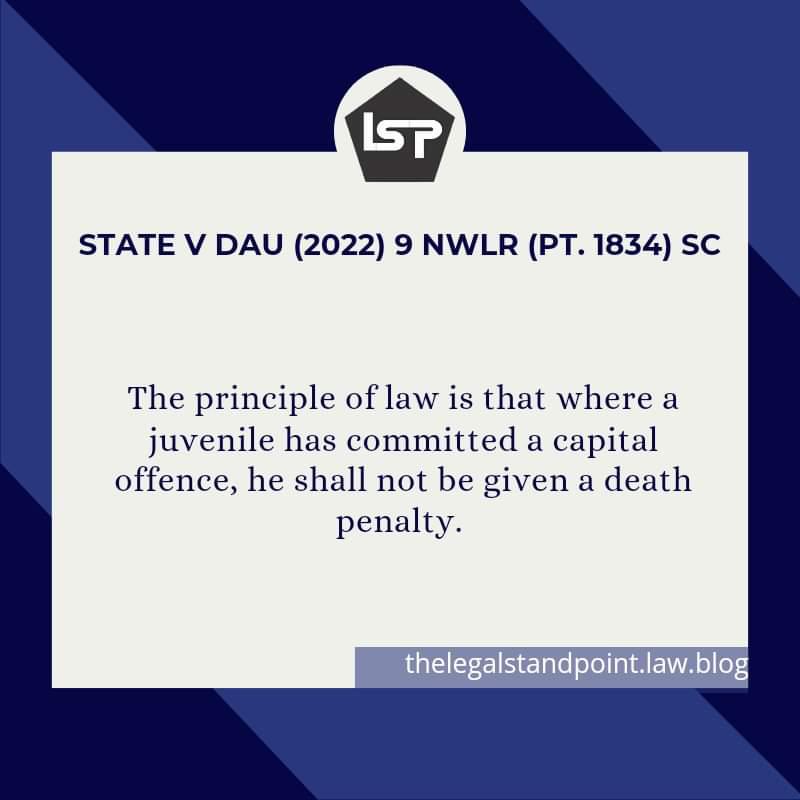
In State v Dau (2022) 9 NWLR (Pt. 1834) SC, the respondent in this appeal had been convicted for culpable homicide punishable with death and sentenced to fifty years imprisonment after conviction by the trial court. The respondent had hit the deceased on the head with the axe belonging to the deceased during a quarrel provoked by the said deceased. The respondent was Fourteen (14) years old at that time. He had also been imprisoned since that time spanning over Sixteen (16) years. 

On appeal, the Appeal court quashed the decision of the trial  Court and held that it was wrong and illegal for the trial court to have sentenced the respondent to Fifty (50) years imprisonment since he was a minor at the time of commission. To make up for the years he had lost as a result of this injustice, the court ordered that he be discharged and released from custody.  

Stating the rationale, the Supreme Court per Ariwoola JSC (now CJN) opined thus: “the draftsmen of section 272(2) of the Criminal Procedure Code and section 12 of the Children and Young Persons Act had a good reason for absolving children and young persons from criminal liability. One of the reasons is that a child lacks the power of self-control and to understand the full import of a criminal act. If a sudden temper can cause an adult to lose control of his mind temporarily, how much more is a child? In the instant case, the respondent committed the offence whilst yet at the Age of criminal irresponsibility provided under section 272(2) of the criminal Procedure Code and section 12 of the Children and Young Persons Act. Therefore, it would amount to grave injustice on the respondent to either pronounce capital punishment on him or incarcerate him for life for an offence which he committed whilst under seventeen years of Age and whilst temporarily deprived of the power of his self-control. (Pp. 82-83, paras. H-C).”

Law

LSP089: Suicide and Attempted Suicide

Suicide and attempted suicide are crimes in Nigeria by virtue of its provisions in the Criminal Code. Section 326 of the Criminal Code states that anyone who aids another person to commit suicide is guilty of a felony and is liable to life imprisonment while Section 327 states that anyone who attempted suicide is guilty of a misdemeanor and is liable for an imprisonment of one year.

While the aforementioned provisions are clear and unambiguous, they appear not to be in sync with the realities of present-day Nigeria especially in relation to the crime of attempted suicide. 

No doubt, any sane person who attempts suicide is definitely going through serious life challenges. As such, rather than punitively commute such an individual to prison, it is suggested that he or she should be placed on compulsory counselling and made to do community service. With this, rehabilitation is within reach and possible. 

In conclusion, while we can only hope for a repeal of the Criminal Code, the law in Nigeria is that aiding someone to take his life or attempting to take your own life is a crime punishable by imprisonment.

Thank you for reading. See you next week