

Law

LSP080: Unlawful Possession of Firearms

Perhaps the best way to start this article is to remind our readers of the fundamental principle of criminal liability which states that for an act to count as an offence, it must have both physical and mental elements. The physical element of a crime is regarded as the guilty act, that is, the overt act which the law forbids while the mental element refers to the guilty mind of the accused. Legally, these elements are called Actus Reus and Mens Rea. This principle is expressed in the Latin maxim “actus non facit reum, nisi mens sit rea’, which literally means an act does not make one guilty unless the mind is also guilty. 

Putting it in context, the actus reus of the offence of stealing is the taking or moving of the property while the mental element is the accused’s fraudulent intent to deprive the owner of that property permanently.

However, for every general principle of law, there is always an exception. And the exception to this principle is strict liability offences. Strict liability offences are offences where a defendant can be convicted notwithstanding that he did not have any mens rea. One of the strict liability offences which we would be considering today is illegal possession of firearms.

In Kelly v State (2022) LPELR-57325(SC) (not the Kelly on Tiktok😂), the appellant was charged with the offence of unlawful possession of firearms contrary to Section 3(1) of the robbery and firearms (Special Provisions) Act, Laws of the Federation of Nigeria, 2004. He was sentenced to ten years imprisonment. Dissatisfied with both the decisions of the Trial Court and the Court of Appeal, the appellant appealed to the Supreme Court.

As a starting point, the Supreme Court held that to succeed against an accused person in a charge of unlawful possession of firearms, the prosecution is duty bound to prove the following essential elements beyond reasonable doubt:

  1. that the accused person was found in possession of a firearm:
  2. that the firearm is within the meaning of the Act; and
  3. that the accused person has no licence to possess a firearm. See Bille v. State (2016) LPELR – 40832 (SC).

Dismissing the appeal, the Court held that the intent of the legislature in Section 3(1) of the Robbery and Firearms (Special Provisions) Act is, that once a person is shown to be in possession of firearms and has no licence permitting him to be in possession, he is liable. Adamu Jauro, J.S.C held that: “the law punishes unlawful possession simpliciter. In other words, as long as the accused person is found in possession of a firearm, it is immaterial whether he intends to use it or whether it belongs to someone else. In the case at hand, assuming the Appellant was truly unaware of the contents of the black nylon in which the gun was found, the lack of knowledge would not have availed him. The offence is a strict liability offence. As long as the accused person is found in possession of a firearm and the three aforementioned ingredients are present, he is guilty of the offence of unlawful possession of firearms.”

In State v. Oladotun (2011) LPELR-3226(SC), the provisions of Section 3(1) of the Robbery and Firearms (Special Provision) Act, supra, were considered; and, the Supreme Court, Per Mukhtar JSC (as he then was) said: “it is palpably clear that the presence and recovery of the gun suggest that the respondent had guilty knowledge. I say so because no person can ordinarily be seen with such dangerous objects with cartridges without an ill motive to perform acts that are contrary to the law. Moving around with a dangerous weapon when he is not a law enforcement agent definitely raises the presumption of guilt. The provision of the Firearms Act supra is simply on possession, no more no less. That is to say that the intent of the legislature lays emphasis on possession, which represents the mere fact that a firearm is found in possession of a person, once the three ingredients stated above have been established, that provision has been met.”

In conclusion, unlawful possession of firearms is a strict liability offence under Nigerian Criminal law. The only exception that the law recognises is the use of a licence and the burden is on the accused to prove his lawful possession by producing the licence that allowed him to have possession of the firearms.

Thank you for reading. See you next week.
Law

LSP079: Diplomatic Immunity and Municipal Courts

Diplomatic immunity is a principle of international law by which foreign government officials are shielded from lawsuits under the host country’s laws for their official activities.

Commenting on the nature of and scope of diplomatic immunity, Sunday JSC (as he then was) in AFRICAN REINSURANCE CORPORATION v J.D.P. CONSTRUCTION (NIG) LTD(2007) LPELR-216(SC) held thus: “the idea of diplomatic immunity was developed from one of the consequences of State equality rule which is expressed in the Latin maxim: par in parem non habet imperium – meaning: no State can claim jurisdiction over another. In practice, although, States can sue in foreign courts, they cannot as a rule be sued there unless they voluntarily submit to the jurisdiction of the court concerned…. the practice of granting diplomatic immunity to States has in practice, been extended to government naval ships, properties, and government servants acting in their official capacities. But such immunity is no longer granted to a foreign State in respect of acts that are non-governmental, which means in most cases, the acts of a foreign state as a trader.”

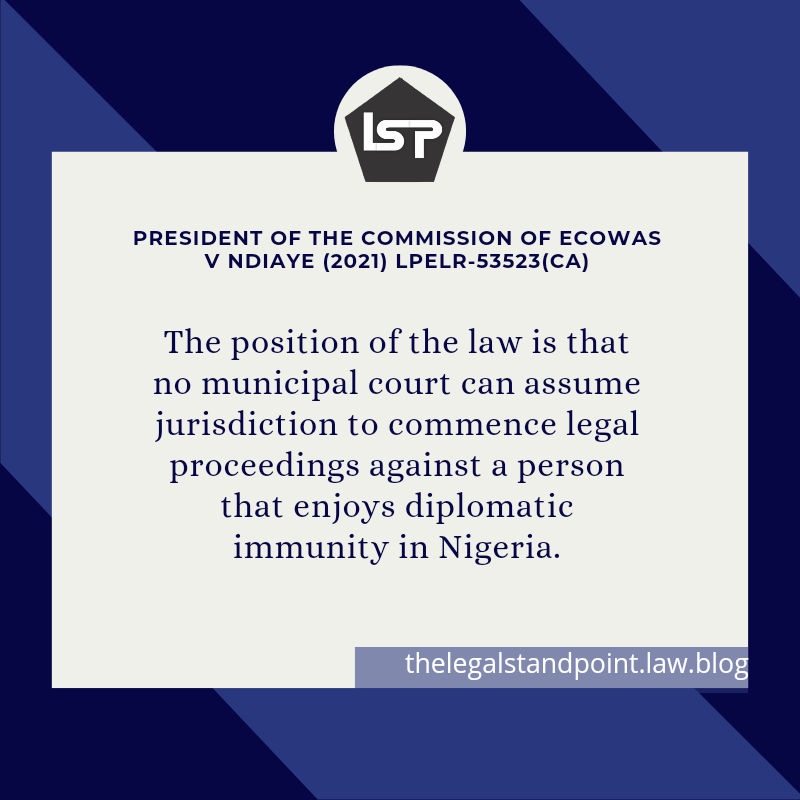
In PRESIDENT OF THE COMMISSION OF ECOWAS v NDIAYE (2021) LPELR-53523(CA), the Respondent, a staff of the Economic Community of West African States (ECOWAS), instituted an action against the President of ECOWAS at the National Industrial Court (NIC) of Nigeria, Abuja Judicial Division for unlawful suspension of employment and damages for libelous suspension letter.

On the matter of jurisdiction, which is the crux of the suit, respondent, who was the plaintiff at the NIC, contended that the court had the jurisdiction to adjudicate on the matter. He supported his assertion with Section 254C(2) of the 1999 Constitution of the Federal Republic of Nigeria which states that: Notwithstanding anything to the contrary in this Constitution, the National Industrial Court shall have the jurisdiction and power to deal with any matter connected with or pertaining to the application of any international convention, treaty or protocol of which Nigeria has ratified relating to labour, employment, workplace, industrial relations or matters connected therewith. 

At the end of the trial, judgment was given in favour of the employee. Dissatisfied, the appellant sued at the Court of Appeal. And the fundamental issue for determination is whether diplomats are susceptible to the jurisdiction of local courts in the host country. Since the issue of jurisdiction is so pivotal, it means that once the NIC has no jurisdiction,  then the judgment given in the plaintiff’s favour becomes null, void, and ineffective. 

In addressing and allowing the appeal, the upper court held that the NIC did not have the jurisdiction to adjudicate the suit. Their ratio decidendi was hinged on three things: first, Section 18 of the Diplomatic Immunities and Privileges Act, the judicial authority of African Reinsurance Corporation v Abate Fantaye (1986) 3 NWLR (PT 32) 811, and the Certificate of Immunity written by the Minister of Foreign Affairs of Nigeria on the ECOWAS Revised Treaty of 1993 which Nigeria has ratified. The letter reads: “the ministry of Foreign Affairs wishes to reaffirm the status of the ECOWAS Commission as an international organization and the immunity and privileges of the Commission and its staff members with exception of Nigerians and holders of Nigeria permanent residency from Criminal, Civil and Administrative proceedings by virtue of ECOWAS Revised Treaty by of 1993, which was ratified by the Federal Republic of Nigeria on 1st July, 1994.”

As such, the court held that all these factors are conclusive evidence affirming the appellant’s immunity from prosecution in the municipal Courts of Nigeria.

Moving on, it is pertinent to state that the fact that the appellant’s base of operation is in Nigeria or that Nigeria is the Host Country does not make the appellant subservient to the jurisdiction of Nigerian Courts. 

Addressing the respondent’s argument in favour of NIC jurisdiction, the Court held that, Section 254C(2) of the Constitution only confers on the National Industrial Court power to apply international conventions, protocols and treaties ratified by Nigeria relating to labour, employment, workplace, industrial relations and matters connected therewith while exercising its jurisdiction over persons subject to its jurisdiction. Diplomats who enjoy immunity from Court processes from municipal Courts in Nigeria like the Respondent are not such persons.

In conclusion, the Court of Appeal restated the aged principle of law that a State enjoys immunity from the jurisdiction of municipal courts, in respect of itself and its persons. 

Thank you for reading. See you next week.🙏

Law

LSP078: Salary during strike: The Legal Position

Strikes are not uncommon under the Nigerian Labour Jurisprudence. In fact, it is commonly said that strike is the only language that the government (employer) understands. The legal question today is whether employees who went on a strike are entitled to payment of salaries for that period?

Answering this, it is pertinent to note that the Nigerian jurisprudence on industrial strike actions is fashioned in accordance with the English common law principle of No Work; no Pay. In Morgan v. Fry (1968) 2 QB 710 at 729, it was held that “to a layman, the position is quite clear: in a strike, the men do not work, and the employers pay no wages.”

This principle has been statutorily documented in Nigeria by virtue of Section 43(1)(a) of the Trade Disputes Act. The section states: 

(1) Notwithstanding anything contained in this Act or in any other law-

(a) where any worker takes part in a strike, he shall not be entitled to any wages or other remuneration for the period of the strike, and any such period shall not count for the purpose of reckoning the period of continuous employment and all rights dependent on continuity of employment shall be prejudicially affected accordingly.

This statutory provision came up for judicial interpretation in the case of ABDULRAHEEM & ORS v OLUFEAGBA & ORS (2006) LPELR-11817(CA). In that case, the 43 respondents were employed, at different times in different departments, as lecturers at the University of Ilorin (the 3rd appellant). They embarked on both domestic and national strikes. The appellants, by letters of cessation of appointments dated 25-05-01, terminated the appointment of the respondents. 

Several issues were up for determination in that case. However, of particular relevance to this analysis, is whether they are entitled to their salaries? at the trial court, the lecturers won. However, on appeal, they lost by a majority of 2-1 decision, with OGUNWUMIJU, J.C.A (as he then was) dissenting. 

Giving its rationale, the Court held that “it was inconsiderate for the lower Court to award them such salaries and allowances in fact, it is illegal in fact it is inequitable for the lower Court to have ordered the payment of the respondents after withholding their services from the 3rd appellant. Equity does not do inequity.”

Speaking in the same vein, the Court further held that “the order of the learned trial Judge was given in clear violation of the provisions of Section 43(1)(a) of the Trade Dispute Act. It is my considered view that in the light of the unambiguous provision of the law stated supra…. the award of the salaries and allowances to the respondents by the trial Judge is not only illegal but also inequitable.”

In conclusion, the principle of law is that employees who embark on a strike shall not be entitled to remuneration or wages.

Thank you for reading. See you next week.