Adulthood is all paying bills. Nothing more; nothing less. As such, after the rigorous journey of getting called to the Bar, legal practitioners have to pay bills. The law must sha chop.
One of the ways by which bills could be paid is through the salary gotten via one’s job. To get clients to pay for services, one needs advertisement either formally or informally. Simply put, advertisement is a marketing strategy that is aimed at bringing public awareness to a product or service.
In the Nigerian Legal Profession, advertisement is provided for in Rule 39 of the Rules of Professional Conduct, 2007. It is pertinent to note nothing forbids a legal practitioner or a law firm from advertising provided such advertisement doesn’t contradict the provisions of the RPC. In other words, advertisement is allowed to an extent.
Rule 39 of the Rules of Professional Conduct provides as follows:
(1) Subject to paragraphs (2) and (3) of this rule a lawyer may engage in any advertising or promotion in connection with his practice of the law, provided:
(a) It is fair and proper in all the circumstances (b) It complies with the provisions of these Rules
(2) A lawyer shall not engage or be involved in any advertising or promotion of his practice of the law which –
(a) Is inaccurate or likely to mislead;
(b) Is likely to diminish public confidence in the legal profession, or the Administration of Justice, or otherwise, bring the legal profession into disrepute;
(c) Makes comparison with or criticises other lawyers or other professions or professionals;
(d) Includes statement about the quality of the lawyer’s work, the size of success of his practice or his success rate; or
(e) Is so frequent or obstructive as to cause annoyances to those to whom it is directed.
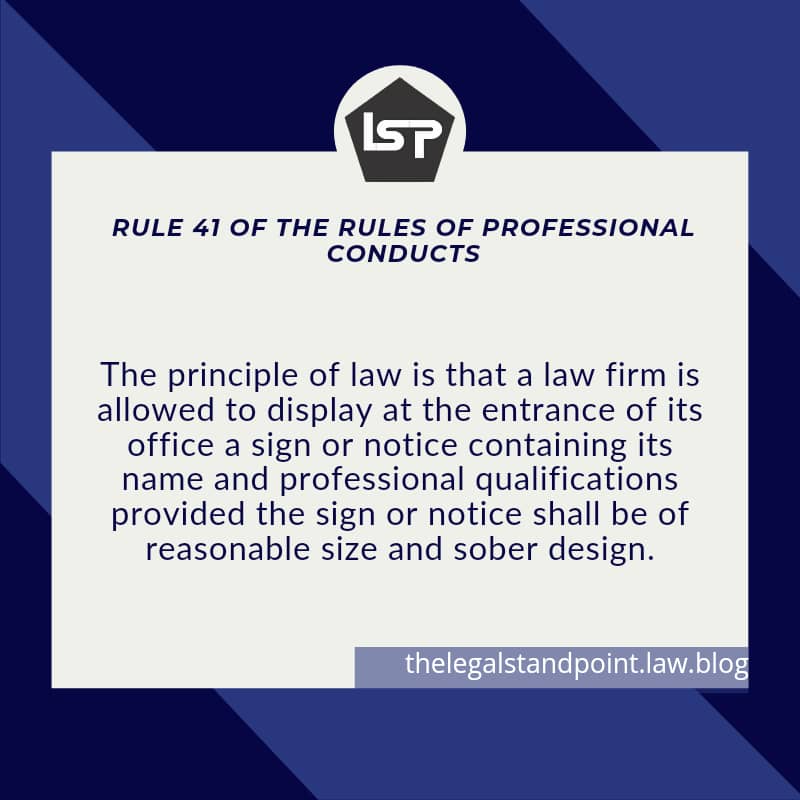
With this in mind, you will now notice why the sign or noticeboard of law firms in Nigeria are of reasonable size, less conspicuous, and contain sober colours. It would be contrary to the law for any law firm to use a big signpost or make use of the billboard to announce its services. See Rule 41 of the RPC.
In conclusion, the rule against the improper attraction of business is aimed to protect the dignity of the legal profession and prevent the unhealthy competition that might arise in the course of superiority among legal practitioners and law firms in Nigeria.
The concept of lion’s share was what I was well acquainted with while growing up. House chores were usually chunked out to me and my siblings. And the rule then at home was that the quantity of your food depends on how much you work. This rule also extends to the allotment of punishment at home.
While the concept of the lion’s share is well enshrined in most social spaces, the same doesn’t apply in an allotment of punishment in Criminal law provided there was a common intention to commit a crime.
In Adio v State (1986) NWLR (pt.24) 581, the Court defined common intention as one which will make the act of one accused the act of the other if the offence committed is in furtherance of the prosecution of their unlawful common purpose. Section 8 of the Criminal Code
The principle of law as held in a plethora of cases such as Alarape v State (201) 2 SC 164 Mohammed v State (1980) 3-4 SC 56 is that in a concerted attack to prosecute an unlawful purpose, it is not the law to look for the person who struck the lethal blow. Everyone who partakes in the attack is equally guilty of the crime committed during prosecution of the unlawful purpose.
In other words, where common intention is established, a fatal blow or gunshot, though given by any of the parties, is deemed in the eyes of the law to have been given by all those present and participating. The person who actually delivered the fatal blow is, in that case, no more than the hand by which others also struck.
Putting it in context, if Ade, Bisi, and Yinka committed the offence of armed robbery and it was Yinka who drove the car, while Bisi and Ade were the ones who shot the gun and took the money. The law will consider the trio as guilty and given the same punishment. It’s no defence to say Yinka had lesser participation.
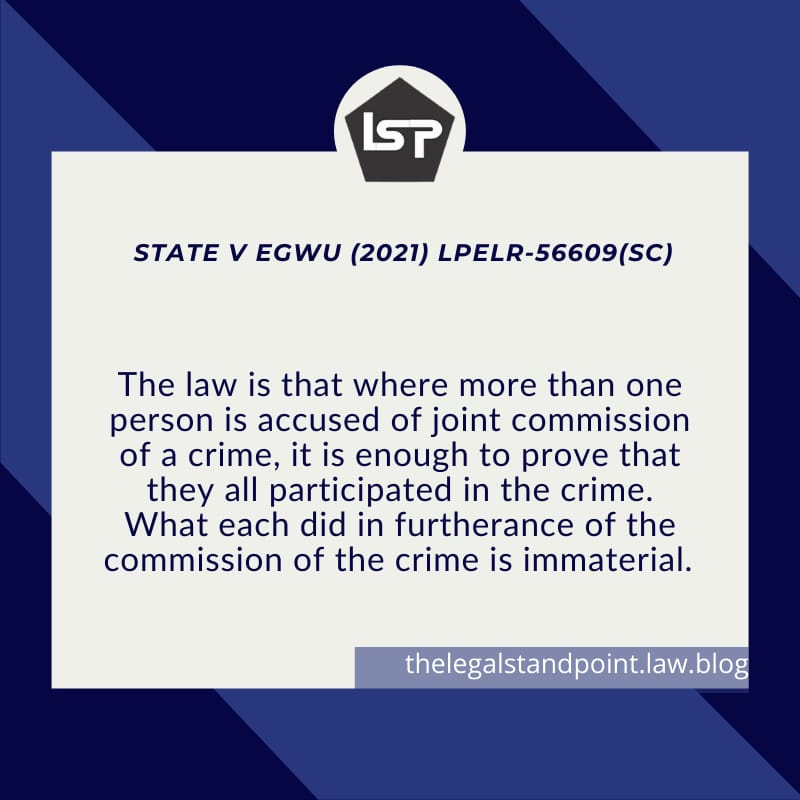
Hence in State v Egwu, the respondent, as President of Youths of Amorie Ozizza Community in Afikpo North L.G.A of Ebonyi State, directed members of the Task Force of the Youths Association of the Amaorie Ozziza to go out as a group to compel youths in the community to attend the meeting of the youths of the community to hold that day at the community playground concerning some development projects to be executed by the community. Armed with sticks, machetes, and axes, the youths invaded the home of one Ali Agha to compel him to attend the said meeting. In the process of compelling him to follow them, they killed him by inflicting multiple machete cuts on his body resulting in acute loss of blood.
The Supreme Court, reaffirming the judgment of the High Court, and reversing the Court of Appeal decision, held that the respondent was guilty of the offence of murder. And it was immaterial that he only gave the directives.
One day, while coming back from the viewing center, my friend and I had a discourse on power and dominance. His team – Arsenal – had just been annihilated by the clinical Manchester City. Perhaps this prompted him to assert that the world is structured in a way where the powerful ones prey on the feeble.
With disappointment in his voice, he gave examples of how, during pre-independence, the white victimised the blacks. How men abuse women and how women in turn now prey on children. He ended by saying everyone was just searching for who to assert dominance over.
While I didn’t totally agree with his submissions, I wouldn’t deny the fact that the world is structured in a binary form of powerful and less powerful. In today’s article, we would discuss how this idea reflects in law between the state and local governments in Nigeria.
By virtue of section 2(2) of the Constitution of the Federal Republic of Nigeria, Nigeria operates a federal system of government comprising the federal, state, and local governments. Over time, people consider the federal and state government as the “big boys” and the local governments as those who want to “bambam” with the big boys. In other words, the state government is considered more powerful than the local government.
With this background, the question then becomes whether or not the state governments in Nigeria can validly and legally remove the elected governing council of a local government? This issue, recently, came up for determination in Governor Ekiti State & Ors v Olubunmo & Ors (2016) LPELR-48040(SC).
Succinctly, the fact of the case goes thus: The respondents were elected into the Local Government Councils in Ekiti State. Their tenure was for three years, that is from 20 December 2008 to 19 December 2011. On 29 October 2010, the appellants, pursuant to section 23B of the Ekiti State Local Government Administration (Amendments) Law, 2001, by a radio announcement, dissolved the Local Government Councils and removed the respondents, and appointed unelected caretaker committees in their place. Outraged by this action, the respondents challenged the dissolution of the councils in the court.
On appeal and further appeal, the Supreme held that the action of the appellant was unconstitutional. In reaching this decision, attention was given to both statutory and judicial authorities.
Firstly, section 23B of the Ekiti State Local Government Administration (Amendments) Law, 2001 states that “the Governor is by this law empowered to dissolve Local Government Councils for overriding public interest subject to the two-thirds majority approval of members of the House of Assembly”.
Moving on, section 7(1) of the Constitution states that “the system of local government by democratically elected local government councils is under this Constitution guaranteed; and accordingly, the Government of every State shall, subject to section 8 of this Constitution, ensure their existence under a Law which provides for the establishment, structure, composition, finance, and functions of such councils.”
Put differently, the Constitution intends to vouchsafe the inviolability of the sacred mandate which the electorate, at that level, democratically donated to the Local government council. As such, it is obvious from the Constitution that section 7(1) thereof guarantees democratically-elected Local Government Councils throughout Nigeria by establishing their existence. See Eze & Ors. v. Governor, Abia State & Ors. (2014) 14 NWLR (Pt. 1426) 192.
In Nigeria, it is indubitably an elementary position that the Constitution is the supreme law of the land and any law which is contrary to the provision of the constitution is null and void. See section 1(1) & (3) of the Constitution and Amadi v. INEC (2012) All FWLR (Pt. 621) 1415. As such, since the provision of Ekiti State Local Government Administration (Amendments) Law, 2001 ran contrary to the provision of the Constitution, the former became null and void. Attorney-General, Abia State v. Attorney-General, Federation (2007) 1 CCLR 104.
On judicial authority, the supreme was influenced by an earlier precedent set in Attorney-General Plateau State v. Goyol (2007) 16 NWLR (Pt. 1059), where the court held that: “the Governor swore to preserve, protect and defend the Constitution and not to mutilate it. Although the House of Assembly has the power to make laws, (it) has no power to make any law by giving the Governor power to truncate a democratically-elected Local Government Council. The penchant by State Governors in dissolving Local Government Councils is clearly undemocratic. It is only when a state of emergency has been declared that can warrant the suspension of democratic institutions in the polity.
Furthermore, the elected governing councils could only be removed if found to be in breach of the rules governing the office as held in Eze v. Governor, Abia State (supra), or by proof that it was in the overriding public interest. These were not shown in the case under review as the appellants failed to demonstrate these facts. The supreme then held that the removal was unconstitutional and that the respondents’ entitlements be paid.
In conclusion, the supreme court judgment reaffirmed the importance of the governing council of the local governments by not portraying them as ‘weak’ and further sets an example to prevent the discretionary exercise of any governor’s power who may want to remove these democratically elected individuals without a just cause.


 THELEGALSTANDPOINT