
Law

LSP037: Election Petition Filling

The trajectory of most Nigerian elections doesn’t end when the result is announced. More often than not, parties always have reason(s) to reject the election results. This has made the election Tribunals and Courts the aftermath of most elections. Hence, an electoral petition is the process that is meant to challenge the validity of an election.

An election petition may be presented by one or more of the following persons -(a) a candidate in an election;(b) a political party that participated in the election. See Section 137 (1) (a) & (b) of the Electoral Act and NYESOM v. PETERSIDE & ORS(2016) LPELR-SC.1002/2015.

Furthermore, election cases are different from civil and criminal cases and the procedural rules applicable to civil and criminal proceedings are not strictly applicable in election petitions. This is the reason election petition proceeding is referred to as sui generis because it has its own rules and procedures. In Egharevba V Eribo (2010) 9 NWLR (Pt. 1199)411, the Supreme Court held that “An election legislation creates a special jurisdiction and the ordinary rules of procedure in civil cases do not always serve to effectuate its purpose.”

By virtue of Section 285(5) of the Constitution of the Federal Republic of Nigeria and Section 134(1) of the Electoral Act, 2010, an election petition shall be filed within twenty-one (21) days after the date of the declaration of results of the elections. Section 134(2) of the Act also states that an electoral petition must deliver its judgment in writing within One Hundred and Eighty Days (180) days from the date of the filling of the petition. The rationale for this swift determination is to allow the elected leaders remain focused on ensuring good governance and not perturbed with litigation.

It is pertinent to note that the date the result is declared is excluded from the computation of time. See Section 15(2) Interpretation Act. In Michael Peter & Anor v Enemi Alabo & Ors(2019) LPELR-CA/PH/EPT/560/2019, there was an election to represent the Asari-Toru Constituency 2 at the Rivers State of Assembly. The result was declared on the 9th day of March 2019.

The petitioner filed his petition on 3rd May, 2019. The Court held that the case was statute-barred because it was filed outside the 21 days prescribed by the Constitution and the Electoral Act.

If a petition is not brought within the time frame, such an action will not be extended, it will be deemed statute-barred and the petitioner shall lose his right of relief. In MARWA & ORS V NYAKO & ORS (2012) LPELR – 7873 (SC) the apex Court, per ONNOGHEN, JSC held thus: – “It is settled law that the time fixed by the Constitution for doing anything cannot be extended. It is immutable, fixed like the rock of Gibraltar. It cannot be extended, elongated, expanded or stretched beyond what it states.”
Law

LSP036: Jurisdiction of Court on Simple Contract

In the spirit of festivity, Happy Eid-l-fitr to all our Muslim readers. We pray Allah answer all your prayer requests during and even after Ramadan. Send my meat if you dor wanra see crazy😃.

Moving in, today’s discourse centers on the Court which has the jurisdiction to entertain simple contract actions when a Federal Government agency is involved.

According to Professor Sagay, simple contracts are all contracts other than formal contracts or contracts required to be under seal. They may be in writing or oral. In this form of contract, it is only a party who has furnished consideration that can bring an action for enforcement of the contract.

Section 251(1) of the Constitution of the Federal Republic of Nigeria(1999 as amended) houses a long list of actions in which the Federal High Court has exclusive jurisdiction to entertain. Particularly, it provides that the Federal High Court shall have exclusive jurisdiction in any matters involving the agencies of the federal government. However, to every rule, there is an exception.

Thus, where an agency of the Federal Government is a party in a matter, the question of jurisdiction becomes two dimensional, that is, Party Jurisdiction and Subject Matter Jurisdiction which the Courts are expected to consider.

The position of Law is that if the res of the suit comes within the provisions under Section 251, then the Federal High Court will have exclusive jurisdiction. However, if the subject matter falls outside the precincts of Section 251, then a State High Court will be vested with jurisdiction notwithstanding that the party involved is a Federal Government agency.

The res of an action basically means what is being litigated upon – the subject matter of the action which both parties seek to preserve for themselves. And in determining the res of a matter, attention is often given to the plaintiff’s statement of claim. See the case of Obiuweubi v. C.B.N. (2011) ALL FWLR (Pt. 321) p.208.

It is worthy to mention that the principle in the celebrated case of NEPA v Edegbenro (2002) 13 SCM P. 78 at 89 is often being erroneously relied upon to canvass argument for party jurisdiction. The principle then was that the Federal High Court should always have jurisdiction when the agencies of the federal government are involved irrespective of the claim. Nevertheless, as stated by Adekeye JCA (as he then was) at (P. 14, paras. A-D) in Isuama v Governor of Ebonyi State of Nigeria & Ors (2005) LPELR-CA/E/163/2004: The case (Nepa v Edegbenro) did not decide on subject-matter jurisdiction.

Based on this, the fact that an action is against agents of the Federal Government of Nigeria does not ipso facto bring the case within the jurisdiction of the Federal High Court, unless the subject matter of the action falls squarely within the jurisdiction of the Federal High Court before the Court can assume jurisdiction in the case against the Federal Government or any of its agencies. Subject matters like breach of Contracts, Negligence, etc against Federal Government Agencies are not within the purview of Section 251 of the CFRN 1999. And since it is impossible to place something on nothing and expect it to stands, it becomes an exercise in futility for the Federal High Court to entertain a matter in which it does not have the authority.

In Essi V. Nigeria Ports, Kekere-Ekun, JSC stated thus: Where the exclusive jurisdiction of the Federal High Court is in issue, the mere fact that an agency of the Federal Government is a party is not sufficient, without more to confer jurisdiction on the Court. The Court deciding the issue will also take into consideration the nature and subject matter of claim.

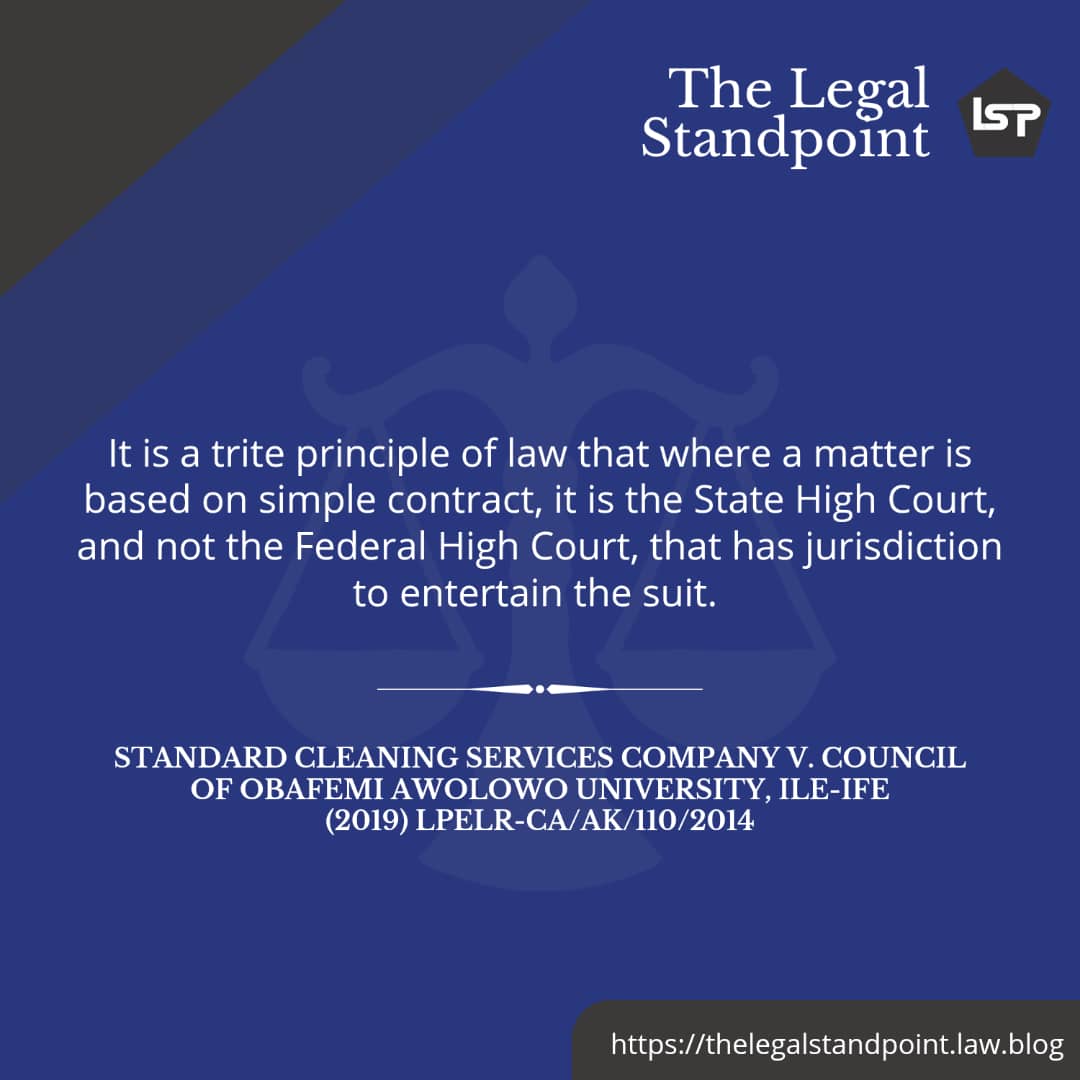
Hence, the Supreme Court in a plethora of cases such as Onuorah v. K. R. P.C. Ltd. (2005) 6 NWLR (Pt.921) 393; Socio-Political Research Development v Ministry of FCT & ORS (2018) LPELR-SC.203/2008; ROE LTD v. University of Nigeria (2018) LPELR-SC.42/2007; Adelekan v. BCU-line NV (2006) 12 NWLR (pt. 993) 33 at 54, Dec Oil & Gas LTD v Shell Nig Gas LTD, etc have held that disputes founded on contracts are not among those envisaged in the exclusive jurisdiction conferred on the Federal High Court under Section 251 of the CFRN. Hence, the State High Court has the jurisdiction to entertain such matters.

In conclusion, it is evident that the Nigerian Courts have tilted towards subject matter jurisdiction over party jurisdiction when it involves agencies of the Federal Government. With this, the era of using the Federal Government or its agencies as a blanket cover to give Federal High Court jurisdiction on matters which are clearly outside Section 251 of the CFRN 1999 is over.

Thank you for reading. See you next week.

Read up on past similar article on the Jurisdiction of Courts when it involves Federal Government agencies and Human Rights Violations here.

Law

LSP035: The ‘SANship’ requirements for Academia

Every profession has that level in which the majority, if not all, of its members, considered the apogee. For footballers, it is either winning the Fifa World Cup or Balon D’or (an award for the best player in the world), for musicians, it is the Grammy. And for some people, they just want to make money and relax. Your table?😄

For lawyers, the zenith of the legal profession is to be conferred the title of the Senior Advocate of Nigeria(SAN). The Senior Advocate of Nigeria is an honorary rank conferred on lawyers who have actively distinguished themselves over a period of ten (10) years. The title was first conferred on April 3, 1975, to Chief F.R.A. Williams and Dr Nabo Graham-Douglas.

Being a slot that attracts many applicants yet only a handful get selected, it is expected that the rank will come with certain benefits. One of such is that a Senior Advocate of Nigeria gets to always present his case first irrespective of whether the case is last on the list for that day. While this seems good, it has met a lot of criticisms and displeasure from junior lawyers. Their argument is hinged on the idea that it does not give everyone an equal level playing ground. For instance, if a non-SAN has a case and there are about four to five SANS in Court that day, the Court will have to listen to the cases of the SANs before attending to his case, which in most cases when it reaches his/her turn, the Court would have been closed for that day. The frustration is further heightened if the lawyer does not practice in that locality and had to travel down. This is common in appellate Courts and necessitated the reason why litigants employ the service of a SAN when the case is at Appeal or the Supreme Court.

Furthermore, SANs enjoy the privilege of sitting in the Inner Bar – the front row of seats in court which is reserved for them – as distinguished from the Outer Bar where junior advocates sit.

According to Section 5 (3)(a-g) of the Legal Practitioners Act, the body in charge of conferring this prestigious award is the Legal Practitioners’ Privileges Committee which comprise: the Chief Justice who shall be chairman; one Justice of the Supreme Court; the Attorney‐General of the Federation; the President of the Court of Appeal; five of the Chief Judges of the States; the Chief Judge of the Federal High Court, and five legal practitioners who are Senior Advocates of Nigeria.

Most of the Senior advocates seen or heard are those in active practice, however the title is also conferred on those in the Academia(lawyers who are lecturers). This gamut of today’s analysis will be on the requirements in which those in academia must fulfill before they could be conferred the prestigious rank in the Nigerian Legal Profession.

The Requirements
1. An applicant must have made a substantial contribution to legal scholarship and jurisprudence through teaching, research, and at least 20 published works (textbooks inclusive) in any reputable journal.

2. The applicant must register for the award with a non-refundable fee of N1,000,000.00 Naira. Before it used to be N 600,000.00 N300,000.00.

3. The committee also checked the number of students such an applicant mentored. There are several ways mentorship could be assessed. It could be in form of projects supervision of LL.B,LL.M, etcs, the societies and clubs in which the applicant serves as patron, matron, staff adviser, etc.

4. Such an applicant must be a professor. Preferably a past or current Dean or any other prestigious rank in the applicant’s university.

5. The committee will also check the national and international recognition of the applicant. Recognition is based on awards won, fellowships, scholarships, places of sabbatical leave, etc

6. Though an applicant in academia is not practising, evidence of practising fee for the last five(5) years shall be attached to his application form.

The aforementioned documents shall each be submitted in seventeen copies(17) to the Committee. The time frame for application is between November 1st of a present year and January 31th of a following year.

Furthermore, the title of ‘SANship‘ is not forever. A SAN can still be stripped of the title for any alleged misconduct pending the determination of any disciplinary action. The popular case that readily comes to mind here is Chief Ajibola Aribisala (SAN) who was suspended in 2013 when Fidelity Bank Plc said it engaged him to recover a N500million debt, but he allegedly unilaterally deducted N163million as his fee without the knowledge of the bank.

In conclusion, the on-becoming journey to ‘Sanship‘ tells the tales of discipline, hard work, tears, defeats, victories, a consistent display of legal scholarship, and a spartan attitude of determination. Indeed, no be beans.

A special appreciation to Prof Oluyemi Bamgbose(SAN), the first female SAN from the Academia for her insightful contributions to this article.

Thank you for reading. See you next week❤