
Law

LSP028: Capacity of Illiterates to enter into a contract

Though all men are created equal by God, the law doesn’t view everybody as equal. They are certain categories of vulnerable persons whose special provisions have been made for them to protect their interest while entering into a contract. These are Infants, Illiterates, Drunkards, etc.

Our focus today will be on the capacity of an illiterate to enter into a contract. In law, an illiterate is someone unable to read with understanding and to express his thoughts by writing, in the language used in the document made or prepared on his behalf. See the case of Otitoju v Governor of Ondo State & Ors (1994) LPELR-SC.269/1990. With this, a professor of English may be illiterate in a contract written in German provided he doesn’t understand the language.

Since an illiterate is not be able to read, write and understand a document; such a person will need the assistance of a literate person. Hence, the need for an illiterate Jurat. An illiterate Jurat is someone who writes the document on behalf of the illiterate person. Section 3 of the Illiterate Protection Act makes provision for this and listed out the requirements that must be fulfilled by the writer. It provides; “any person who shall write any letter or document at the request, or on behalf or in the name of illiterate person shall also write on such letter or other document, his own name as the writer thereof and his address and his so doing shall be equivalent to statement”.
(a) That he was instructed to write such letter or document by the person to whom it purports to have been written and that the letter or document fully and correctly represents his instruction;
(b) If the letter or document purports to be signed with the signature or mark of the illiterate person that prior to its being so signed, it was read over and explained to the illiterate person and that the signature or mark was made by such person.

The purpose of the said provisions under Section 3 of the law is also to ensure in furtherance to the said protection of illiterate that the writer of such document is identified or traced. Implicit in that Section is that where there exists a doubt or a denial as to the correct statements that were made by the illiterate, the writer will be traced to show whether the contents of the document represent the veracity of what the illiterate asserts. In other words, the protection singularly enures only to the illiterate.

Furthermore, it is the trite principle of law that the court cannot presume illiteracy on behalf of a party. Rather, it must be established in evidence with the burden on proof being on the party who asserts it. See the cases of Ezeigwe v Awudu (2008) ALL FWLR (Pt.434) 1529. Kumo Furniture co v BOI LTD (2019) LPELR-SC 48080 (CA).

Also, the issue of capacity in the Illiterate Protection Act and laws of different states in Nigeria will arise only where the contract is in a written form. It doesn’t apply to oral contracts. This is because illiteracy does not necessarily suggest infirmity.

In conclusion, capacity to contract is one of the essential elements of a valid contract. The absence of which is fatal in a contract. In order to ensure that the illiterates are not defrauded during contractual relationships, there are several principles of law to be taken into consideration prior to the formation of a contract with an illiterate.
Law

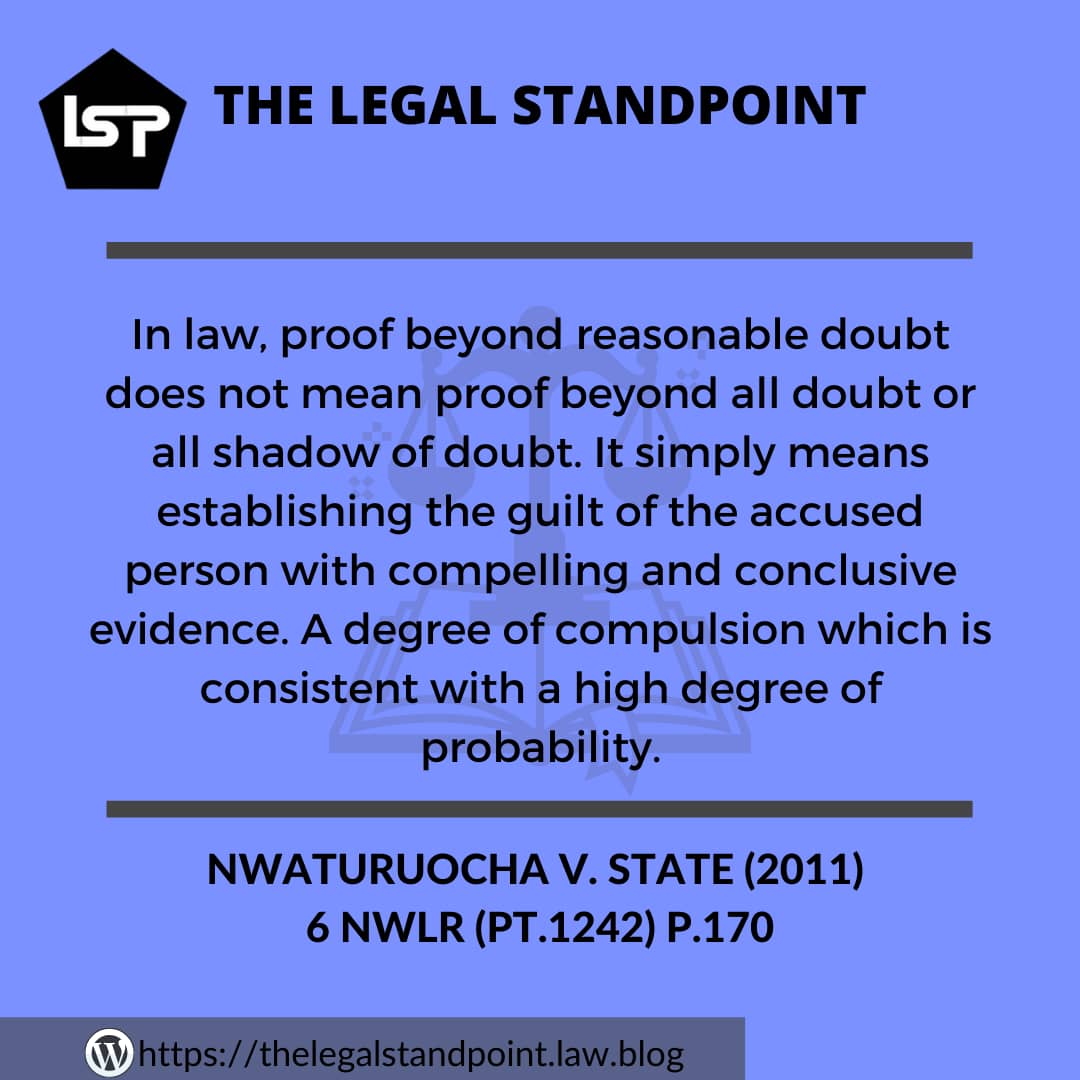
LSP027: Standard of Proof in Criminal Cases.


Life is like a proof. It has to be….woo, I really don’t know😃. It is sha a proof. Nevertheless, I know that proofs are important in both civil and criminal cases.

To determine the guilt of the accused or secure a conviction in a criminal case, there has to be proof beyond reasonable doubt. This has been given statutory provision in Section 135 of the Evidence Act.

In criminal cases, the legal burden is entirely on the Prosecution to prove the guilt of the Defendant. This resonates with the landmark principle of law that who asserts must prove. As such, if an individual is being accused of committing a crime, the prosecution has the onus of adducing clear and credible evidence showing the culpability of the accused to the alleged offence.

It is pertinent to state that this legal burden does not shift if the prosecution must secure conviction. This is because, there is the presumption of innocence in favour of the Defendant, by virtue of Section 36(5) of the Constitution of the Federal Republic of Nigeria 1999 (as amended), as he has no responsibility in law to prove his innocence.

What then is Proof beyond Reasonable Doubt? The Supreme Court, in a plethora of cases, defined the principle to mean the standard which the prosecution must meet in order to successfully find the accused guilty of a crime. For instance, if an accused is charged with a homicide (murder), the prosecution must prove that:
(a) the deceased is dead;
(b) that the death was caused by the accused;
(c) that the accused intended to either kill the victim or grievously harm. him. See Idemudia v State @2001 FWLR (PT.55) 549 at 564, Akpan v State (2001) FWLR (Pt.56) 735; Madu Vs. State (2012) 15 NWLR (Pt.1324) 405 etc. If these vital ingredients are proven by clear and compelling evidence to the satisfaction of the Court, then the persecution has successfully proved the case beyond a reasonable doubt. Contrary, when there is any doubt in the course of proving any ingredient of the offence; the doubt will be resolved in favour of the Defendant which will lead to his exculpation as that will mean that the prosecution has not proved his case beyond reasonable doubt.

Furthermore, there are very few things in this world that we know with absolute certainty, and in criminal cases, the law does not require proof that overcomes every possible doubt. In fact, there cannot probably be any proof that can be beyond all doubts or shadow of doubt. For as long as we are on this side of life, we are limited to grasp the total truth of what transpired in a matter. As such, it will be wilting to prove a criminal case beyond any shadow of a doubt. The Courts frown on proving a case beyond all doubt or shadow of doubt because it is practically impossible. Fabiyi (JSC) (as he then was) stated in the case under review that ‘Proof beyond reasonable doubt should not be stretched beyond a reasonable limit. Otherwise, it will cleave.’

In conclusion, presenting evidence to prove the guilt of the accused beyond  reasonable doubt is one of the important features of  criminal trials. The burden which is stationary placed on the Prosecution doesn’t mean the case should be proved beyond all shadow of doubts. Rather, the prosecution must successfully establish every ingredient for the offence charged. Once this is achieved, then such a case has been proven beyond reasonable doubt. Failure to establish all ingredients of a crime will lead to the accused being exculpated.

NB: The traffic on the site is blooming. Thank you for always reading and sharing the link. It means a whole lot to me. See you next week, esteemed readers.🥰.

Law

LSP026: Jurisdiction of Courts in Fundamental Human Rights Matters

Overtime, the question as to which court has the jurisdiction to entertain cases involving breach of Fundamental Human Rights has been reoccurring. Its reoccurrence has led to several (mis) interpretations. In course of this article, attention will be paid to the factors that led to these misinterpretations and the correct position of the law. Before that, attention will quickly be given to the definition of Jurisdiction and Fundamental Human Rights.

Jurisdiction is the authority which a court of law has to determine matters or issues which are litigated before it or to take cognizance of issues presented in a formal way for its resolution. See the case of UTIH & ORS. V. ONOYIVWE & ORS. (1991) LPELR-SC.160/1988.

Human rights are those rights which every individual born into the world possesses regardless of race, sex, nationality, ethnicity, language, religion, or any other status simply because he or she is human. Fundamental Human Rights, on the other hand, are the human rights which are recognized, supported, and protected by the state usually in a written constitution. See the case of Ransome-Kuti V. Attorney General Federation (1985) 2 NWLR (PT. 6) 211.

In Nigeria, Fundamental Human Rights are enshrined in Chapter 4, Section 33-46 of the Constitution of the Federal Republic of Nigeria (1999 as amended). Some of these rights are: Right to Life, Right to Dignity of the Human Person, Right to Freedom of Expression, etc. These rights are sacred, sacrosanct, and meant to be enjoyed by all citizens without fear or victimization. However, several situations abound on the breach of these rights.

The salient question is which court has the jurisdiction to entertain the breach of any of these rights. Section 46(1) of the CFRN 1999 as amended states: Any person who alleges that any of the provisions of this Chapter has been, is being or likely to be contravened in any State in relation to him may apply to a High Court in that State for redress. (Emphasis on IN).

At this juncture, it is pertinent to note that there are two issues to be resolved. First off, people often overlook the preposition IN in that aforementioned section. A High Court in that state could mean the State High Court or the judicial division of the Federal High Court in a state, including the Federal High Court, FCT. In fact, Order 1 Rule 2 of the Fundamental Rights (Enforcement Procedure) Rule 1999 defines a court as meaning Federal High Court or the High Court of a State or the High Court of the Federal Capital Territory, Abuja.

In law, once the provisions of a statute or law are clear, they should be given their natural and ordinary meaning. Ergo, both the Federal High Court and State High Courts have the authority to entertain issues bothering on breaches of Fundamental Human Rights. Giving the rationale behind these alternative choices, KEKERE-EKUN, J.S.C in the case under review stated that: ‘The violation of a citizen’s fundamental right is reviewed so seriously that the framers of the Constitution sought to ensure that no fetters are placed in the path of a citizen seeking to enforce his rights. In other words, the provision ensures that he has access to any High Court as long as it is within the State in which the alleged infraction occurred. Indeed it would negate the principle behind the guarantee of fundamental rights if a citizen were to have any obstacle placed in the path of enforcing those rights. There is no ambiguity in the provisions of the Constitution or of the fundamental rights (Enforcement Procedure) Rules… regarding which Court has jurisdiction to entertain an application for the enforcement of fundamental rights.’

In addition, the second issue centers on the breach of Fundamental Human Rights by a Federal Agency. This issue, like fire on a bush during the harmattan season, is further complicated by virtue of Section 251 of the CFRN 1999. Section 251(1)(P) states that: Notwithstanding anything to the contrary contained in this Constitution and in addition to such other jurisdiction as may be conferred upon it by an Act of the National Assembly, the Federal High Court shall have and exercise jurisdiction to the exclusion of any other court in civil causes and matters -(p) the administration or the management and control of the Federal Government or any of its agencies.

In essence, what this section is saying is that the Federal High Court has the exclusive jurisdiction to entertain all civil matters that involve a federal agency.

Thus, it appears that the provisions of Section 46(1) and 251(1(P) conflict. These aforementioned provisions raise some questions. For example, if an agent of the EFCC, which is a federal agency, acting in his official capacity, attacks an individual without a just cause, this is clearly a breach of the Fundamental Right. However, which court has the jurisdiction to entertain this matter? Is it the State High Court? Or the Federal High Court since it involved a federal agency?

The position of law has always been that where there is a conflict between a general and specific provision in a statute, the latter will prevail. Tobi JSC(as he then was) in KRAUS THOMPSON ORGANISATION V. NATIONAL INSTITUTE FOR POLICY AND STRATEGIC STUDIES (2004) LPELR-SC.38/2000 held that: ”It is a well-established canon of statutory interpretation that where an issue in a statute is governed by a general provision and a specific provision, the latter will be invoked in the interpretation of the issue before the court. This is because the specific provision will be deemed to have anticipated the issue as against the general provision.” See also Jack V. University of Agriculture Makurdi 2004 LPELR-SC.262/2000. So, while Section 251(1)(P) is a general provision, Section 46(1) is a specific provision and thus will prevail.

Furthermore, the high court in a state also extends to the National Industrial Court. As such, when a breach of fundamental human rights occurs in the course of employment, the National Industrial Court will have the jurisdiction to entertain the suit.

In conclusion, the position of law is that irrespective of the parties involved, as long as the enforcement of Fundamental Human Rights is the main claim, the State High Court, Federal High Court, the High Court of the Federal Capital Territory including the National Industrial Court in applicable instances have the concurrent jurisdiction to entertain the matter.

Kindly subscribe to the mailing list if you haven’t. Go to the homepage and scroll down.

Thank you for reading. See you next week.