

The end goal for every litigant when instituting an action before the court of law is to win and receive favourable verdict. In the quest to win, some litigants often resort to using mechanisms that are contrary to the tenets of Justice. One of such is forum shopping.
Forum shopping is the unscrupulous practice of instituting an action in a court where a party is likely to receive favourable decision. As stated by the Court of Appeal in Oyinlola v. Dayo & Ors (2013) LPELR-CA/A/84/2013, a plaintiff may engage in forum-shopping by filing a suit in a Judicial Division with a reputation where the learned Judge awards heavy costs or damages to the successful party, or where the judge, belongs to the same religious affiliation, has a soft spot for a political party or they belong to the same social or sporting club, etc.
As held in Alhaji Muhammadu Maigari Dingyadi & Anor v. Independent National Electoral Commission & 2 Ors, forum shopping is an abuse of court process and it is regarded as a jurisdictional issue. It is not merely an irregularity that could be pardoned or overlooked but it constitutes a fundamental defect, the resultant effect of which would lead to a dismissal of the process that is abusive. As noted in the case of Arubo v. Aiyeleru(1993) 3 NWLR (PT. 280) Page 125, the Supreme Court held that once a court is satisfied that the proceeding before it amounts to an abuse of process, it has the right or duty to invoke its powers to punish the party which is in abuse of its process.
In Mailantarki v. Tongo & Ors (supra), the facts of the case were that the Appellant and Respondent contested the National Assembly primary election for the election of APC candidate for the Gombe/Kwami/Funakaye seat in the House of Representatives. The whole voting exercise, which was held on 8th December 2014, took place in the Malam Sidi constituency, Gombe State. The first respondent (Tongo) won the primary ticket. This caused the Appellant to institute an action before the High Court of the Federal Capital Territory (FCT) against the emergence of the 1st respondent as the 2nd respondent’s (All Progressives Congress) flag bearer. The main issue for determination in this appeal is whether or not the High Court of the FCT lacked territorial jurisdiction to entertain the appellant’s claim.
Giving the lead judgment, Per EKO, J.S.C. stated thus: the decision to file this suit in the FCT High Court far away from Gombe State where the cause of action arose cannot be anything but a sheer decision to abuse the judicial process. It was a decision to actuate forum shopping….the instant Appellant, as the plaintiff, had artfully avoided the High Court of Gombe State, in preference to the FCT High Court, because the former as it appears maybe a forum inconvenience.
In addition, Kekere Ekun J.S.C also stated unequivocally that: in the instant case, the cause of action, which is the primary election of the 2nd respondent, took place in Gombe State. The appeal committee also sat in Gombe State. There is therefore no justification for the institution of the suit before the High Court of the FCT in Abuja. The filing of the suit before that Court is a clear example of “forum shopping” in the hope of securing a favourable outcome. This practice has been seriously deprecated in numerous decisions of this Court; The practice does not augur well for the administration of justice. It is also unethical practice on the part of the legal practitioner who filed the suit.
At this point, it is worthy of note that forum shopping is different from exercising one’s choice in courts that have concurrent jurisdiction. For instance, if a party’s Fundamental Human Rights have been violated, such an individual, by virtue of S.46(1) of the Constitution of the Federal Republic of Nigeria 1999 (as amended) and Order 1 rule 2 of the Fundamental Rights (Enforcement Procedure) Rules, can either institute the action in High Court of that State or the division of the Federal High Court in that State. This was in recognition of the fact that by conferring jurisdiction on the Federal High Court and the High Court of a State or the Federal Capital Territory, the intention of the lawmaker was to give an aspirant the flexibility of ventilating his grievance in any of the Courts listed therein depending on which location is most convenient to the parties. And it is immaterial whether the defendant is a Federal Agency. See the celebrated case of Jack v. University of Agriculture, Makurdi (2004) 1 SC (Pt.1) 100 @ 111-112 and a recent 2020 case of EFCC v. Reinl (2020) LPELR-SC.428/2018
In conclusion, forum shopping is an abuse of court process which is aimed at interfering with the course of Justice.
Thanks for reading. See you next week.❤
Category: Law
LSP015: Incorporated Associations and Juristic Personality
It is a trite principle of law that for an individual to sue or be sued, such an individual must be a recognized person under the law. In law, there are two recognized persons. The natural persons which are, of course, human beings and juristic persons. A common example of a juristic personality is a company.
Besides, an association can also be made a juristic person either by registration under Section 832 of the Company and Allied Matters Act 2020 or through a legislation. In this second instance, they will be referred to as statutory bodies. For example, the NNPC created under The NNPC Act.
If an association has not been incorporated by either of these two methods, such an association can not sue and be sued in their name (eo nomine). However, they can sue through their members or officers which are representatives of the action. In Dairo & Ors v Registered Trustees of the Anglican Diocese of Lagos (2017) LPELR-42573(SC) the Court held that: Where an association of persons is unincorporated, it does not have the legal status of a juristic person. Consequently, it can sue only by a representative action. Likewise, any person who has been wronged by such an association of persons can only sue it by suing some of its members as representatives of the association.
This is the point that was surprisingly omitted in the two cases under review as the NBA was sued eo nomine (in its name).
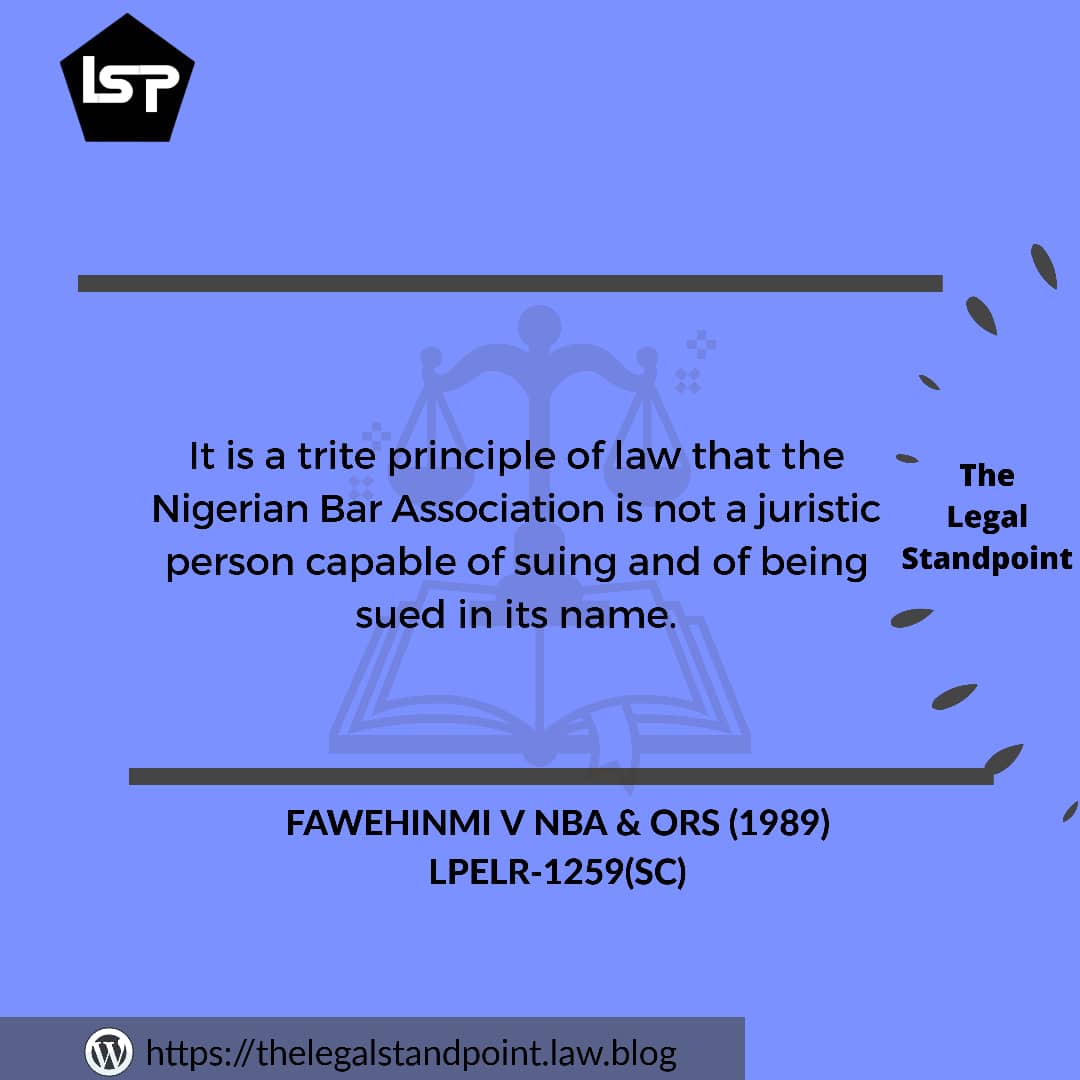
In the celebrated case of Fawehinmi v NBA (supra), the court giving reasons for the non-juristic personality of the NBA held that: The Constitution of the Nigerian Bar Association is not a statutory instrument. It is not a subsidiary legislation to the Legal Practitioners Act. It is a pure and simple private document which the members of the Nigerian Bar Association were entitled to draw up in exercise of their right to provide a constitution for the Association to regulate its affairs…. this does not make the Nigerian Bar Association a juristic person. It only gives the body recognition as a legal entity made up of legal practitioners.
This landmark decision also received judicial affirmation in the 2019 recent case of Moses v NBA (2019) LPELR-46918(SC).
THE FACT OF THE CASE
In this case, the Appellant, a Legal Practitioner practicing in Port Harcourt, Rivers State, represented a Member of the Rumu-Amadi Family in a case involving family land. The Appellant’s client lost at the High Court and while the case was on appeal, it was alleged that the Appellant partitioned the family land and sold plots of land; and he misrepresented himself as the Family’s lawyer and began negotiating more sales without valid authority.
Infuriated, the family wrote a petition to the Disciplinary Committee of the NBA, who after its investigations, held that the Appellant was found guilty. The NBA then filed a complaint at the Legal Practitioners Disciplinary Committee (LPDC) against the Appellant. The LPDC, after due consideration, found the Appellant guilty of improper conduct in the course of performing his duty as a legal practitioner and directed the Chief Registrar of the Supreme Court to strike out the name of the Appellant from the roll of Legal Practitioners.
The Appellant challenged the decision of the LPDC by an appeal to the Supreme Court. In the appeal, the NBA was named as Respondent by the Appellant. The Respondent (NBA) raised a preliminary objection on the ground that it is not a juristic person and as such, cannot sue or be sued.
The Appellant contended that since the NBA was the complainant before the LPDC, the NBA can validly be a Respondent for the purpose of the appeal filed at the Supreme Court. The contention is logical in the sense that if the NBA could stand as complainant at the proceedings before the LPDC, then there is no reason it should not be a proper party at the appeal. Otherwise, as argued by the Appellant, the proceedings before the LPDC should be declared a nullity.
THE JUDGMENT
As logical as the contention of the Appellant may sound, the Supreme Court held that same was however misconceived because the NBA was merely playing the role assigned to it under the Legal Practitioners (Disciplinary Committee) Rules (as amended) whereby the NBA can validly forward a report of any investigation to the LPDC for proper action, pursuant to Sections 1(1) and 10(1)(b) of the Legal Practitioners’ Act. In effect, while the NBA plays its part, the LPDC will go ahead and consider the complaint.
The Supreme Court concluded that an appeal against the decision of the LPDC can be brought while making the LPDC a party instead of the NBA. This is because the LPDC is a legal person that can sue and be sued. See LPDC v. Fawehinmi [1985] 2 NWLR (Pt. 7) 300.
REPOSITIONING THE PROPER CONTEXT
For a proper determination of suit against the NBA, the party should be: Registered Trustees of NBA, because they are the ones that possess a juristic personality. Registered Trustees of NBA are those people that have been appointed by the NBA to be the Trustees, the equivalent of directors in a company, and they are distinct from NBA in that they have juristic personality.
THE EFFECT OF AN INCOMPETENT PARTY IN A LAWSUIT
It is well settled that for an action to be properly constituted so as to vest jurisdiction in the Court to adjudicate on the matter, there must be a competent Plaintiff and a competent Defendant, and where either of them is not a legal person, the action is liable to be struck out for being incompetent. See Maersk Line & Anor V Addide Investments Investments Ltd & Anor (2002) LPELR-1811(SC) and Agbonmagbe Bank Ltd. v. General Manager G.B. Ollivant Ltd. & Ors. (1961) 1 All NLR 116; (1961) 2 SCNLR 317.
Thank you and see you next week❤.
LSP014: Spraying of Nigerian Currencies in Party: the Position of the Law.
From mummy Risi’s Ówambẹ̀ to Prof. Okonkwo’s retirement party down to Musa’s hangout, parties are 5 unit courses Nigerians don’t like carrying over. In fact, being that Nigerians are hardworking, we always create time to unwind, enjoy life, and reconnect with family and friends before the resumption of our routine activities.
In all these parties, Nigerians have a culture of spraying money either on the musician, the celebrant, or even both. Will it be an exaggeration if I aver that social events in Nigeria and the spraying of money have been inseparable? I doubt it. If you have been a guest at any social event, you will attest to this fact.
Aside from being a norm, money spraying culture also serves as an effortlessly sign of flamboyance especially when you are spending higher denominations. It portrays, on one hand, the I have arrived mentality. On the other hand, it appears people are doing this even without the showoff mentality. Some are engaging in this practice simply because they are ignorant that there is a law that regulates such activity.
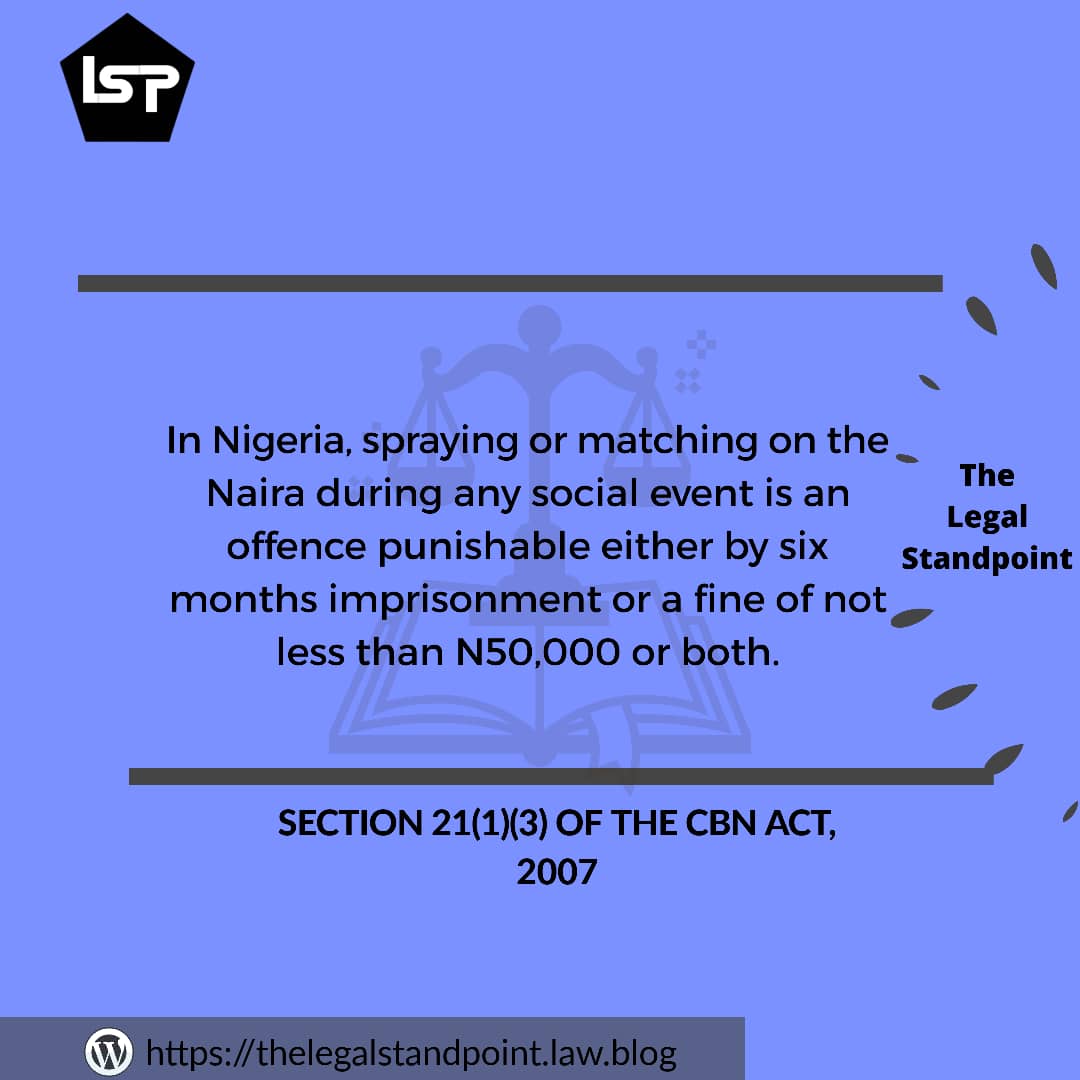
However, this practice is against the law as prescribed in Section 21 of the CBN Act 2007 because it is illegal and an abuse of the banknotes. S. 21 provides that: ‘For the avoidance of doubt, spraying of, dancing or matching on the Naira or any note issued by the Bank during social occasions or otherwise howsoever shall constitute an abuse and defacing of the Naira or such note and shall be punishable under Sub-section (1) of this section…. imprisonment for a term not less than six months or to a fine not less than N50,000 or to both such fine and imprisonment.’
It is pertinent to state that this is the law. Because we see people engage in this activity and go scot-free doesn’t make it less than the law neither does it allow us to indulge in it. As seen in this Latin maxim: dormiunt aliquando leges, nunquan moriuntur, which translates to mean, law sometimes sleeps, but never dies. It is better to know and adhere to the law so that its provision will not be raised against you.
Regarding the process to wake this law from its slumber, The CBN made its intention known, last year, to see that those who engage in this practice face the music. Interestingly, if someone is caught, the regularized court processes will be dispensed with and such an individual will be tried instantly. According to The CBN spokesman, Isaac Okorafor, ‘mobile courts would be deployed nationwide to enforce the law, confirmed the police and officials of the Federal Ministry of Justice would be involved in the monitoring and enforcement of the law…. If a celebrant is dancing and you spray him/her, you may go to jail from the party venue, because the law enforcement agents will be there, waiting to arrest you.’
In conclusion, the Nigerian currencies are symbols of national unity and sovereignty, which most be treated with respect.
Thank you. See you next week.❤
 THELEGALSTANDPOINT