
As humans, we enter into contracts every day whether knowingly or unknowingly. In fact, contracts are everywhere and they come in different forms, from buying a package of gum in a street to renting a house to paying the cabman to transport you from one location to a destination, etc our lives are permeated by contracts. Owing to this, the law basically sets out rules to follow anytime we are about to engage in contracts cum commercial transactions.
In any contract for the sale of goods, there is an implied condition on the part of the seller to possess a title in what he or she is about to sell. S.12(1) of the Sales of Goods Act (hereinafter referred as SGA) provides that: In a contract of sale, unless the circumstances of the contract are such as to show a different intention there is (i) An implied condition on the part of the seller that in the case of a sale he has a right to sell the goods, and that in the case of an agreement to sell he will have a right to sell the goods at the time when the property is to pass.
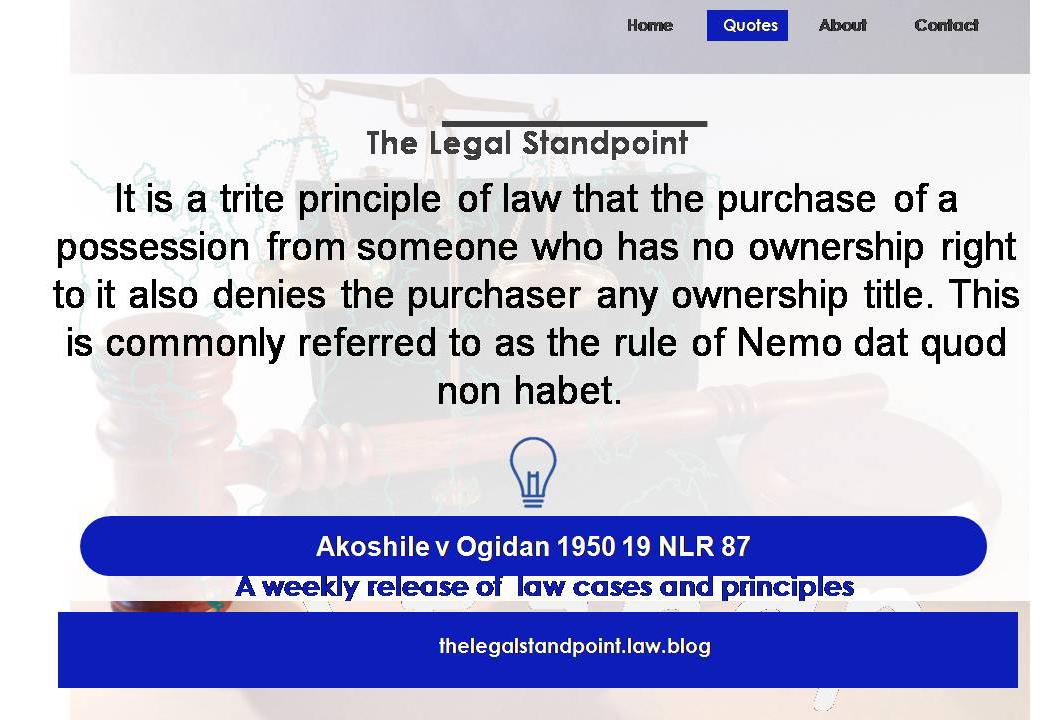
Thus, a seller who has no title will obviously be in breach of this obligation. In Akoshile v Ogidan 1950 19 NLR 87, the plaintiff bought a stolen Vauxhall salon car, No. A6286, from the defendant for £340 and took possession of the car. The European who sold the car to the defendant was convicted of stealing the car and the police took the car from the plaintiff. The plaintiff brought an action to recover the money paid to the defendant upon the grounds that the defendant had no authority to sell the car. The Court held that it was a breach of section 12(1) of SGA and that the plaintiff was entitled to recover the money. See also Rowland v Divall [1923] 2 KB 500.
From these two cases, it is evident that just as it is impossible to build something on nothing and expect it to stand, it is also unthinkable to give out what you do not have. This informed the Latin maxim nemo dat quod non habet. This translates to mean you can not give what you do not have.
At this juncture, it is also important to note that the law envisages a situation where the seller who is the owner of the goods or who has been authorized by the seller to sell will not be permitted to. In other words, the true meaning of S.12 of SGA is that the seller must have the right to sell the goods indisputably without any legal constraint, otherwise, he has breached a condition that will amount to a repudiation (rejection) of the contract by the other party. Hence, in Niblett v Confectioners’ Material [1921] 3 KB 387, the plaintiff purchased 1,000 tins of condensed milk from the defendant. The tins were labeled ‘Nissly’. Nestle told the plaintiff that if they attempted to sell these on, they would apply for an injunction to prevent the sale as the label was very similar to Nestle’s labels for their condensed milk. The claimants agreed not to sell them and brought an action against the sellers. The court held the sellers did not have the right to sell the goods and therefore the buyers were entitled to repudiate the contract. In effect, a person who can sell goods only by infringing a trademark of another has no right to sell, even though he may be the owner of the goods. The effect of this is that the law places an obligation on a seller or his agent acting on his authority to always come through and true in transactions.
EXCEPTIONS TO THE NEMO DA QUOD. NON HABET RULE
Let’s imagine the aftermath of the man called Ogidan; the defendant in that case. Poor man!😥 The Court ordered him to refund the money despite the fact that he was not aware that the European whom he also got the car from stole the car. Well, as touching as it could be, the law is the law. Since he had a defective(fake) title, what he transferred was no title. The only way out for him, in that case, was also to institute an action against the European in order to recover his money. Unfortunately, most times the third parties in situations like this(in this case the European) will have absconded and even if they were found, they would have entered insolvency. Indeed, life no just balance😃.
Now, that was harsh. Hence, because of the apparent harshness of the rule, several exceptions to it were developed at common law and also have been added by statute. All of the exceptions will apply only in favour of a person who acquires the goods in good faith and without notice of the rights of the original owner. In simpler terms, it means it will favour those who got the goods without knowledge that the seller stole the goods.
The exceptions are Agency Arrangements; Estoppel; Sales in a Market Overt; Sale Under Special Powers; By a Mercantile Agent etc. Out of these exceptions, quick attention will be given to Sales in a Market Overt. An Overt Market is defined as an open, public, and legally constituted market where purchasers of goods with certain exceptions acquire good title regardless of any defects in the seller’s title. S.21(1) of SGA stated that “where goods are sold in market overt according to the usage of the market, the buyer: acquires a good title to the goods, provided he buys them in good faith and without notice of any defect or want of title on the part of the seller.”
To further illustrate this, a practical example will be given: Omotunde steals a bundle of cloths from Kofoworola and takes to Gbagi market to sell, If Omotunde sells those items at the usual market place of Gbagi within the working hours after displaying and Segun buy them, then the buyer acquires a valid title against that of the true owner (Kowoforola). Though the rule has been abolished in some countries like The United Kingdom, The United States of America, etc, it is still operative in some common law jurisdictions, for instance, Nigeria.
For a sale to constitute one in a market place, the following requirements must be met:
1. The sale must be made in the usual market place upon the lawful market day and during the hours and not at night.
2. The goods must be exposed for sale and the whole transaction must begin and conclude in the market. See Reid v. Metropolitan Police Commissioner (1973)2 AER 97 where the sale of stolen goods took place in a market overt in the morning when the sun had not risen and it was still only half-light. The court held that the goods should have been sold in day time when all who passed could see the goods.
3. The sale must be a real sale by a person of contractual capacity.
4. The goods must be goods sold normally in that market.
5. The buyer is not aware that the seller stole the goods and bought it in good faith.
When these conditions precedent are fulfilled, a buyer obtains a valid title from a non-owner seller through sale in market overt.
In conclusion, the doctrine of Nemo dat quod non habet, first off, aims at protecting the plaintiff who got a defective title while its exceptions provide a soft landing provision for a person who acquires the goods in good faith and without notice of the rights of the original owner.
Thank you for reading. See you next week.
Happy New Month. Stay blessed💝.

 THELEGALSTANDPOINT
Well-done boss.. Learning more.. 💪💪🙌
LikeLike
Thank you
LikeLike