
The Nigerian Police has the power to make an arrest. It has been clothed with the statutory provision by virtue of S.4 of the Police Act. Hence, an arrest can be made once there is a reasonable suspicion that someone is suspected to have committed an offence. Reasonable suspicion, as held in Ubochi v. Ekpo (2014) LPELR-23523(CA), ‘presupposes the existence of facts or information which would satisfy an objective that the person concerned may have committed the offence or likely to commit the offence.’
In addition, this statutory provision of the Power to arrest offenders has received judicial blessings in a plethora of cases. In Dokubo Asari v. Federal Republic of Nigeria (2007) JELR 54962 (SC) the Supreme Court held that: The power of arrest of suspected offenders is vested in the police and no one can take it away from them. See also Isiaka Adeboye & Ors v. Saheeto International limited & Ors (2019) LPELR-46752(CA). Now, it is not in doubt, as it is clear as crystal, that the Police enjoys both statutory and judicial backing in the exercise of its power to arrest offenders and suspects.
However, it must be noted that this sword given to the Police must be wielded in accordance with the provisions of the law. The power to arrest does not give the Police carte blanche to violate the rights of citizens in the name of crime detection. When an arrest is not done lawfully, the Courts are ever readily prepared to reject it. Thus, in Igweokolo v. Akpoyibo & Ors (3),(2017) LPELR-41882(CA), the Court opined that ‘By all odds, the police have the statutory power to investigate, arrest, interrogate, search and detain any suspect. The only qualification is that the power must be exercised in accordance with the law.’
ARREST IN LIEU
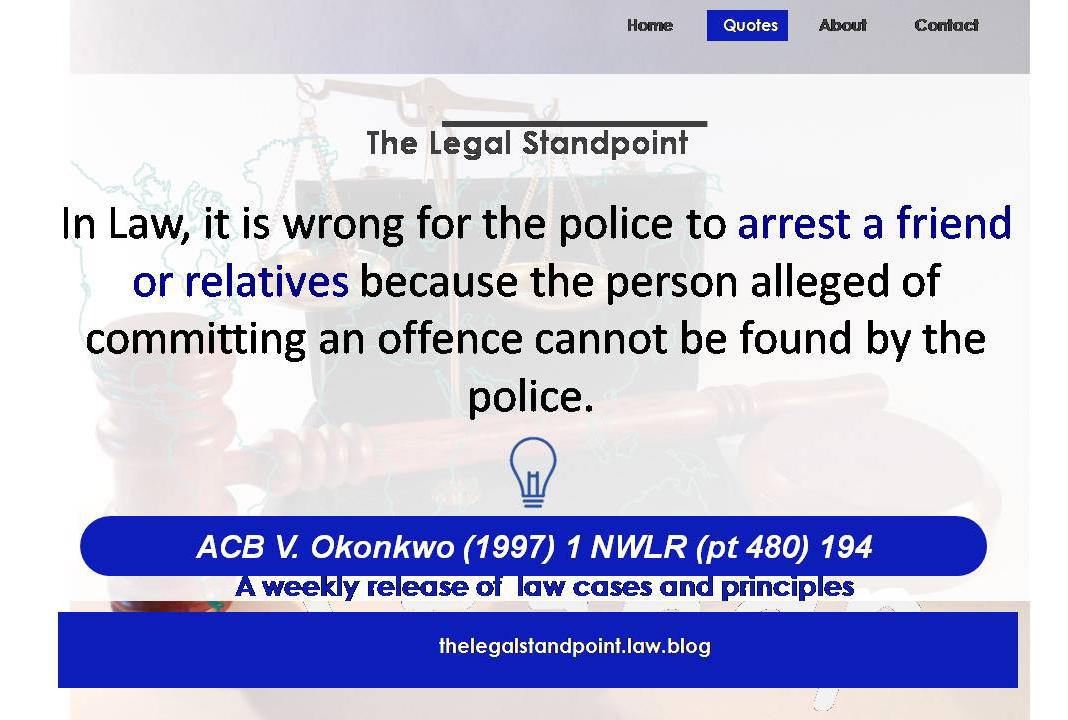
Also known as substitutional arrest, this literally means the arrest of one person in place of another. It occurs when a person who has not committed or has not been alleged of committing any offence is arrested because their friend or relative who is alleged of committing an offence cannot be found by the police. The rationale behind this that once a relative, particularly a consanguine or affinal is arrested, the offender will be forced to come out from his hiding place. This reasoning is self defeating because, in situations where the alleged offender has a hardened heart and refuses to step out, the arrested person will continually be incarcerated leading to clear deprivation of his/her fundamental human rights particularly right to Personal Liberty and Freedom of Movement.
Furthermore, S.7 of the Administration of Criminal Justice Act 2015 provides that: ‘A person shall not be arrested in place of a suspect.’ Even if there is an argument that since the ACJA applies in Abuja and Federal High courts in Nigeria, substitutional arrest can be allowed in states that have not yet domesticated ACJA, the writer still submits that this argument is implausible because arrest in lieu is unconstitutional, therefore it cannot be limited to a particular jurisdiction. In fact, S.36(6)(a) of the Constitution of the Federal Republic of Nigeria 1999 (as amended) states that ‘Every person who is charged with a criminal offence shall be entitled to (a) be informed promptly in the language that he understands and in detail of the nature of the offence.’ The pronoun ‘he’ in that section refers to just one person. Had it been the drafters of the Constitution had a substitutional arrest in mind, the phrase would have been extended to make provisions for that. Everyone is distinct in the eyes of the law, so it will be wrong to arrest someone merely because he is related to a suspect that cannot be found.
Importantly, the Courts in Nigeria have unequivocally and persistently frown on substitutional arrest. In Akpan v. State (2008) 14 NWLR (pt 1106) 72, the court stated that ‘There is no law that where the offender is unable to be arrested, his relative should be arrested.’ Similarly, in ACB v. Okonkwo (1997) 1 NWLR (pt 480) 194, the mother of the accused was arrested and detained by the police for the offence of her child. In delivering a judgment in that case, the late eminent jurist, Niki Tobi said: ‘I know of no law which authorizes the police to arrest a mother for an offence committed or purportedly committed by the son. Criminal responsibility is personal and cannot be transferred….a police officer who arrests ‘A’ for the offence committed by ‘B’ should realize that he acted against the law. Such a police officer should, in addition to liability in civil action be punished by the police authority.’ See also, Odogwu v. State (2013)LPELR-22039(CA).
From our analysis, let us paint a practical example to aid our understanding. If a husband committed a crime and disappeared, and there is no evidence that his wife acted as an accomplice to the crime, can she be arrested? No. However, if she was an accomplice, let us say she was aware of the offence and then provided a way for her husband to escape and evaded capture, then can she be arrested? Yes. With this, she has become an accessory. An accessory is a person who assists in the commission of a crime, but who does not actually participate in the commission of the crime.
In conclusion, it is clear that the Police cannot arrest a person in lieu of another. An attempt to do that means that they are acting ultra vires (beyond their power). Also, anyone arrested in lieu of another can sue the Police for the violations of his/her Fundamental Human Rights. Comically, such a person is allowed to ‘may I’ and ‘approach my Lord without being too forward’ at the State High Court seeking damages.

 THELEGALSTANDPOINT
Nice one
LikeLike
Thank you, Olamide.
LikeLike
Brilliant insight.
We can finally boast of a docent unveiling certain legal intricacies.
Keep it up Kiki! I’m ever proud of you!
LikeLike
Thanks for the enlightenment
LikeLike
really insightful… even laymen should read this!
LikeLike
I think NOLLYWOOD movies has made Police arresting families instead of the criminal whether they are accomplice or not right, Which is quite disappointing, I hope this information can be passed to many people to enlighten us all more. Nice one 👍🏽👍🏽
LikeLike
Wow…very educative!
LikeLike
Nice one big man, more power to your elbow.
LikeLike
Wow! This is deep. Keep it up bro.
LikeLike
Wow! This is deep.
Keep it up bro.
LikeLike
Thank you, brother.
LikeLike
Insightful
LikeLike
Thank you
LikeLike
Knowledge gained, a good read.
LikeLike
Thank you.
LikeLike
Well written
LikeLiked by 1 person
Thank you
LikeLike