
Generally, parties are bound by the terms of the contract entered into and expected to perform their obligations. This is known as the principle of pacta sunt servanda, which means all promises must be kept and honoured. In a situation where there is a breach of contract, the law will avail certain remedies to a party who had suffered a certain loss due to the non-performance of the obligations by the other party.
Marriage is also a contract. Thus, an agreement to enter into a marriage should be clear, precise and should leave nobody in doubt as to the real intention of the parties to enter into a marriage. Speculations are not allowed.
Unfortunately, we have heard stories and seen people who got jilted in a relationship. This situation is always followed by intense emotional trauma. Well, we are The LegalStandpoint and not emotional therapists. Hence, we will only restrict ourselves to the standpoint of the law in this matter leaving out how to deal with the emotional consequences.
BREACH OF THE AGREEMENT TO MARRY
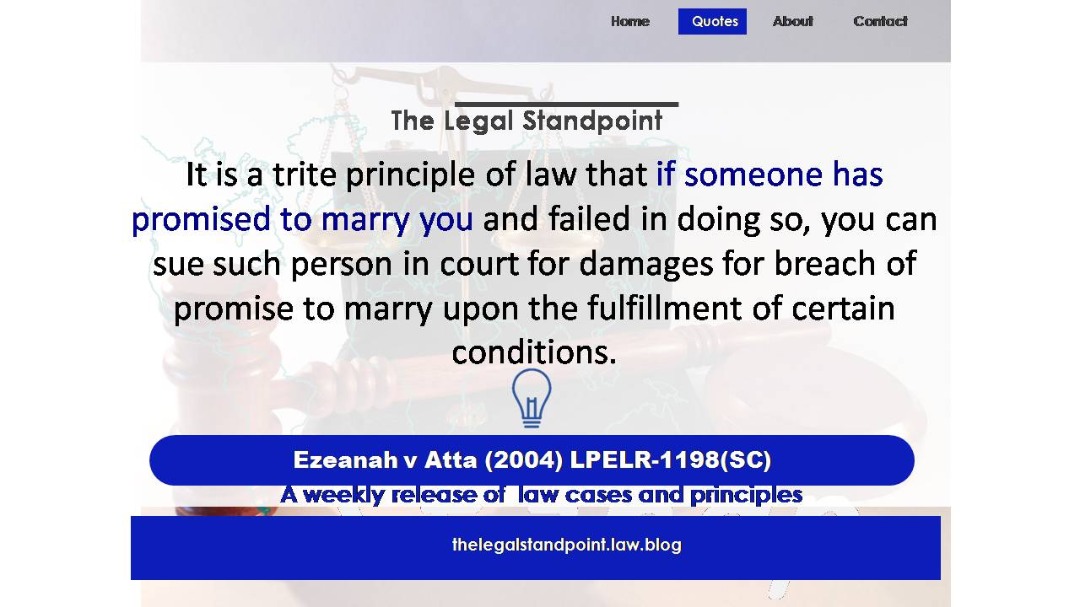
In the case under review, the Court per Niki Tobi JSC (as he then was) listed the two elements which are necessary to constitute a breach of an agreement to marry. These are:
1. The party jilted must prove to the satisfaction of the court that there was in fact a promise of marriage under the Matrimonial Causes Act, or under Islamic Law or under Customary Law, on the part of the other sex.
2. The party reneging has really, and as a matter of fact, failed or refused to keep to the agreement of marriage.
It is worthy to mention that the first element goes beyond a mere boyfriend and girlfriend romantic affairs. It is way beyond saving his/her name on your phone as Messiah or My Indispensable as the case may be. All these are immaterial because they do not raise a presumption of marriage. To prove the first element, the jilted party needs to plead either oral, written or electronic evidence to show that the other party reneges on his/her promise. This can be done by showing that there is an actual proposal of marriage (engagement ring) and acceptance of a marriage proposal. Also, evidence like recordings, pictures, letters, chats, etc will suffice. By extension, the court will listen to corroborative evidence from people who are aware of the proposal of marriage. See Olasore & Anor V. Ajibolade & Anor (2011) LPELR-8953 (CA) (Pp. 32-33, paras. F-C)
THE FACT OF THE CASE
The two parties met around 1993. The respondent, Alhaji Atta proposed a relationship but the appellant refused. The friendship however progressed gradually into that of boyfriend/ girlfriend. This romantic state of affairs so flourished that Alhaji Atta sent Miss Chinye Ezeanah to England to further her studies, paid all her school fees, rented an apartment, etc. Filled with this sweetness, Chinye asked to be married to him but Alhaji refused on account of his low sperm count. In fact, he promised to finance her marriage with any other man of her choice.
Subsequently, the respondent provided the money with which the appellant used to purchase the land in dispute in Abuja. However, the land was purchased in the name of the appellant but the Certificate of Occupancy was signed by the respondent. The relationship went sour and he refused to hand over the original title documents to the appellant, who in turn sued the respondent for a declaration that the she is the bonafide owner of the plot and an order directing Alhaji Atta to handover the C of O to the plot, inter alia.
The plaintiff won as the Court of first instance, lost at the Court of Appeal, and therefore appealed before the Supreme Court. One of the defences raised by the respondent particular to this issue was that he did everything for her with the notion of getting married. The court held that from the facts of the case, there was no agreement to marry as there was no bilateral contract since they were never ad idem on any agreement to marry, as a result, the certificate of occupancy being issued in the name of the appellant, the court held her to be the owner of the land in issue.
Commenting on the nature of gifts passed, Niki Tobi JSC (as he then was) held that: ‘It seems to me that the learned trial Judge was carried away by the quantity, quality, and magnificence of the gifts in coming to the conclusion that there was an agreement to marry. Is that the law? No. Premarital gifts, in order to qualify as gifts in furtherance of an agreement to marry, must be clearly, cleanly, and unequivocally traceable to an agreement on the part of the parties to marry. Where gifts part from any of the parties to the other on love and not on the business of agreement to marry, with all the ingredients of offer, acceptance, consideration, intention to create legal relation and capacity to contract the agreement, the court must not come to the conclusion that the parties agreed to get married hence the gifts. That is not talking law.’
In addition, Pats Acholunu JSC (as he then was) stated that: ‘In fact, this is a case that the respondent should have spared himself the agony of going through the court processes. For him, when the going was good he lavished love (I imagined it was reciprocated) money and eventually landed property on the appellant. When the tide turned, he fell back on non-existent agreement to marry and urged the court to go the extra mile of pronouncing the existence of a resulting trust. I refuse to lend hand to assuage the feelings of a lover whose romance went away. The love that once bound these two people and now got frosted can be likened to verse xxxv of Shakespeare “Sonnets” a sort of lamentation, and also verse 1 of “Passionate Pilgrim”. Thus we have in this case so much love and then so much pain. It is the way of the world.’
RELIEFS
If the two elements of breach of promise to marry can be successfully and satisfactorily proven, the court will award damages for the breach. This can be in form of damages for any financial loss resulting from the breach, for example, expenses already incurred towards the wedding ceremony, like, renting of the event hall, purchase of Aṣọ ẹbí, payment of event planners, printing of IVs, etc.
Also, we shouldn’t forget that marriage in Nigeria is not just about the two individuals (male and female), the families who take deep pride and fulfillment in giving out their children in marriage are also involved. Hence, the embarrassment that both the jilted party and his family will face is better imagined than experienced😪. The question is can the Courts award damages for the humiliation and disgrace like this? Yes, they can, provided it can be shown that the humiliation was a natural and probable consequence of the breach complained of. This has been given judicial encomium in the case of Prince Edison Eweka v. Midwest Newspaper Corporation n (1976) 6 ECSLR 280.
However, the Court can not grant specific performance of the contract because it would be impossible to force two people into a matrimonial union even if one of them is willing.
EXCEPTIONS
Notwithstanding the aforementioned, there are also defences available for a defaulting party. Just like every other contract, the vitiating elements of a valid contract apply in marriage agreement. They include: duress, undue influence, mistake, illegality, incapacity, misrepresentation, etc Misrepresentation, using a practical example, is that if a man represents himself as being rich, while in the real sense, he is not. If the proposed wife decided not to proceed with the wedding, she is allowed in law to do that.
However, it is pertinent to note that the knowledge of the above factors before making the promise to marry or accepting such promise may affect the validity of such defence. Hence, if a lady knows her proposed husband is poor and nevertheless accepted the proposal, then she may be bar from reneging on her promise. Others defences include: consanguine ties, blood group, family background, cheating, intolerable behavior, rape, etc
From all that has been said, this area of breach of promise to marry is one of those areas that has seen less judicial activism with few cases and authorities on it. The reason, to me, is not farfetched. Dating, courtship, and marriage are private affairs. This could explain why a jilted party will rather accept the breakup, move on with his/her life, and jettison the idea of wasting precious time to litigate the matter. In fact, it is safe to assume that had it been ownership as to the land/house in the case under review was not disputed, the plaintiff would not have brought the matter to Court.
CONCLUSION
Law regulates all humans affairs whether public or private. Also, like every other contract we engage in, marriage is a contract and it behooves each party to be clear and precise as to the nature of their relationship leaving out assumptions in order to avoid stories that touch.
Thank you for reading. See you next week😍

 THELEGALSTANDPOINT
As ever, Kiki continues to stimulate our minds with timeless, interesting and educational cases and principles. A job well done bro. However, you promised me data some time ago, let’s not litigate this, pacta sunt servanda 😂
LikeLike
😃😃 thank you. I really appreciate.
Kindly DM for the Data talk.
LikeLike
Nice
LikeLiked by 1 person
Oh, I’m getting enlightened! ❤️More knowledge of the law, Mr Kiki.
LikeLiked by 1 person
Hmmm, as always, inspiring, capable of flourishing the mind, and insightful.
LikeLiked by 1 person
Nice one sir
LikeLiked by 1 person
Igniting and eye-opening!
More knowledge
LikeLiked by 1 person
This is extremely enlightening.
LikeLiked by 1 person
Enlightening
LikeLiked by 1 person
I totally enjoyed reading this
Thank you Kiki.
LikeLike
I’m glad you found it enjoyable. Thank you.
LikeLike
First time and I like this
LikeLike
Thank you, Adebusoye. I appreciate.
LikeLike