
In life, there are some things we don’t have control over. One of them is that children can’t be involved in the selectional process of their biological parents. On this issue, we can’t sòrò sókè. Nevertheless, there are still some people that are being referred to as bastards (illegitimate) in society. In Nigeria, the concept of legitimacy is very important because of the social stigma that is associated with it. Nobody likes being called a bastard.
Under Family Law, a child is considered illegitimate if born outside of a valid marriage. It is important to note that the issue associated with illegitimacy is always heightened during succession. Fortunately, this issue doesn’t pose as a problem provided the deceased died testate, that is, he died leaving a Will behind. The rationale is that the testator has the right to give any of his/her properties to his/her child or anybody whatsoever, whether the child is born within or out of wedlock or not born by him at all.
Conversely, this issue is heightened when the deceased died intestate; that is without a Will on how his assets should be distributed, and this problem is further compounded where the paternity of the child is not acknowledged by the deceased before his death, either because he did not know about the existence of that child, or for one reason or the other.
Furthermore, S.42 of the Constitution of the Federal Republic of Nigeria 1999 as (amended) houses the Right to Freedom from Discrimination and subsection(2), by extension, particularly provides that no citizen of Nigeria shall be subjected to any disability or deprivation merely by reason of the circumstances of his birth. While the provision of the supreme law is appreciated, the writer still submits that this provision tends to encourage promiscuity in most homes. The reason is that a father or mother, having known, that no child will be discriminated against based on sex may be motivated to walk the path of adultery.
Since the Courts will not allow the law to be used as a mechanism to perpetrate acts contrary to public opinion, they have, through their various judicial pronouncements, extended the requirements which include either acknowledgment by the father or presentations of clear and convincing evidence. Based on this, the Court in Okonkwo v. Okonkwo, (2014) 17 N.W.L.R (pt 1435) 18 held that: by virtue of section 42 of the Constitution of the Federal Republic of Nigeria 1999, children born out of wedlock but whose paternity was acknowledged by the intestate have equal share with the children of the marriage.
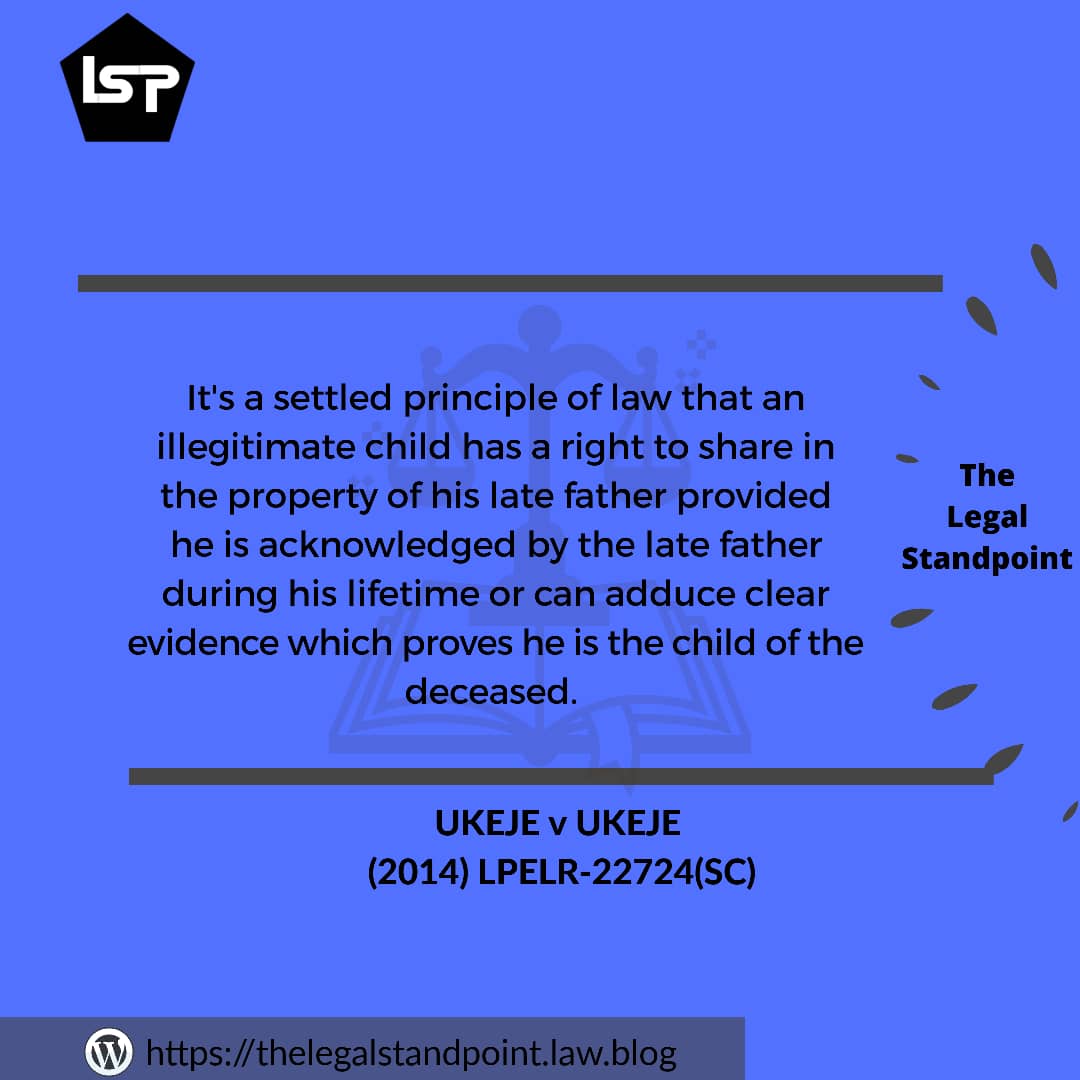
What if the father doesn’t acknowledge the child? Is that the end of the road for such a child on the voyage of inheritance? No. In addition to the acknowledgment of paternity by the intestate, the paternity of a child can be established by proof such as a birth certificate, forms, photographs, and other forms of documentary evidence. The case of Ukeje v. Ukeje (supra) is very illustrative of this point as the respondent won the case solely on documentary evidence. The court held that per Olabode Rhodes-Vivour JSC: ….on the issue of whether the respondent was the daughter of L.O. Ukeje (deceased), family photographs may have helped to resolve the issue, but the birth certificate of the respondent was decisive in settling the issue.
It is also noteworthy that the paternity of a child can also be proven using scientific test. This test is also recognized by the Child Rights Act. According to S.63(1)(a) of the Act: In any civil proceedings in which the paternity or maternity of a person falls to be determined by the court hearing the proceedings, the court may, on application by a party to the proceedings give a direction (sic) for the use of scientific tests, including blood tests and Deoxyribonucleic Acid tests to show that a party to the proceedings is or is not the father or mother of that person.
In conclusion, the process of proving the paternity of an illegitimate child is cumbersome, particularly where the deceased died intestate. However, once it is proven, the web of stigmatization hitherto placed on such an individual will be removed and he/she will be on the same pedestal as the legitimate child consequently giving him/her the right to partake in the succession process.
Thank you. See you next week. Please do not forget to comment and share.💝
LSP011: Illegitimate Child and Right of Inheritance in Nigeria.

 THELEGALSTANDPOINT
Knowledge
LikeLiked by 1 person
What if there is no will left behind by the father? What if there is a will that exclude the supposedly illegitimate child?
LikeLike
Both of your questions have been answered in the post. For reiteration, on the first question, the supposedly illegitimate child will have to adduce clear and convincingly evidence that he’s the child of the deceased OR show that he/she has been acknowledged by the deceased during his life time.
On your second question, a person can choose to give Will his assets to anybody he/she likes whether he/she knows them or not. It’s personal.
LikeLike