
Today, our convoy has gotten to the street of Negligence in the famous city of Tort. Being a broad street, we shall only be visiting the home of Product Liability.
In law, when someone acts carelessly and causes an injury to another person, under the legal principle of negligence, the careless person will be legally liable for any resulting harm. Hence, the tort of negligence is a legal wrong that is suffered by someone at the hands of another who fails to take proper and reasonable care to avoid what a reasonable person would regard as a foreseeable risk. For instance, a person who forgets to remove a banana peel on the floor in a house after several hours consequently leading to the injury of another person may likely be liable for negligence. This is because there is a foreseeable risk that someone will go through that place and most likely get injured.
To succeed in an action for negligence, the plaintiff (the one who suffered harm due to the omission of the other party) must establish three things:
(a). He must prove the existence of a duty of care owed by the defendant to the plaintiff.
(b). He must prove the breach of that duty of care by the defendant.
(c). He must prove the damage resulting from the breach.
For the first requirement, a duty of care can be viewed as a social contract – the implicit responsibilities – held by individuals to act with thoughtfulness and exercise reasonable care towards another. Over time, through constant judicial pronouncements, there have been some recognized care of duty instances that have gained prominence. One of such is Product Liability.
Product liability is the area of law in which manufacturers, distributors, suppliers, retailers, and others in the supply chain, who make products available to the public are held responsible for the injuries those products cause. For example, let us imagine you bought a Coca-Cola drink from one mummy Tope in your street and while drinking, you saw a dead mice in the drink, who will be held liable? Is it mummy Tope or the manufacturing company? Most times, it is the latter that will be held liable because all manufacturers owe a duty of care to their final consumer and the former will escape liability if it can be proven that she didn’t tamper with the products when gotten from the manufacturer.
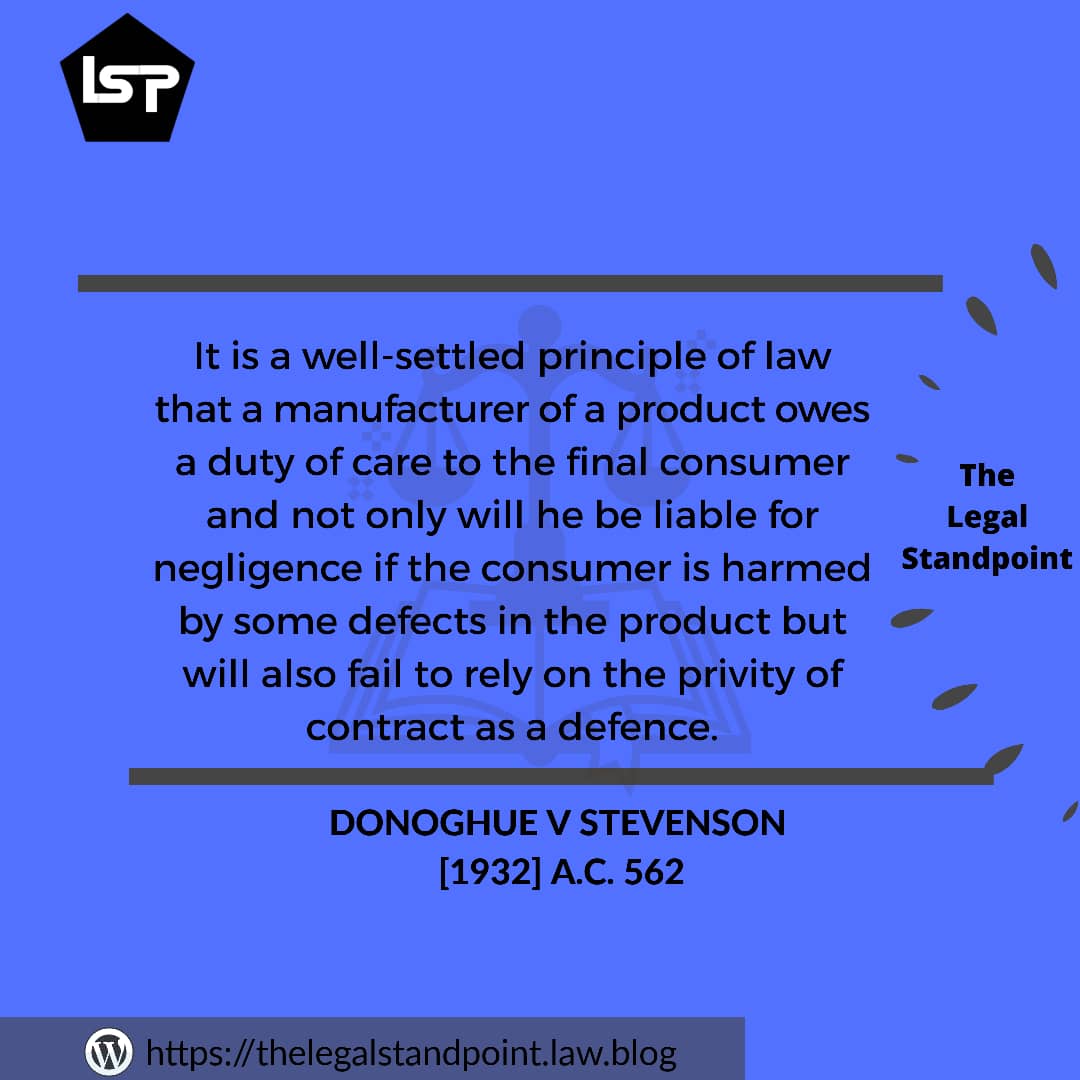
In the celebrated case of Donoghue v Stevenson [1932] A.C. 562, Donoghue bought and drank a bottle of ginger beer in a café. A dead snail was in the bottle. She fell ill, and she sued the ginger beer manufacturer, Mr. Stevenson. The House of Lords held that the manufacturer owed a duty of care to her, which was breached because it was reasonably foreseeable that failure to ensure the product’s safety would lead to harm to consumers. Even though the contract was between Donoghue and the retailer, the court held that manufacturers owe the final consumer of their product a duty of care (at least in the instance where the goods cannot be inspected between manufacturing and consumption) and there need not be a contractual relationship, or privity between the final consumer and the manufacturer, in order for the final consumer to sue in negligence.
Being a locus classicus, the principle in the celebrated case of Donoghue has found its way into Nigerian jurisprudence. In the case of Osemobor v Niger Biscuits Co. Ltd (1973) 7 CCHCJ 71, the plaintiff, in course of chewing a biscuit purchased at a supermarket, felt something hard in her mouth which turned to be a decayed tooth. As a result, she became ill. Finding the defendants liable in negligence, the court, per Kassim J (as he then was), held that: I am satisfied that there was no probability of an intermediate examination of the biscuits before they reached the plaintiff and I find myself unable to uphold the submission of the learned counsels for the defendants that she was bound to look at the biscuits before she put them in her mouth…. A person who manufactures goods, which he intends to be used or consumed by others, is under a duty to take reasonable care in their manufacture so that they can be used or consumed in the manner intended, without causing physical damage to person or property.
This decision also received a stamp of approval by the Supreme and Appeal Courts in Okwejiminor v Gbakeji & Anor (2008) LPELR-2537(SC) and Nigeria Bottling PLC v Jokotade Ibrahim (2016) LPELR-41943(CA).
At this juncture, it is pertinent to note a product liability is not limited to defects in drinks. It also includes all medical devices, commercial/personal vehicles, aircraft, and consumable goods such as food and prescription drugs. In Nigeria, agencies such as Standard Organisation of Nigeria (SON), National Agency for Food and Drugs Administration and Control (NAFDAC); the Federal Competition and Consumer Protection Commission (FCCPC) are some of the regulatory agencies saddled with the responsibility of ensuring consumers’ protection.
In conclusion, manufacturers owe a duty of care to all those who can reasonably be expected to make use of their product and a claim in negligence is not limited by the doctrine of privity of contract, which states that only a party to a contract can sue under it.
Thank you for reading. See you next week.

 THELEGALSTANDPOINT
Wow!!! This is educating, thanks for the enlightement. Great work.
LikeLiked by 1 person
Very insightful!
Thanks Kiki.
LikeLiked by 1 person