It is a trite principle of law that for an individual to sue or be sued, such an individual must be a recognized person under the law. In law, there are two recognized persons. The natural persons which are, of course, human beings and juristic persons. A common example of a juristic personality is a company.
Besides, an association can also be made a juristic person either by registration under Section 832 of the Company and Allied Matters Act 2020 or through a legislation. In this second instance, they will be referred to as statutory bodies. For example, the NNPC created under The NNPC Act.
If an association has not been incorporated by either of these two methods, such an association can not sue and be sued in their name (eo nomine). However, they can sue through their members or officers which are representatives of the action. In Dairo & Ors v Registered Trustees of the Anglican Diocese of Lagos (2017) LPELR-42573(SC) the Court held that: Where an association of persons is unincorporated, it does not have the legal status of a juristic person. Consequently, it can sue only by a representative action. Likewise, any person who has been wronged by such an association of persons can only sue it by suing some of its members as representatives of the association.
This is the point that was surprisingly omitted in the two cases under review as the NBA was sued eo nomine (in its name).
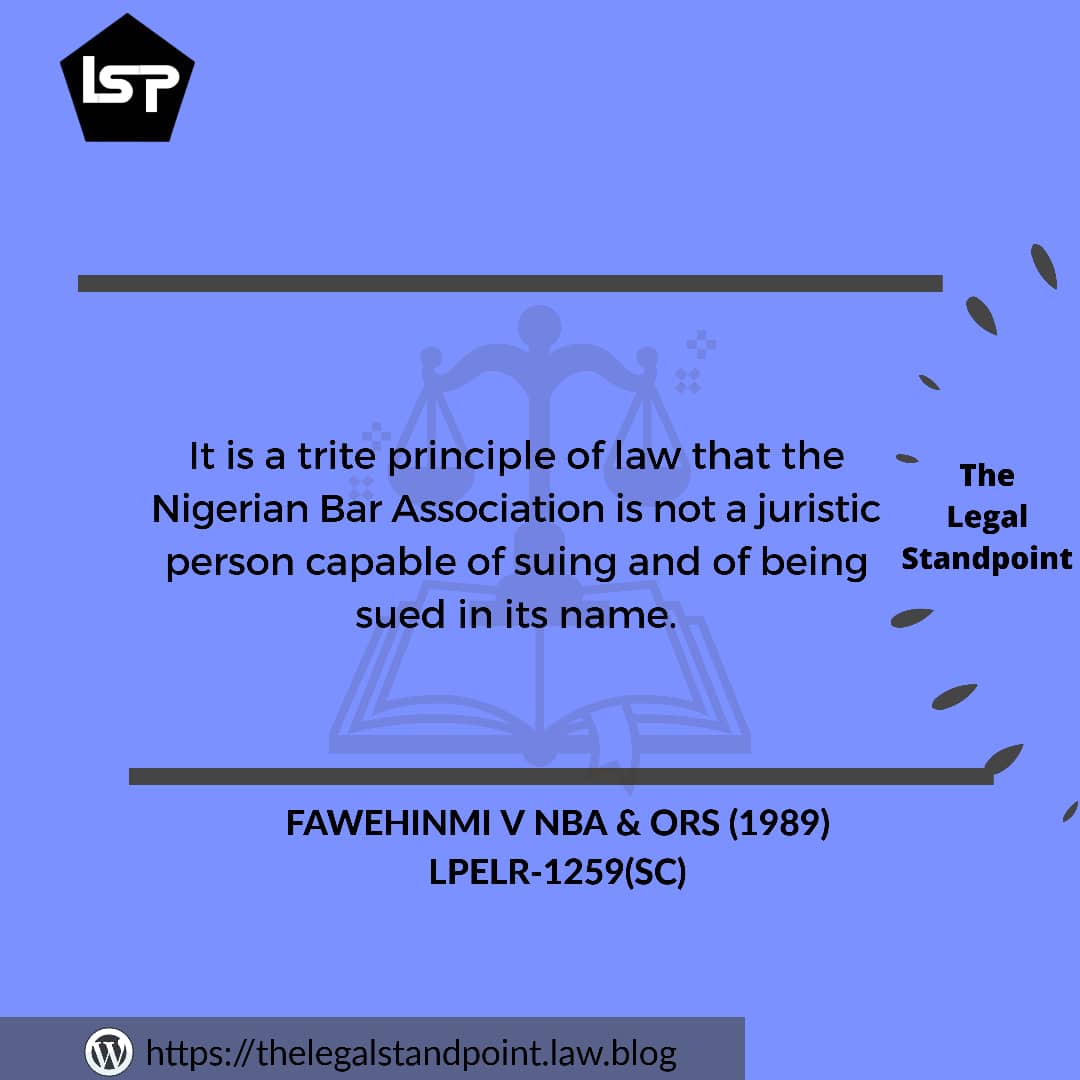
In the celebrated case of Fawehinmi v NBA (supra), the court giving reasons for the non-juristic personality of the NBA held that: The Constitution of the Nigerian Bar Association is not a statutory instrument. It is not a subsidiary legislation to the Legal Practitioners Act. It is a pure and simple private document which the members of the Nigerian Bar Association were entitled to draw up in exercise of their right to provide a constitution for the Association to regulate its affairs…. this does not make the Nigerian Bar Association a juristic person. It only gives the body recognition as a legal entity made up of legal practitioners.
This landmark decision also received judicial affirmation in the 2019 recent case of Moses v NBA (2019) LPELR-46918(SC).
THE FACT OF THE CASE
In this case, the Appellant, a Legal Practitioner practicing in Port Harcourt, Rivers State, represented a Member of the Rumu-Amadi Family in a case involving family land. The Appellant’s client lost at the High Court and while the case was on appeal, it was alleged that the Appellant partitioned the family land and sold plots of land; and he misrepresented himself as the Family’s lawyer and began negotiating more sales without valid authority.
Infuriated, the family wrote a petition to the Disciplinary Committee of the NBA, who after its investigations, held that the Appellant was found guilty. The NBA then filed a complaint at the Legal Practitioners Disciplinary Committee (LPDC) against the Appellant. The LPDC, after due consideration, found the Appellant guilty of improper conduct in the course of performing his duty as a legal practitioner and directed the Chief Registrar of the Supreme Court to strike out the name of the Appellant from the roll of Legal Practitioners.
The Appellant challenged the decision of the LPDC by an appeal to the Supreme Court. In the appeal, the NBA was named as Respondent by the Appellant. The Respondent (NBA) raised a preliminary objection on the ground that it is not a juristic person and as such, cannot sue or be sued.
The Appellant contended that since the NBA was the complainant before the LPDC, the NBA can validly be a Respondent for the purpose of the appeal filed at the Supreme Court. The contention is logical in the sense that if the NBA could stand as complainant at the proceedings before the LPDC, then there is no reason it should not be a proper party at the appeal. Otherwise, as argued by the Appellant, the proceedings before the LPDC should be declared a nullity.
THE JUDGMENT
As logical as the contention of the Appellant may sound, the Supreme Court held that same was however misconceived because the NBA was merely playing the role assigned to it under the Legal Practitioners (Disciplinary Committee) Rules (as amended) whereby the NBA can validly forward a report of any investigation to the LPDC for proper action, pursuant to Sections 1(1) and 10(1)(b) of the Legal Practitioners’ Act. In effect, while the NBA plays its part, the LPDC will go ahead and consider the complaint.
The Supreme Court concluded that an appeal against the decision of the LPDC can be brought while making the LPDC a party instead of the NBA. This is because the LPDC is a legal person that can sue and be sued. See LPDC v. Fawehinmi [1985] 2 NWLR (Pt. 7) 300.
REPOSITIONING THE PROPER CONTEXT
For a proper determination of suit against the NBA, the party should be: Registered Trustees of NBA, because they are the ones that possess a juristic personality. Registered Trustees of NBA are those people that have been appointed by the NBA to be the Trustees, the equivalent of directors in a company, and they are distinct from NBA in that they have juristic personality.
THE EFFECT OF AN INCOMPETENT PARTY IN A LAWSUIT
It is well settled that for an action to be properly constituted so as to vest jurisdiction in the Court to adjudicate on the matter, there must be a competent Plaintiff and a competent Defendant, and where either of them is not a legal person, the action is liable to be struck out for being incompetent. See Maersk Line & Anor V Addide Investments Investments Ltd & Anor (2002) LPELR-1811(SC) and Agbonmagbe Bank Ltd. v. General Manager G.B. Ollivant Ltd. & Ors. (1961) 1 All NLR 116; (1961) 2 SCNLR 317.
Thank you and see you next week❤.
LSP015: Incorporated Associations and Juristic Personality

 THELEGALSTANDPOINT
A really stellar exposition!
LikeLiked by 1 person
This is a great legal appreciation of the context of parties in legal proceedings. Great job. Kindly check the differences between proper party and necessary party for the purpose of a better appreciation of the concept. Green Vs Green.
LikeLiked by 1 person
Well done, sir. Very well dissected.
LikeLiked by 1 person