
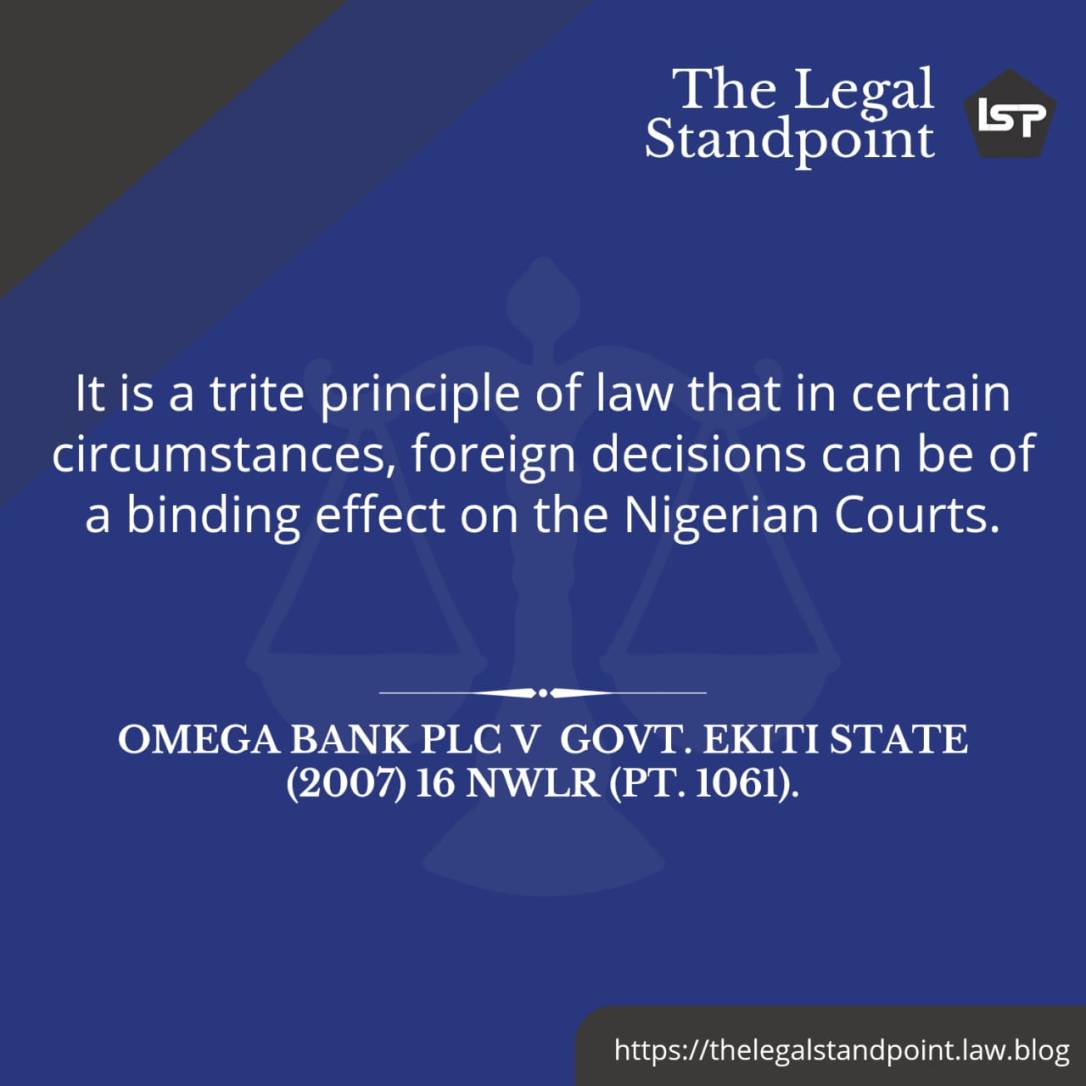
 Irrespective of the mode of instituting an action, whether it is based on contention issues (Writ of Summons); interpretation of the Constitution (Originating Summons) etc, every counsel representing a litigant is always asking the Court to do something for his client.Before the court can dance to the counsel’s tune, he needs to present authorities before the Court. In Nigerian jurisprudence, authorities can either be primary or secondary. The main difference between them is the weight of influence attached to each of them.While primary authorities are binding upon the Nigerian court, secondary authorities, on the other hand, are persuasive as held in a plethora of cases such as Ladoja v. INEC (2007) 12 NWLR (Pt. 1047) 119 at 182. The general principle of law is that foreign precedents, that is, judgments gotten from other countries, are persuasive in Nigeria. However, there are two exceptions:1. The first exception is that where the principle adopted from a foreign decision has been applied by Nigerian courts over the years, such a principle cannot be regarded as a foreign decision. This exception was laid down by Akintan JSC in Adetoun Oladeji (Nig) LTD v Nigerian Breweries PLC (2007) LPELR-SC.91/2002 where he stated that: “the other point I will like to deal with is the controversy as to whether or not the principles of law laid down in Hadley v. Baxendale (1854) 9 Ex. 341 is applicable in Nigeria and binding on the courts in Nigeria. I agree with the view expressed in the lead judgment that generally speaking, decisions of English courts or any foreign courts are not binding on Nigerian courts but they are merely persuasive. I will, however, like to add that where Nigerian courts have followed a particular principle adopted from a foreign decision over the years, such as in the one in the Hadley v. Baxendale case, it will be totally erroneous to hold that such principle remains foreign in nature. I believe and hold that the said principles have ceased to be regarded as foreign in Nigeria. It has, no doubt, become part and parcel of our case law of contract. This is because the mere statement of the principles and citing any of the numerous decisions of this court where the principle had been adopted will be sufficient to make it binding on all courts in Nigeria”.2. The second exception is that Nigerian courts may resort to foreign decisions where there are no known Nigerian decisions on a principle of law. Thus, English authorities can be binding where the facts before a Nigerian Court are similar to the English case, and there are no known Nigerian decisions on the same set-out facts. Thus, in Omega Bank Plc. v. Govt. Ekiti State (2007) 16 NWLR (Pt. 1061), the Court relied on the foreign precedent of Derbyshire C.C. v. Times Newspapers in reaching its decision.Based on this second exception, if a case comes before the Nigerian Court on emerging areas of law such as Intellectual Property, Fintech, Competition Law, etc which its jurisprudence hasn’t fully been developed in Nigeria compared to other jurisdictions, the Court can rely on the foreign precedent to reach its decision provided the decided case and the case at hand are reasonably similar in fact.In conclusion, these are the two existing exceptions where foreign decisions can assume the binding nature on the Nigerian Courts.Thank you for reading. See you next week.❤
LSP047: Effects of foreign precedent on the Nigerian Courts


This is amazing! You guys are really doing a lot, please continue the good work. I’m learning ahead very well in my legal journey through you.
LikeLike
Thank you
LikeLike
Learnt a lot. Thanks for this
LikeLike
I’m glad you did. Thank you
LikeLike
Thanks for this
LikeLike
You’re welcome.
LikeLike
Great Work by Mr Kiki. Well researched and full of insight. I look forward to seeing more of this. I’m constantly on the look out!
LikeLike
Thank you, Sir.
LikeLike