
If you have been to any standard moot competition where a hypothetical scenario was staged or real-life Courts, one of the noticeable things you will observe is that the judge(s) is always writing while being addressed by the counsel.
This writing is what such a judge relies on upon giving his judgment after the final address of the counsel. A judgment is the final determination of a court of competent jurisdiction upon matters submitted to it.
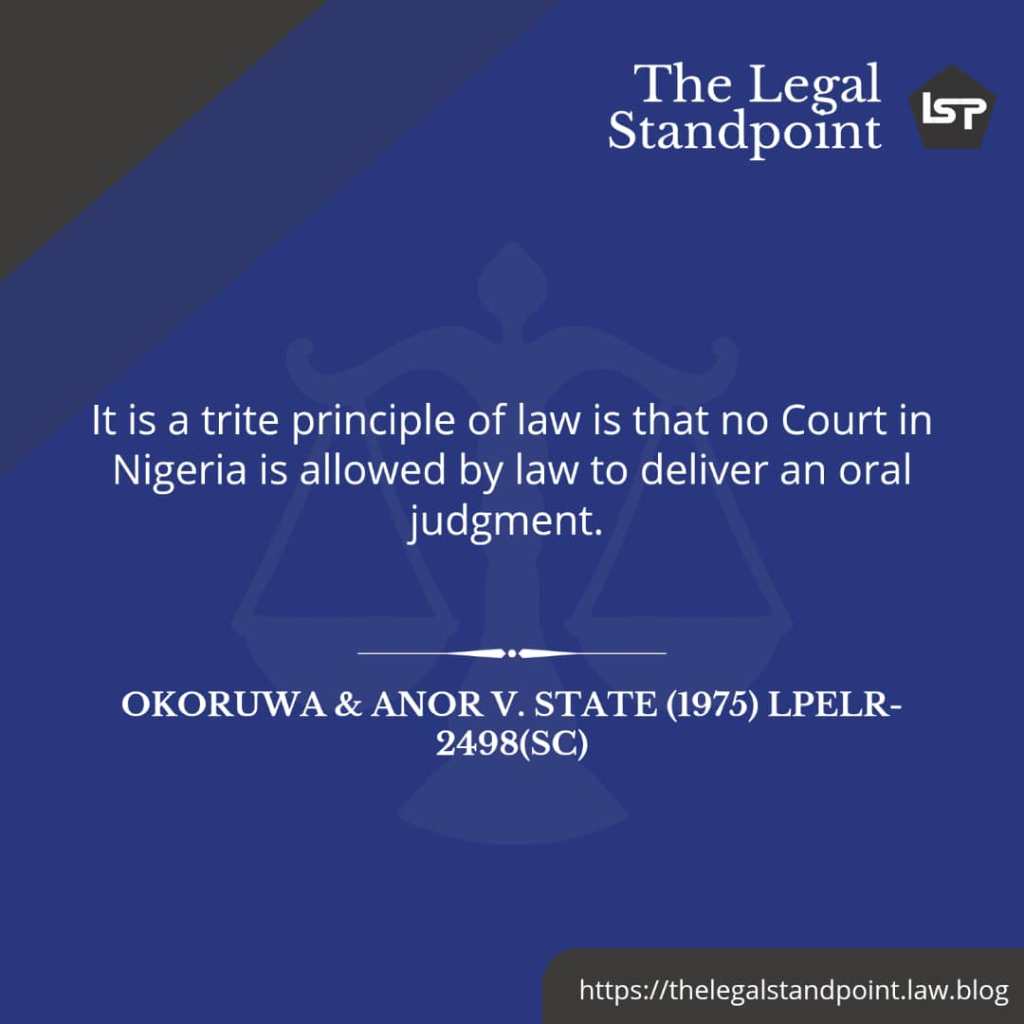
The trite principle of law is that no Court in Nigeria is allowed by law to deliver an oral judgment. As such, every judgment is meant to be in writing after the final address of the Counsel which is to be delivered within ninety(90) days as enshrined in section 294 (1) of the 1999 Constitution.
This principle received judicial authority in Okoruwa & Anor v. State (1975) LPELR-2498(SC). In that case, the supreme Court per Elias CJN (as the then was) condemned – in totality – the sentencing of the accused by the High Court Judge of the Mid-Western State of Nigeria for the offence of Manslaughter, which was not evidenced in writing.
The Court held that such judgment was contrary to the then Section 245 of the Criminal Procedure Act (Cap. 43) of the 1958 Edition of the Laws of the Federation, which reads as follows:- The Judge or magistrate shall record his judgment in writing and every such judgment shall contain the point or points for determination, the decision thereon and the reasons for the decision and shall be dated and signed by the Judge or magistrate at the time of pronouncing it.
That statutory provision has been reiterated in the present section 308(1) of the Administration of Criminal Justice Act(ACJA) 2015. Also, judgment read from the note made by the judge during the trial is an oral judgment as held in Queen v Timothy Fadina (1958) 3 F.S.C. 11. Similarly, oral judgment delivered in open court by the court, and later reduced into writing in the judge’s chambers remains an oral judgment as held in State V Lopez SC.309/1967. The rationale being that the court becomes functus officio after delivering the judgment and it cannot purport to do anything to the judgment as it will amount to an irregularity. The effect of this is that the trial would be regarded as a nullity.
However, as stated in this case under consideration, it was held that a magistrate judge may give an oral judgment and record his conclusions briefly. This is because of the large number of cases that the magistrate has to handle, often by summary procedure. This principle has been statutorily provided for in S.308(2) of the ACJA.
Nonetheless, this exception in section 308(2) ACJA does not conflict with the Constitution because the constitutional requirement that every judgment is in writing under section 294(1) of the Constitution applies only to every court established under the constitution. The Magistrate court is not established under the constitution as it is not listed under section 6(5) of the 1999 Constitution
In conclusion, the principle of law is that oral judgment is not allowed in law. One of the significances of written judgment is that it aids the smooth administration of law reportage.

 THELEGALSTANDPOINT
🙌
Yeah, every judgement ought to be documented.
LikeLike