Simply put, family land is a land which belongs to the family as a whole with no member having a separate claim to the property. Family land was defined by the Supreme Court in the case of Olowosago v. Adebanjo (1988) NWLR Part 88 Page 275 at 287 Para A-B per Karibi-Whyte JSC as: “the concept of family property is original to our indigenous society, and is the bedrock of our law of inheritance. It is regarded correctly as the cornerstone of our indigenous land law.“
Furthermore, the management and control of anything relating to the family land are usually vested in the family head and principal members of the family. The questions then become: can the family head sell the family land without recourse to the family members and can any member of the family transfer the ownership in the land to a another party without the consent of the family head and principal members?
On the first question, there are two legal consequences: one, when a family head misrepresented the family land as his property, such a sale is void abinitio. The rationale behind this is that the property doesn’t belong to him and as such, he can’t transfer ownership. This principle received a judicial blessing in Solomon & Ors v Mogaji & Ors (1982) 11 S.C. 1.
On the second legal consequence, if the family head sells the family land on behalf of the family, such a sale is voidable, that is, valid until being rejected. In Okonkwo v Okonkwo (1998) LPELR-SC.44/1992, the Court held that: the law is that a sale of family land which the head of the family carries out as such head of family, without some principal members of the family is only voidable but not void at the instance of the non-consenting principal members of the family provided such non-consenting members acted timeously and are not caught by laches.
In addition, in Salako v Dosunmu (1997) 12 NWLR (pt. 531) 56, the Court held that: “it is, therefore, the law that where the head of a family alone sells family land without the consent of the principal members of the family, the sale is not void but prima facie voidable. Such sale can therefore be set aside at the instance of the family”.
From this, it is evident that a sale of family land by the family head would amount to either void or voidable depending on the capacity in which he represented himself. On the distinction between voidable and void sale of family land, Oputa JSC (as he then was) in Adejumo v. Ayantegbe (1989) 3NWLR (Pt.110) Pg 417 at 451 Para. E held as follows: the distinction between a transaction which is void and one which is only voidable is that if a transaction is void, it is in law a nullity, not only bad but incurably bad and nothing can be founded on it, for having no life of its own, it cannot vivify anything. But if a transaction is voidable, it has some life and it remains good until set aside.
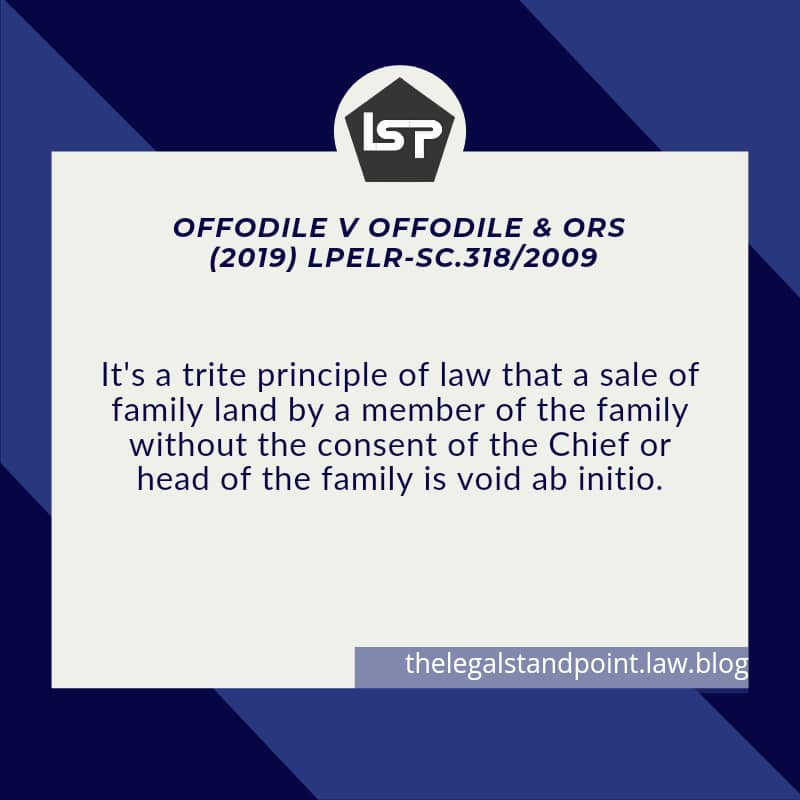
Moving on to the second leg of the question, it is pertinent to state that any member of the family does not have the authority, whether in the personal or official capacity, to sell a family land. Such a sale is always void abinitio. On this principle, there have been a plethora of decisions. In Fayehun v Fadoju (2000) 6 NWLR (pt 661) 378 the Supreme Court, per Karibi-Whyte (as he then was) page 404 had this to say: “a sale of family land by a member of the family without the consent of the Chief or head of the family is void ab initio. It is an essential customary element that the head of the family must join in the sale of family property together with the principal members of the family for such transaction to become valid.”
Hence, in a 2019 case of Offodile v Offodile & Ors (2019) LPELR-SC.318/2009, the disputed land comprises the 25 plots which were sold to the 6th defendant/respondent without the consent of the plaintiff/appellant, the only surviving direct son of Chief Ozo Offodile, who is the head of the said Chief Ozo Offodile family in accordance with the Awka native law and custom. The Supreme Court, overturning the decision of the High Court and Court of Apeal, held that the sale was void abinitio.
In conclusion, the family head is the caretaker and not the owner of the family property. Bearing in mind that ownership doesn’t reside in him, he cannot transfer such to another party by acting arbitrarily or with selfish interest. Also, any member of the family doesn’t have any right to sell the family property. Thank you for reading. See you next week.

 THELEGALSTANDPOINT
Impressive
LikeLike
Thank you.
LikeLiked by 1 person
So the only event where a sale of a family property can be rendered valid is ONLY if the head of the family and principal members of the family consents to the sale right? If so, what is the provision of the law as regards the definition of “principal members”? (position and number of consenting parties)
LikeLike
Yes, that’s the only event.
On definition, traditionally, the principal members of the family are from the
branches existing in the family. In a polygamous family, the eldest of the children begotten by each wife is a
principal member, while in the case of a monogamous family; every child could constitute a principal member.
LikeLike
Thank you so much
LikeLike
You’re welcome.
LikeLike
Good one sir. In the event where the family head direct principal members to sell family land but later returned to cancel the sale after it has already been carried out. Can such a family head validly cancel the said sale?
LikeLike
What the law requires is that the consent and concurrence of both the family head and principal members
LikeLike
Master piece explanation. Thank you
LikeLike
You’re welcome
LikeLike
Hello. What if four of five principal members sign the agreement. Is it still voidable?
LikeLike
Yes, voidable at the instance of the last non-consenting principal member
LikeLike
What if an only surviving child, male sold the property, where 2 of his direct brothers are already dead, can his late eldest brother’s son’s cancel the sales?
LikeLike
The sale will be void because he’s not the family head
LikeLike
Pls, I need this response to settle a similar case
LikeLike