
Murder stands as a grave offense within the legal framework of Nigerian Criminal Law. It is categorized as a capital offense, thus carrying the severe consequence of the death penalty, as stipulated in Section 319 of the Criminal Code.
Moving on, it is a well-settled principle of law, having received judicial blessings in a plethora of cases, that in a charge of murder, the prosecution must prove the following beyond reasonable doubt: a) The deceased had died. b) The death of the deceased was caused by the accused, and c) The act or omission of the accused which caused the death of the deceased was intentional with the knowledge that death or grievous bodily harm was its probable consequence.
Today’s article seeks to answer the question: Whether the Court can convict for murder in the absence of a corpus delicti (dead body)? The concept of corpus delicti, which means “body of the crime” in Latin, refers to the evidence that a crime has been committed. While the presence of a dead body is often an important piece of evidence in murder cases, it is not always necessary for a court to convict someone of murder.
In Nigeria, a conviction for murder can be based on circumstantial evidence and testimony, even without the physical presence of a body. Over time, the courts may consider other evidence such as eyewitness testimonies, forensic evidence, DNA analysis, motive, and other supporting factors to establish the offence of murder.
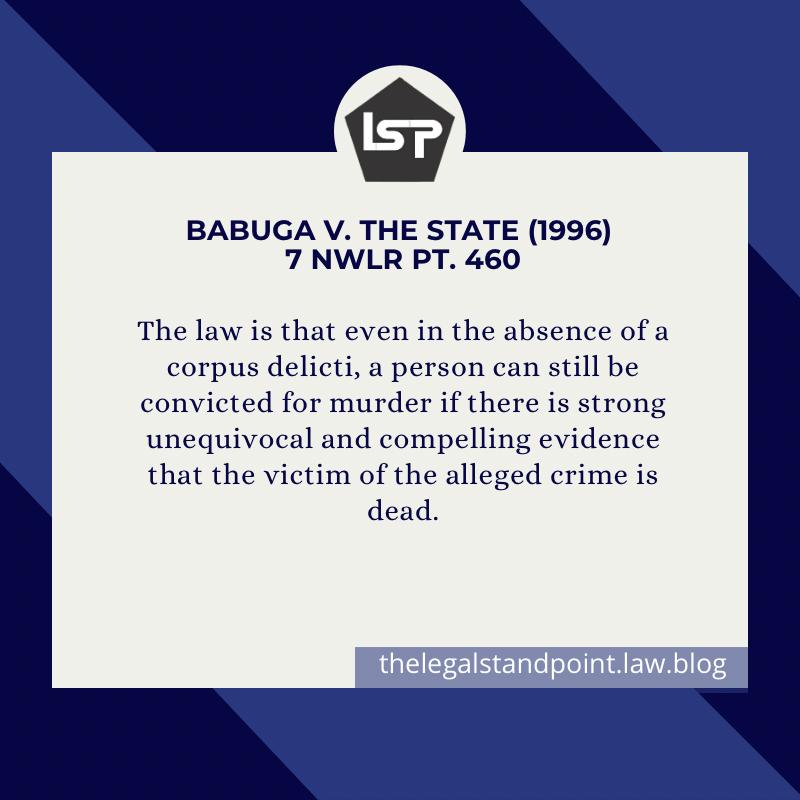
Clothing this with judicial approval, in Babuga v. The State (1996) 7 NWLR Pt. 460 pg. 279 at 296, per Onu JSC, that:- “as a matter of fact conviction can properly be secured in the absence of a corpus delicti where there is a piece of strong direct evidence. It is true that the body of the deceased has not been recovered. But it is settled that where there is positive evidence that the victim had died, failure to recover his body need not frustrate conviction.”
This principle of law is also held in Ubani v State(2003) 18 NWLR (Pt. 851) where death was inferred from the fact that the deceased was last seen with the Appellants three years ago. According to Edozie JSC on page 244 of the report: “having regard to the circumstances of this case, particularly the fact that three years after the incident, the deceased has not been found and there was no explanation from his assailants as to his whereabouts other than a bare denial of complicity in the crime, the inference is irresistible that he is dead; that it was the act of his assailants that caused his death and judging from the nature of the attack and the lethal weapons used, the attackers had the intention to kill or at least cause grievous bodily harm on the deceased. All the three ingredients of murder earlier enumerated having been established, the judgment of the trial Court convicting the 1st and 2nd appellants and the Court below affirming the conviction remains unassailable.”
In Joshua v State (2009) LPELR-8189(CA), the court per Sotonye Denton-West JCA held that in cases of extrajudicial killings, where the bodies of the victims are usually never found, the perpetrators cannot escape liability. The absence of the bodies does not absolve the murderers of responsibility
In conclusion, the principle of law is that even in the absence of a corpus delicti, a person can still be convicted of murder if there is strong unequivocal and compelling evidence that the victim of the alleged crime is dead.
Thank you for reading. See you next week.

 THELEGALSTANDPOINT
Thank you, Kiki.
This was insightful.
LikeLike
I had an insightful read. Thank you, LSP.
LikeLike
Wow!
This is an eyeopener…🔥🔥
Well done, boss…
LikeLike
Thank you
LikeLike
Nice job Kiki.
LikeLike
Thank you so much
LikeLike
So insightful!
Thanks alot.
LikeLike