
In Nigeria, the general principle of law states that English language serves as the official language for proceedings in superior courts of record. Therefore, if a party’s extra-judicial confessions or statements are uttered in a language other than English, they must be translated into English. This principle was upheld in the case of Babarinde & Ors. v. The State (2012) LPELR-CA/IL/C.18/2010, as well as in other cases like Madu v. State (1997) 1 NWLR (pt. 482) and Ogunye v. State (1999) LPELR-SC.47/1997.
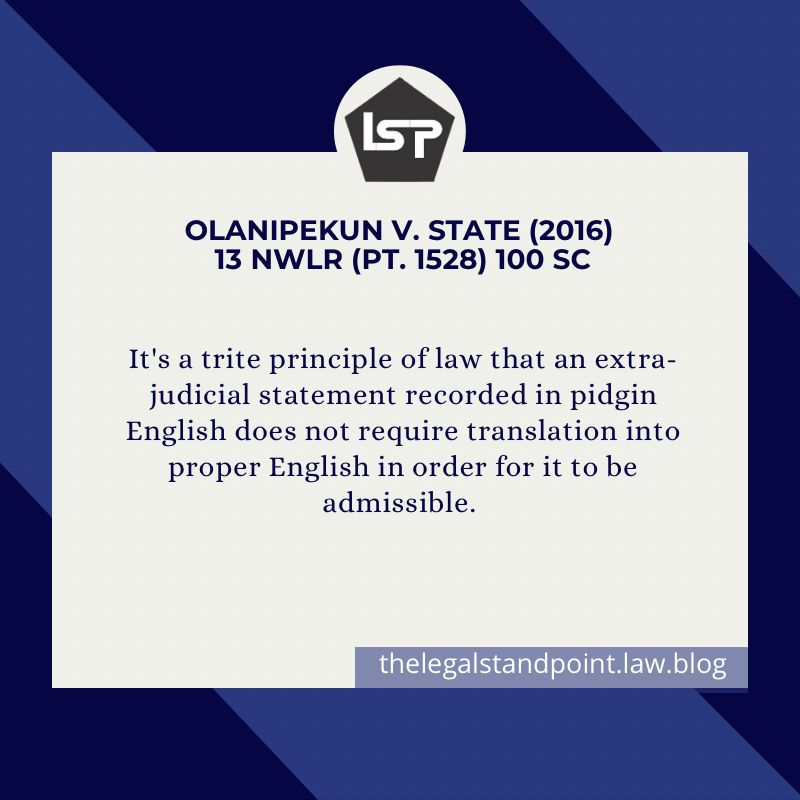
While this a settled principle, this week’s article aims to explore whether a statement recorded in pidgin English requires translation to standard English for proper admissibility in court. To effectively do this, attention is given to the 2016 supreme court case of Olanipekun v. State (2016) 13 NWLR (Pt. 1528) 100 SC.
The facts of the case: in August 2002, the appellant was charged as the 4th accused person along with three others at the High Court of Ogun State for the crimes of conspiracy and armed robbery. The robbery occurred at Ewi’s compound in Oke-Afon area, Abeokuta, Ogun State. According to the prosecution’s case, the appellant and the three other accused individuals, armed with guns and cutlasses, broke into the apartment of Evangelist Oluseye Ogunremi at around 3:30 am. During the robbery, the appellant assaulted Oluseye Ogunremi, hit him on the head with an iron, and robbed him of N800 and two mobile phones.
The arrest of the 1st accused led to the apprehension of the other three suspects, including the appellant, and the recovery of two locally made single-barrel shotguns in an uncompleted building. A police inspector, PW4, recorded a confessional statement from the appellant in pidgin English after cautioning him. The statement was confirmed by the appellant in the presence of a superior police officer and was later admitted as evidence in court (Exhibit “D”).
On the issue of whether extrajudicial statements recorded in pidgin English require translation, the court held that it doesn’t. Onnoghen JSC (as he then was) opined as follows: “It is erroneous for anyone to assume that people who communicate in pidgin English do not understand proper or Queen’s English, especially in Nigeria. The use of pidgin English allows for free expression without minding the grammar which is usually employed in the proper English. Consequently, a statement recorded in pidgin English does not require translation into proper English and any statement made in pidgin English can be recorded in proper English. Pidgin English is English Language whether spoken or written. The distinction between pidgin English and English language is that of half a dozen and six. In the instant case,the appellant’s statement, exhibit “D”, could not be treated as secondary evidence but was treated as primary evidence.”
Furthermore, Akaahs JSC in that case held that “English is the official language of the court and it does not matter that the statement was said to have been recorded in pidgin English… The issue of fair hearing would have arisen if the appellant did not understand English at all and the statement had to be recorded in the language he speaks or understands and later translated into English”. See also Opara v. A.-G., Fed (2017) 9 NWLR (Pt. 1569) 61.
Similarly, on Pidgin English as a species of the English language, the supreme court in a 2022 case of Taiwo v FRN (2022) 13 NWLR (Pt. 1846) 61 held that: The court is entitled to take judicial notice of the fact that Pidgin English is a specie of English language freely and commonly used in Nigeria. A person who speaks Pidgin English usually understands the English language although he may not be able to communicate effectively in the correct English language.
In conclusion, extra-judicial statements made in pidgin English are considered admissible. Such statements recorded in pidgin English do not require any further translation, and this implies that pidgin English is also recognized as a valid language in the court proceedings
Thank you for reading. Kindly help fill this form: https://surveyheart.com/form/64cb84b414735f680604a0ca

 THELEGALSTANDPOINT
An insightful read❤
LikeLike
Thank you
LikeLike
On the post on Extra judicial statement in pidgin language, seems the Conclusion is different from the case cited ?
LikeLike
Yes, it was a mistake. It has been corrected. Thank you
LikeLike
Wow! Thank you, LSP.
LikeLike