
In society, insanity is often recognized by outward appearances such as tattered clothes and unkempt hair. However, in law, insanity is defined differently and does not necessarily align with medical definitions or societal perceptions of madness. Legally, insanity can encompass various conditions, including sleepwalking as seen in R v Burgess [1989] 1 QB 92 (CA); epilepsy as held in R v Sullivan [1904] 1 AC 156 (HL) and other similar states. This explains why cases on this matter that come before the court are always considered in the legal sense. After all, no one expects otherwise. who wan go sue madman whey dey street?
Moving on, the general principle of law is that the law presumes every human being is sane until the contrary is proven, as stated in Section 27 of the Criminal Code. Under our criminal law jurisprudence, the defense of insanity is statutorily provided for in both Section 28 and Section 29(2)(b) of the Criminal Code. While the defense of insanity under Section 28 pertains to mental disease or natural mental infirmity, the defense of insanity under Section 29(2) is founded on involuntary intoxication. There is a common bond in these two defenses: in either case, the accused must establish that at the relevant time, they were deprived of the capacity to understand what they were doing, to control their actions, or to know that they ought not to do the act or make the omission. Involuntary intoxication occurs when someone becomes intoxicated without their knowledge or against their consent, such as through spiked drinks, forced consumption, or unexpected medication reactions.
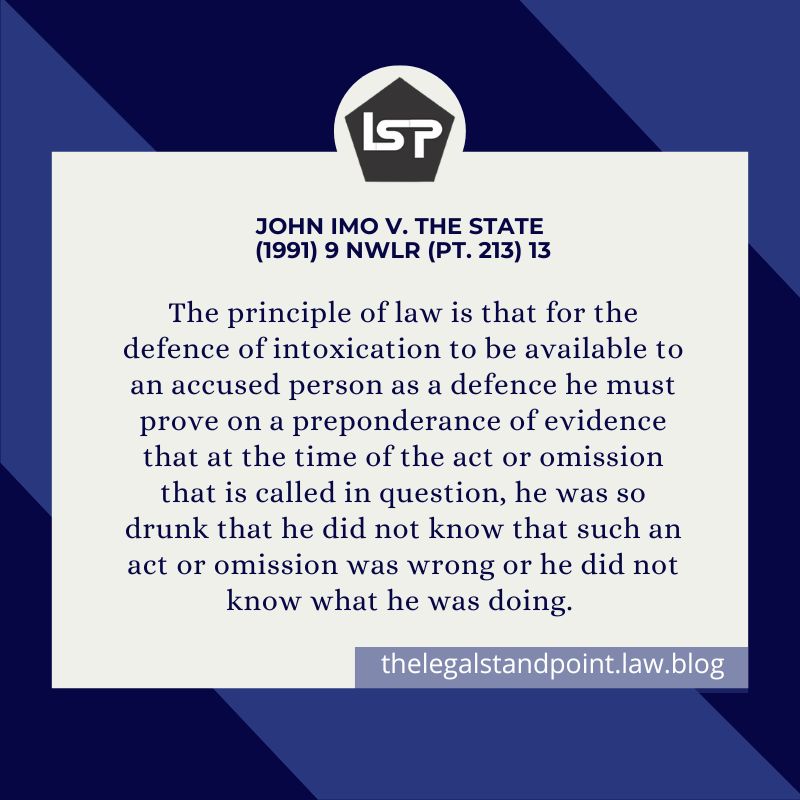
Furthermore, the law is settled and beyond dispute that the onus of establishing the defense of drunkenness, which amounts to insanity and unsoundness of mind such that the accused did not know what they did, rests squarely on the accused person. The burden is discharged on a preponderance of evidence led by and for the accused person, as established in John Imo v. The State (1991) 9 NWLR (pt. 213) 13. The surest way of establishing insanity is through medical evidence or compelling evidence from eyewitnesses, particularly relatives of the appellant, relating to their general conduct, family medical history, and behavior before, during, and after the incident in question, as seen in Anthony Ejinima v. The State (1991) 722.
Thus, when an accused person relies on the provision of Section 29(2)(b), they assume a burden of proof analogous to a person who relies upon a defense of insanity simpliciter under Section 28. They must prove that as a result of the intoxication, they were in a similar state of mind as an insane person, i.e., that they did not know what they were doing or that they did not know that what they were doing was wrong. This was highlighted in Imasuen v. State (2014) LPELR-22193(CA), where the appellant was convicted on a charge of the murder of a nine-year-old girl, Favour Ihoeghilan, under Section 319(1) of the Criminal Code Laws of Bendel State of Nigeria, 1976, applicable in Edo State. The prosecution’s facts indicated that the appellant took the young girl under the pretext that her mother needed her in the market, lured her to the bush, raped her, and then set her ablaze.
He raised the defense of insanity by intoxication under Section 29(2)(b), claiming that he was involuntarily intoxicated by inhaling the smoke of Indian hemp, which was caused by a group of boys at a canteen in Urora village on April 5, 2003. He argued that he became confused and did not know what happened until he found himself at the police station the next day. However, the court rejected this defense. The court held that, based on his confessional statements (Exhibits ‘A’ and ‘D’), he was conscious of his actions before and after the incident. His actions, such as drinking four bottles of Guinness stout, buying a bottle for a girl and the barman, and purchasing and smoking Indian hemp, were all deliberate and unsolicited decisions.
Therefore, the court concluded that his intoxication could not be attributed to the malicious or negligent acts of others, and as a result, sentenced the appellant to death by hanging.
Being dissatisfied with the decision of the trial court, the appellant appealed to the Court of Appeal. Dismissing the appeal, the court, per Yakubu JCA, held that the appellant’s consumption of Indian hemp and Guinness stout on April 5, 2003, boosted rather than impaired his sexual appetite. This led to his sexual encounter with a girl and subsequent assault of a nine-year-old, indicating he was a sex maniac rather than insane. Additionally, the learned justice opined that the appellant did not establish, on a preponderance of evidence, that he was “out of his mind.” The justice suggested that had the appellant instead gone to his own family compound and committed the same acts on a young relative, such as a sibling, niece, or cousin, it would have unequivocally demonstrated his insanity. Since this was not the case, the court rejected his insanity defense.
In conclusion, the defense of insanity, whether due to mental disease or involuntary intoxication, requires substantial evidence to prove that the accused was deprived of the capacity to understand their actions or know they were wrong. In the case under review, the appellant’s actions were found to be deliberate and conscious, thereby failing to meet the legal standard for insanity.
Thank you for reading. See you next week.

 THELEGALSTANDPOINT
Thank you, LSP.
LikeLike