
My people! Good Afternoon. How has your week been?
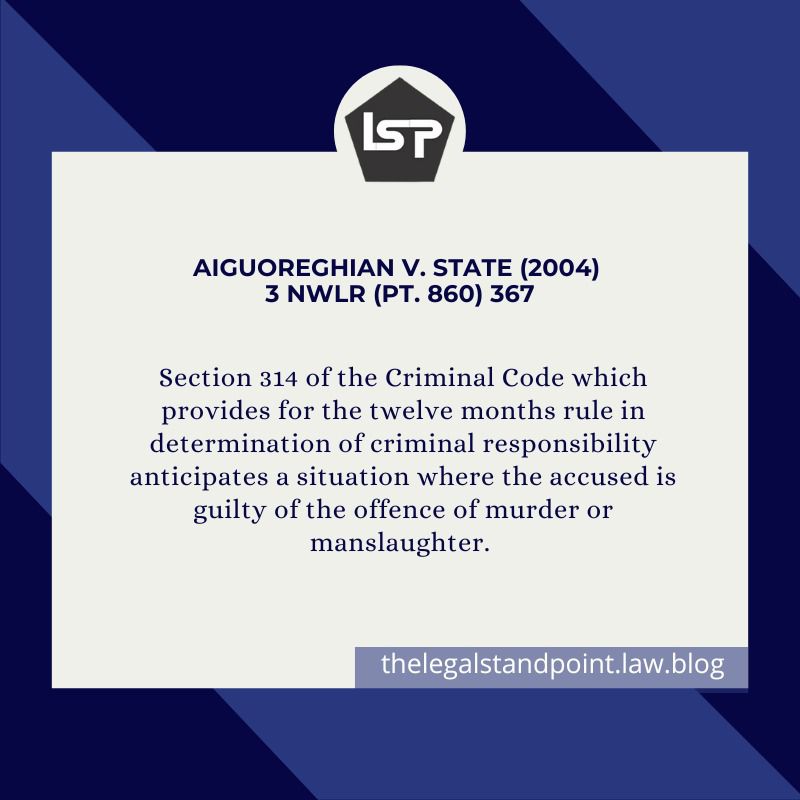
Today, we will be discussing an important issue in criminal law causation in murder and manslaughter cases. Specifically, we will examine the case of Aiguoreghian v. State (2004) 3 NWLR (Pt. 860) 367 which raises important questions about the relationship between an accused person’s actions and the eventual death of a victim, particularly within the a year and a day rule stated in the Section 314 of the Criminal Code Act
The Facts of the Case
On March 7, 1989, Chief Alfred Amu instructed Mr. Doherty Sunny Osifo (PW2), an agricultural expert, to visit a family farm and assess its condition. The deceased, Nathaniel Amu, accompanied PW2 to the farm where the appellants worked as security guards. Upon arrival, a dispute occurred because the appellants, following the farm manager’s instructions, refused to open the gate. The situation escalated when the deceased attempted to force open the gate, leading to an alleged assault by the appellants. In the chaos, a mob mistook PW2 for a thief and attacked him as well.
The deceased sustained serious injuries and was taken to the police station, then to the hospital. He was treated and discharged on March 20, 1989, appearing to recover. However, several months later, he developed symptoms such as a swollen stomach and legs. Despite treatment at the University of Benin Teaching Hospital (UBTH), he passed away on June 29, 1989. The cause of death was subject to conflicting medical opinions. A provisional diagnosis suggested liver cirrhosis, but an autopsy revealed liver abscesses and cysts, unrelated to the earlier injuries. The appellants were charged with murder but were convicted of manslaughter, receiving a seven-year sentence. Their appeals were dismissed.
Legal Principles and Decision
(A) Proof of Murder: In criminal law, to prove murder, the prosecution must establish beyond a reasonable doubt that the accused’s actions directly caused the victim’s death. It is not sufficient for the prosecution to show that the accused’s actions “could have” caused the death; the prosecution must demonstrate that the actions were the direct cause of death. P. v. Oledinma (1940) 6 WACA 202, Omogodo v. State (1981) 5 SC 5. In this case, the evidence was insufficient to link the appellants’ actions to the victim’s death, leading to a conviction of manslaughter instead of murder.
(B) The Duration Between the Act and the Death: The time between the act and the death does not always affect the determination of causation in murder cases. The key issue is whether the accused’s actions directly led to the death. Even if there is a considerable delay between the act and the death, a conviction for murder or manslaughter may still be valid if it is proven that the accused’s actions were the direct cause of the death. This principle was established in Uyo v. A.-G Bendel State (1986) 1 NWLR (Pt. 17) 418. However, if multiple potential causes of death exist and none can be definitively proven to be the direct cause, the benefit of the doubt should be given to the accused.
3. Chain of Causation: The chain of causation principle holds that the accused can only be held responsible for the death if their actions were the proximate cause of it. If there is an intervening cause that breaks the chain (known as novus actus interveniens), the accused may not be held liable. In this case, medical evidence suggested multiple possible causes for the deceased’s death, which weakened the argument that the appellants’ actions directly caused the death. R. v. Effanga (1996) 1 All NLR 339, Oguntolu v. State (1996) 2 NWLR (Pt. 432) 503.
4. A Year and a Day Rule: The rule in question says that someone is not criminally responsible for another person’s death if the death does not happen within one year and one day from the act that caused it. For example, if someone is injured in an incident but does not die until more than a year later, the person who caused the injury might not be held criminally responsible for the death.
The Supreme Court clarified that this rule only applies when the person accused of causing the death is found guilty. If the court decides the accused person is not guilty, then the rule doesn’t matter because there’s no crime to be responsible for. In the case being discussed, even though the deceased died within the year and a day from the incident, the accused were not found guilty of murder or manslaughter. Therefore, the rule didn’t apply in this case because the accused weren’t found guilty.
Thank you for reading. See you next week.


Criminal Law is really interesting. Thank you, LSP.✍️
LikeLike