
Hello, my readers. How are you doing? Winter ❄️ is finally here. This week, we discuss the limitation period in land disputes, using the Supreme Court case of Adeniran v. Adio (2024) 16 NWLR (Pt. 1964) 351 as our guide. The decision provides valuable insights into how the law applies to time limits in land recovery actions.
In this case, the respondents sued the appellants at the High Court of Lagos State on March 11, 2009. They sought a declaration of title to a property at 52, Patey Street, Ebute-Metta, Lagos, damages for trespass, an injunction to prevent further trespass, and possession of the land. The respondents claimed their late father purchased the land in 1936 and built two houses on it, one of which was rented out to the appellants’ father. Over time, the appellants refused to pay rent and eventually demolished the rented structure in 2008, erecting a new building while asserting ownership of the land.
The appellants argued that their late father had acquired the land from the respondents’ family through deeds of conveyance. However, they presented a deed dated 1968, eight years after the respondents’ father’s death in 1960, casting doubt on its validity. Despite this, they claimed long possession and enjoyment of the property since 1960. Both the trial court and the Court of Appeal ruled in favor of the respondents, prompting the appellants to appeal to the Supreme Court. A key issue raised at this stage was whether the respondents’ claim was barred by the Limitation Law of Lagos State.
The Supreme Court affirmed both the trial and lower courts’ decisions, holding that the respondents’ suit was not statute-barred. Section 16(2) of the Limitation Law of Lagos State states that an action for recovery of land must be brought within 12 years from when the cause of action arises. The limitation period refers to the time allowed by law for a person to bring a legal action after their rights have been violated. If this time passes, the right to sue is permanently lost. In this case, the respondents’ right to sue began either in 2005 when the appellants stopped paying rent or in 2008 when they demolished the building. Since the suit was filed in 2009, it was well within the 12-year period.
To help readers understand better, a cause of action “accrues” when the facts that give someone the right to sue first happen. For instance, if a tenant stops paying rent, or a person occupies land without the owner’s consent, the owner’s right to sue starts at that point. This aligns with the principle in British Airways Plc v. Akinyosoye (1995) 1 NWLR (Pt. 374) 722, where time began to run from the date the claimant’s rights were first infringed.
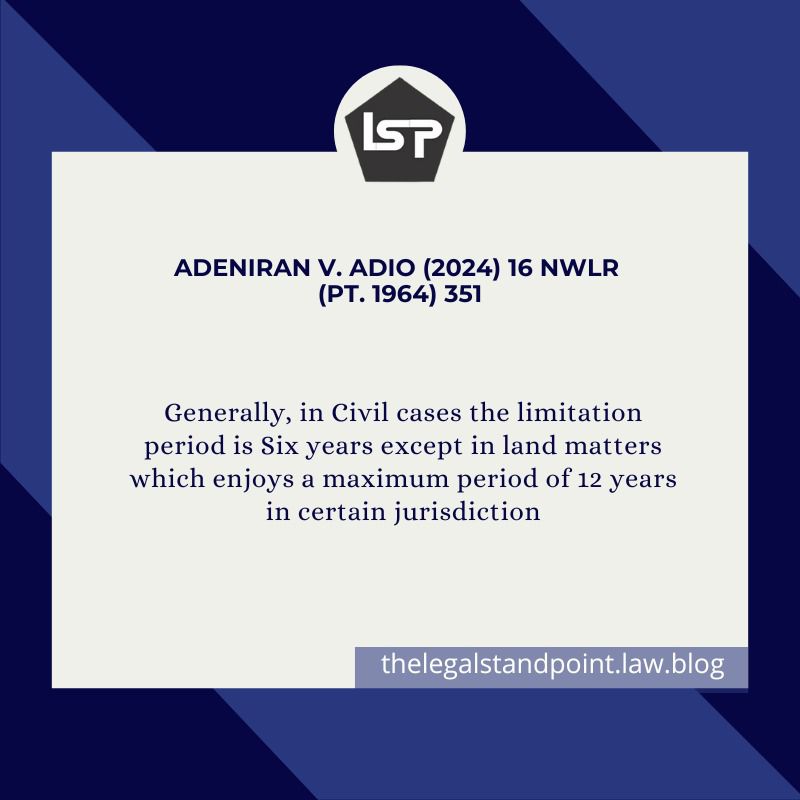
Limitation periods vary depending on the type of action. Generally, civil cases must be brought within six years, while land matters have a longer period of up to 12 years in some jurisdictions. This ensures that claimants act promptly and that evidence for both parties remains reliable.
A statute-barred action has severe implications. As held in Obiefuna v. Okoye (1961) 1 All NLR 357 and Egbe v. Adefarasin (No. 2) (1985) 1 NWLR (Pt. 3) 549, if the limitation period expires, the right to sue is extinguished. Courts determine whether an action is statute-barred by comparing the date the wrongful act occurred with the date the case was filed.
In conclusion, knowing when your right to sue begins and acting promptly can make all the difference in protecting your rights or else as the colloquial saying “oti lor”
Thank you for reading. See you next week..

 THELEGALSTANDPOINT
Insightful! It is important for everyone to know this. Well done, LSP.✍️
LikeLike